Thank you for visiting SNEWPapers!
Sign up free
The Virginia Gazette
Williamsburg, Virginia
What is this article about?
British House of Commons debates January 23-25, 1775, on merchant petitions from various cities urging consideration of American trade impacts from duties and non-importation; votes largely reject referrals to American papers committee; speeches by Burke, Fox, North; Lords debate on withdrawing troops from Boston led by Chatham.
Merged-components note: This is a continuation of the report on the House of Commons debate from page 5 to page 6, with direct textual flow between the components.
Clippings
1 of 2
OCR Quality
Full Text
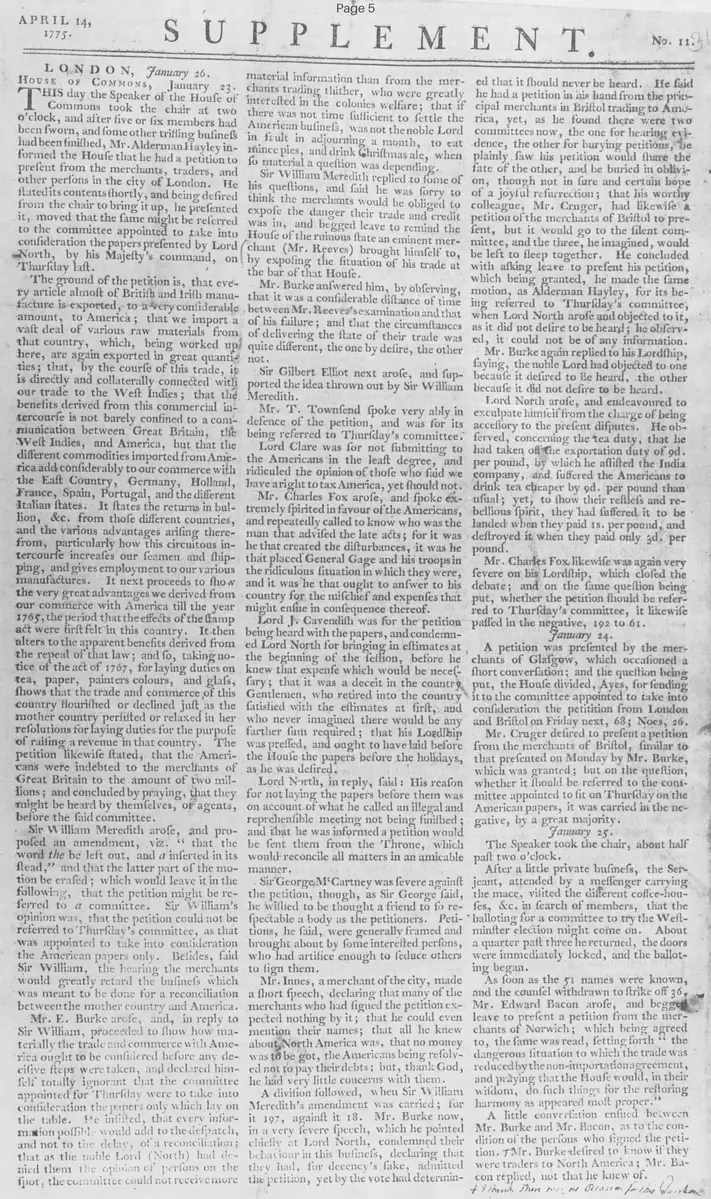
LONDON, January 26.
House Of Commons, January 23.
The Commons took the chair at two o'clock, and after five or six members had been sworn, and some other trifling business had been finished, Mr. Alderman Hayley informed the House that he had a petition to present from the merchants, traders, and other persons in the city of London. He stated its contents shortly, and being desired from the chair to bring it up, he presented it, moved that the same might be referred to the committee appointed to take into consideration the papers presented by Lord North, by his Majesty's command, on Thursday last.
The ground of the petition is, that every article almost of British and Irish manufacture is exported, to a very considerable amount, to America; that we import a vast deal of various raw materials from that country, which, being worked up here, are again exported in great quantities; that, by the course of this trade, it is directly and collaterally connected with our trade to the West Indies: that the benefits derived from this commercial intercourse is not barely confined to a communication between Great Britain, the West Indies, and America, but that the different commodities imported from America add considerably to our commerce with the East Country, Germany, Holland, France, Spain, Portugal, and the different Italian states. It states the returns in bullion, &c. from those different countries, and the various advantages arising therefrom, particularly how this circuitous intercourse increases our seamen and shipping, and gives employment to our various manufactures. It next proceeds to show the very great advantages we derived from our commerce with America till the year 1765, the period that the effects of the stamp act were first felt in this country. It then alters to the apparent benefits derived from the repeal of that law; and so, taking notice of the act of 1767, for laying duties on tea, paper, painters colours, and glass, shows that the trade and commerce of this country flourished or declined just as the mother country persisted or relaxed in her resolutions for laying duties for the purpose of raising a revenue in that country. The petition likewise stated, that the Americans were indebted to the merchants of Great Britain to the amount of two millions; and concluded by praying, that they might be heard by themselves, or agents, before the said committee.
Sir William Meredith arose, and proposed an amendment, viz. "that the word the be left out, and a inserted in its stead," and that the latter part of the motion be erased: which would leave it in the following, that the petition might be referred to a committee. Sir William's opinion was, that the petition could not be referred to Thursday's committee, as that was appointed to take into consideration the American papers only. Besides, said Sir William, the hearing the merchants would greatly retard the business which was meant to be done for a reconciliation between the mother country and America.
Mr. E. Burke arose, and, in reply to Sir William, proceeded to show how materially the trade and commerce with America ought to be considered before any decisive steps were taken, and declared himself totally ignorant that the committee appointed for Thursday were to take into consideration the papers only which lay on the table. He insisted, that every information possible would add to the dispatch, and not to the delay, of a reconciliation; that as the noble Lord (North) had denied them the opinion of persons on the spot, the committee could not receive more
SUPPLEMENT
material information than from the merchants trading thither, who were greatly interested in the colonies welfare; that if there was not time sufficient to settle the American business, was not the noble Lord in fault in adjourning a month, to eat mince pies, and drink Christmas ale, when so material a question was depending.
Sir William Meredith replied to some of his questions, and said he was sorry to think the merchants would be obliged to expose the danger their trade and credit was in, and begged leave to remind the House of the ruinous state an eminent merchant (Mr. Reeves) brought himself to, by exposing the situation of his trade at the bar of that House.
Mr. Burke answered him, by observing, that it was a considerable distance of time between Mr. Reeves's examination and that of his failure; and that the circumstances of delivering the state of their trade was quite different, the one by desire, the other not.
Sir Gilbert Elliot next arose, and supported the idea thrown out by Sir William Meredith.
Mr. T. Townshend spoke very ably in defence of the petition, and was for its being referred to Thursday's committee.
Lord Clare was for not submitting to the Americans in the least degree, and ridiculed the opinion of those who said we have a right to tax America, yet should not.
Mr. Charles Fox arose, and spoke extremely spirited in favour of the Americans, and repeatedly called to know who was the man that advised the late acts; for it was he that created the disturbances, it was he that placed General Gage and his troops in the ridiculous situation in which they were, and it was he that ought to answer to his country for the mischief and expense that might ensue in consequence thereof.
Lord J. Cavendish was for the petition being heard with the papers, and condemned Lord North for bringing in estimates at the beginning of the session, before he knew that expense which would be necessary; that it was a deceit in the country Gentlemen, who retired into the country satisfied with the estimates at first; and who never imagined there would be any farther sum required; that his Lordship was pressed, and ought to have laid before the House the papers before the holidays, as he was desired.
Lord North, in reply, said: His reason for not laying the papers before them was on account of what he called an illegal and reprehensible meeting not being finished; and that he was informed a petition would be sent them from the Throne, which would reconcile all matters in an amicable manner.
Sir George M'Cartney was severe against the petition, though, as Sir George said, he wished to be thought a friend to so respectable a body as the petitioners. Petitions, he said, were generally framed and brought about by some interested persons, who had artifice enough to seduce others to sign them.
Mr. Innes, a merchant of the city, made a short speech, declaring that many of the merchants who had signed the petition expected nothing by it; that he could even mention their names; that all he knew about North America was, that no money was to be got, the Americans being resolved not to pay their debts; but, thank God, he had very little concerns with them.
A division followed, when Sir William Meredith's amendment was carried: for it 197, against it 18. Mr. Burke now, in a very severe speech, which he pointed chiefly at Lord North, condemned their behaviour in this business, declaring that they had, for decency's sake, admitted the petition, yet by the vote had determin
No. 11.
ed that it should never be heard. He said he had a petition in his hand from the principal merchants in Bristol trading to America, yet, as he found there were two committees now, the one for hearing evidence, the other for burying petitions, he plainly saw his petition would share the fate of the other, and be buried in oblivion, though not in sure and certain hope of a joyful resurrection; that his worthy colleague, Mr. Cruger, had likewise a petition of the merchants of Bristol to present, but it would go to the silent committee, and the three, he imagined, would be left to sleep together. He concluded with asking leave to present his petition, which being granted, he made the same motion, as Alderman Hayley, for its being referred to Thursday's committee, when Lord North arose and objected to it, as it did not desire to be heard: he observed, it could not be of any information.
Mr. Burke again replied to his Lordship, saying, the noble Lord had objected to one because it desired to be heard, the other
because it did not desire to be heard.
Lord North arose, and endeavoured to exculpate himself from the charge of being accessory to the present disputes. He observed, concerning the tea duty, that he had taken off the exportation duty of 3d. per pound, by which he assisted the India company, and suffered the Americans to drink tea cheaper by 3d. per pound than usual; yet, to show their restless and rebellious spirit, they had suffered it to be landed when they paid 1s. per pound, and destroyed it when they paid only 3d. per pound.
Mr. Charles Fox likewise was again very severe on his Lordship, which closed the debate; and on the same question being put, whether the petition should be referred to Thursday's committee, it likewise passed in the negative, 192 to 61.
January 24.
A petition was presented by the merchants of Glasgow, which occasioned a short conversation; and the question being put, the House divided, Ayes, for sending it to the committee appointed to take into consideration the petition from London and Bristol on Friday next, 68; Noes, 26.
Mr. Cruger desired to present a petition from the merchants of Bristol, similar to that presented on Monday by Mr. Burke, which was granted; but on the question, whether it should be referred to the committee appointed to sit on Thursday on the American papers, it was carried in the negative, by a great majority.
January 25:
The Speaker took the chair, about half past two o'clock.
After a little private business, the Sergeant, attended by a messenger carrying the mace, visited the different coffee-houses, &c. in search of members, that the balloting for a committee to try the Westminster election might come on. About a quarter past three he returned, the doors were immediately locked, and the balloting began.
As soon as the 51 names were known, and the counsel withdrawn to strike off 36, Mr. Edward Bacon arose, and begged leave to present a petition from the merchants of Norwich; which being agreed to, the same was read, setting forth "the dangerous situation to which the trade was reduced by the non-importation agreement, and praying that the House would, in their wisdom, do such things for the restoring harmony as appeared most proper."
A little conversation ensued between Mr. Burke and Mr. Bacon, as to the condition of the persons who signed the petition. Mr. Burke desired to know if they were traders to North America; Mr. Bacon replied, not that he knew of.
On the motion for its being referred to this day's committee, it passed in the negative, 85 to 11.
Another petition was presented from Dudley to the same purport. The House were going to divide; but Mr. Burke said, he would not trouble the noble Lord (North) and his train, to walk out every five minutes, in funeral pomp, to enter petitions.
On the same question of referring it being put, it was likewise carried in the negative, without a division.
Mr. Skipwith next desired to present a petition from the inhabitants, manufacturers, &c. of Birmingham; which being received and read, set forth, that they (the petitioners) desired the laws against America might be put in force, so as to bring the Americans to a speedy sense of their duty, and that Great Britain would exert her authority."
Lord North was for referring this petition to the same committee as the North American merchants petition is referred; but Mr. Burke objected, saying, this was not a petition concerning commerce, it was a warlike blood-thirsty petition, and desired to hear the names of the persons who had signed it read, which was complied with. This petition, however, was referred to the same committee as the other petitions.
Sir George Saville arose, and acquainted the House, that his not understanding any business except the balloting was meant to come on that day, he left the House immediately, as it was over; but on going home, a petition of Dr. Franklin, Mr. Lee, and Mr. Bollan, the three Gentlemen who had the direction of the petition from the North American Congress to the King, was put into his hand. He stated the contents, which were, "that the petitioners could explain and throw great light on the petition presented from the Congress to the King, which, by his Majesty's command, had been referred to that Hon. House, and therefore praying to be heard on the same."
A conversation now ensued concerning a point of order, whether a petition could be received concerning a petition which lay before the House, but of which they could have no possible knowledge. This conversation lasted some time, in which Lord North, Mr. Rigby, the Solicitor General, Lord Frederick Campbell, and Mr. Gacoigne, were against the receiving it, complaining of the thinness of the House, and the lateness of the hour; but it was very ably contended, that it could be received by Sir George Saville, Mr. Burke, and Mr. T. Townshend, who all showed the difference there was between receiving a petition and complying with its prayer.
A motion was drawn up by Mr. Burke, in order for the point to be discussed; but as the House was so thin, there being but forty members, with the Speaker, it was withdrawn, and the point was to be discussed next day, before the House went into a committee on the American papers.
The House broke up at half past six o'clock, and adjourned until this day.
The Debate in the House of Lords upon the motion for withdrawing the troops from Boston.
LORD Chatham first, by complaining of the great delay there was on the side of Administration respecting American business: that the papers had been detained above six weeks, and now were brought with an empty parade, the contents of which he dared to say every noble Lord in the House, as well as many other persons out of it, had been previously acquainted with. His Lordship next adverted to the present miserable state of America, which he described in strong, descriptive, forcible, pathetic terms; and observed, that there was not, perhaps, in
What sub-type of article is it?
What keywords are associated?
What entities or persons were involved?
Where did it happen?
Foreign News Details
Primary Location
America
Event Date
January 23 25, 1775
Key Persons
Outcome
amendments carried rejecting or referring merchant petitions from london, bristol, glasgow, norwich, dudley, birmingham; divisions: 197-18, 192-61, 68-26, 85-11; debate on withdrawing troops from boston in house of lords ongoing.
Event Details
Debates in House of Commons on January 23-25 over petitions from merchants in London, Bristol, Glasgow, Norwich, Dudley, Birmingham regarding trade disruptions with America due to duties and non-importation; arguments on referring petitions to committees on American papers; speeches by Burke, Fox, North et al. on reconciliation, taxes, tea destruction; House of Lords debate on withdrawing troops from Boston initiated by LORD Chatham.