Thank you for visiting SNEWPapers!
Sign up free
Editorial
October 19, 1881
Connecticut Western News
North Canaan, Salisbury, Canaan, Litchfield County, Connecticut
What is this article about?
E.C. Gardner advises a village improvement society leader to prioritize thinning overcrowded trees in streets and near homes to ensure sunlight and air circulation for public health, rather than planting more, while supporting trees in suitable locations like parks and open areas.
Clipping
OCR Quality
95%
Excellent
Full Text
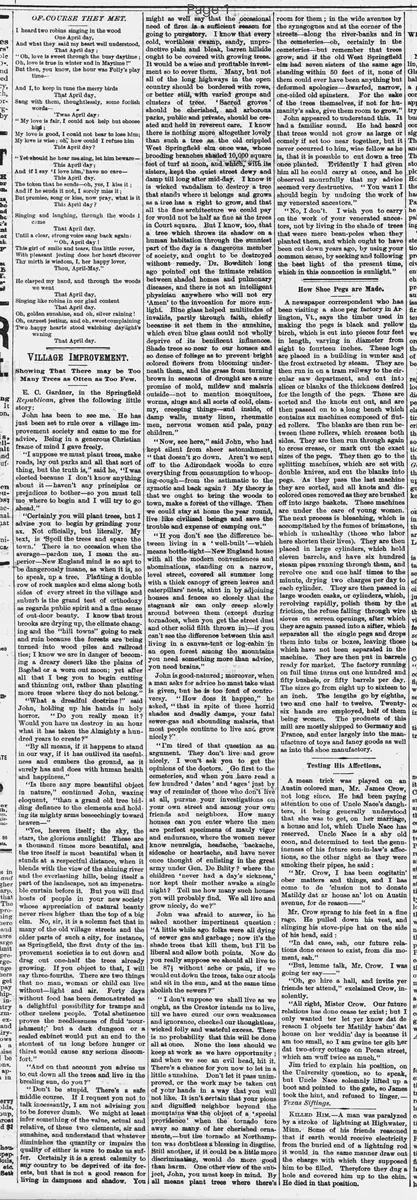
VILLAGE IMPROVEMENT.
Showing That There may be Too
Many Trees as Often as Too Few.
E. C. Gardner in the Springfield
Republican, gives the following little
story:
John has been to see me. He has
just been set to rule over a village improvement society and came to me for
advice. Being in a generous Christian
frame of mind I gave freely.
"I suppose we must plant trees, make
roads, lay out parks and all that sort of
thing, but the truth is," said he, "I was
elected because I don't know anything
about it-haven't any principles or
prejudices to bother-so you must tell
me where to begin and I will try to go
ahead."
"Certainly you will plant trees, but I
advise you to begin by grinding your
ax. Not officially, but literally. My
text is 'Spoil the trees and spare the
town.' There is no occasion when the
average-pardon me, I mean the su-
perior-New England mind is so apt to
be dangerously insane, as when it is, so
to speak, up a tree. Planting a double
row of rock maples and elms along both
sides of every street in the village and
suburb is the grand test of orthodoxy
as regards public spirit and a fine sense
of out-door beauty. I know that trout
brooks are drying up, the climate changing and the "hill towns" going to rack
and ruin because the forests are being
turned into wood piles and railroad
ties; I know we are in danger of becoming a dreary desert like the plains of
Bagdad or a worn out moon; yet after
all that I beg you to begin cutting
and thinning out, rather than planting
more trees where they do not belong.
"What a dreadful doctrine!" said
John, holding up his hands in holy
horror.
"Do you really mean it?
Would you have us destroy in an hour
what it has taken the Almighty a hun-
dred years to create?"
"By all means, if it happens to stand
in our way, if it has outlived its usefulness and cumbers the ground, as it
surely has and does with human health
and happiness."
"Is there any more beautiful object
in nature," continued John, waxing
eloquent, "than a grand old tree bidding defiance to the elements and holding its mighty arms beseechingly toward
heaven-
"Yes, heaven itself: the sky, the
stars, the glorious sunlight! These are
a thousand times more beautiful, and
the tree itself is most beautiful when it
stands at a respectful distance, when it
blends with the view of the shining river
and the everlasting hills, being itself a
part of the landscape, not an impenetrable curtain before it. But you will find
hosts of people in your new society
whose appreciation of natural beauty
never rises higher than the top of a big
elm. No, sir, it is a solemn fact that in
many of the old village streets and the
older parts of such a city, for instance,
as Springfield, the first duty of the improvement societies is to cut down and
drag out one-half the trees already
growing. If you object to that, I will
say three-fourths. There are two things
that no man, woman or child can live
without-light and air. Forty days
without food has been demonstrated as
a delightful possibility for tramps and
other useless people. Total abstinence
proves the needlessness of fluid 'nour-
ishment;' but a dark dungeon or a
sealed cabinet would put an end to the
stoutest of us long before hunger or
thirst would cause any serious discomfort."
"And on that account you advise us
to cut down all the trees and live in the
broiling sun, do you?"
"Don't be stupid. There's a safe
middle course. If I request you not to
talk incessantly, I am not advising you
to be forever dumb. We might at least
infer something of the value, actual and
relative, of these two elements, air and
sunshine, and understand that whatever
diminishes the quantity or impairs the
quality of either is sure to make us suffer. Certainly it is a great calamity to
any country to be deprived of its forests, but that is not a good reason for
living in dampness and shadow. You
might as well say that the occasional
need of fires is a sufficient reason for
going to purgatory. I know that every
cold, worthless swamp, sandy, unproductive plain and bleak, barren hillside
ought to be covered with growing trees.
It would be a wise and profitable investment so to cover them. Many, but not
all of the long highways in the open
country should be bordered with rows,
or better still, with varied groups and
clusters of trees. 'Sacred groves'
should be cherished, and arborous
parks, public and private, should be created and held in reverent care. I know
there is nothing more altogether lovely
than such a tree as the old crippled
West Springfield elm once was, whose
brooding branches shaded 10,000 square
feet of turf at noon, and which, with its
sisters, kept the quiet street dewy and
damp till long after mid-day. I know it
is wicked vandalism to destroy a tree
that stands where it belongs and grows
as a tree has a right to grow, and that
all the fine architecture we could pay
for would not be half as fine as the trees
in Court square. But I know, too, that
a tree which throws its shadow on a
human habitation through the sunniest
part of the day is a dangerous member
of society, and ought to be destroyed
without remedy. Dr. Bowditch long
ago pointed out the intimate relation
between shaded homes and pulmonary
diseases, and there is not an intelligent
physician anywhere who will not cry
'Amen' to the invocation for more sunlight. Blue glass helped multitudes of
invalids, partly through faith, chiefly
because it set them in the sunshine,
which even blue glass could not wholly
deprive of its beneficent influences.
Shade trees so near to our houses and
so dense of foliage as to prevent bright
colored flowers from blooming underneath them, and the grass from turning
brown in seasons of drought are a sure
promise of mold, mildew and malaria
outside-not to mention mosquitoes,
worms, slugs and all sorts of cold, clammy, creeping things--and inside, of
damp walls, musty linen, rheumatic
men, nervous women and pale, puny
children."
"Now, see here," said John, who had
kept silent from sheer astonishment,
"that doesn't go down. Aren't we sent
off to the Adirondack woods to cure
everything from consumption to whooping-cough-from the asthmatic to the
zymotic and back again? My theory is
that we ought to bring the woods to
town, make a forest of the village. Then
we could stay at home the year round,
live like civilized beings and save the
trouble and expense of camping out."
"If you don't see the difference between living in a 'well-built'-which
means bottle-tight New England house
with all the 'modern conveniences and
abominations, standing on a narrow,
level street, covered all summer long
with a thick canopy of green leaves and
caterpillars' nests, shut in by adjoining
houses and fences so closely that the
stagnant air can only creep slowly
around between them (except during
tornadoes, when you get the street dust
and other solid filth thrown in)-if you
can't see the difference between this and
living in a canvas-tent or log-cabin in
an open forest among the mountains
you need something more than advice,
you need brains."
John is good-natured; moreover, when
a man asks for advice he must take what
is given, but he is too fond of controversy.
"How does it happen," he
asked, "that in spite of these horrid
shades and deadly damps, your fatal
sewer-gas and abounding malaria, that
most people continue to live and grow
nicely?"
"I'm tired of that question as an
argument. They don't live and grow
nicely. I won't ask you to get the
opinions of the doctors. Go first to the
cemeteries, and when you have read a
few hundred 'dates' and 'ages' just by
way of reminder of those who don't live
at all, pursue your investigations on
your own street and among your own
friends and neighbors. How many
houses can you enter where the men
are perfect specimens of manly vigor
and endurance, where the women never
know neuralgia, headache, backache
sideache or heartache, and have never
once thought of enlisting in the great
army under Gen. De Bility? where the
children never had a day's sickness,
nor kept their mother awake a single
night? Tell me how many such houses
you will probably find. We all live and
grow nicely, do we?"
John was afraid to answer, so he
asked another impertinent question:
"A little while ago folks were all dying
of sewer gas and garbage; now it's the
shade trees that kill them, but I'll be
liberal and allow both points. Now do
you really suppose we should all live to
be 87 without ache or pain, if we
would cut down the trees, take our stools
and sit in the sun, and at the same time
abolish the sewers?"
"I don't suppose we shall live as we
ought, as the Creator intends us to live,
till we have cured our own weaknesses
and ignorance, checked our thoughtless,
wicked folly and wasteful excess. There
is no probability that this will be done
all at once. None the less should we
keep at work as we have opportunity;
and when we see an evil head, hit it.
There's a chance for you now to let in a
little sunshine. Don't let it pass unimproved, or the work may be taken out
of your hands in a way that you will
not like. It isn't certain that your pious
and dignified neighbor beyond the
mountains was the object of a special
providence when the tornado tore
away so many of her cherished ornaments.-but the tornado at Northampton
was doubtless a blessing in disguise.
Still another, if it could be a little more
discriminating, would do more good
than harm. One other view of the subject, John, you must keep in mind. By
all means plant trees where there's
room for them: in the wide avenues by
the synagogues and at the corner of the
streets--along the river-banks and in
the cemeteries--oh, certainly in the
cemeteries--but remember that trees
grow; and if the old West Springfield
elm had seven sisters of the same age
standing within 50 feet of it, none of
them could ever have been anything but
deformed apologies--dwarfed, narrow,
one-sided old spinsters. For the sake
of the trees themselves, if not for humanity's sake, give them room to grow."
John appeared to understand this. It
had a familiar sound. He had heard
that trees would not grow as large or
comely if set too near together, but it
never occurred to him, wise fellow as he
is, that it is possible to cut down a tree
once planted. Evidently I had given
him all he could carry at once, and he
observed mournfully that my advice
seemed very destructive. "You want I
should begin by undoing the work of
my venerated ancestors."
"No, I don't. I wish you to carry
on the work of your venerated ancestors, not by living in the shade of trees
that were mere bean-poles when they
planted them, and which ought to have
been cut down years ago, by using your
common sense, by seeking and following
the best light of the present time,
which in this connection is sunlight."
Showing That There may be Too
Many Trees as Often as Too Few.
E. C. Gardner in the Springfield
Republican, gives the following little
story:
John has been to see me. He has
just been set to rule over a village improvement society and came to me for
advice. Being in a generous Christian
frame of mind I gave freely.
"I suppose we must plant trees, make
roads, lay out parks and all that sort of
thing, but the truth is," said he, "I was
elected because I don't know anything
about it-haven't any principles or
prejudices to bother-so you must tell
me where to begin and I will try to go
ahead."
"Certainly you will plant trees, but I
advise you to begin by grinding your
ax. Not officially, but literally. My
text is 'Spoil the trees and spare the
town.' There is no occasion when the
average-pardon me, I mean the su-
perior-New England mind is so apt to
be dangerously insane, as when it is, so
to speak, up a tree. Planting a double
row of rock maples and elms along both
sides of every street in the village and
suburb is the grand test of orthodoxy
as regards public spirit and a fine sense
of out-door beauty. I know that trout
brooks are drying up, the climate changing and the "hill towns" going to rack
and ruin because the forests are being
turned into wood piles and railroad
ties; I know we are in danger of becoming a dreary desert like the plains of
Bagdad or a worn out moon; yet after
all that I beg you to begin cutting
and thinning out, rather than planting
more trees where they do not belong.
"What a dreadful doctrine!" said
John, holding up his hands in holy
horror.
"Do you really mean it?
Would you have us destroy in an hour
what it has taken the Almighty a hun-
dred years to create?"
"By all means, if it happens to stand
in our way, if it has outlived its usefulness and cumbers the ground, as it
surely has and does with human health
and happiness."
"Is there any more beautiful object
in nature," continued John, waxing
eloquent, "than a grand old tree bidding defiance to the elements and holding its mighty arms beseechingly toward
heaven-
"Yes, heaven itself: the sky, the
stars, the glorious sunlight! These are
a thousand times more beautiful, and
the tree itself is most beautiful when it
stands at a respectful distance, when it
blends with the view of the shining river
and the everlasting hills, being itself a
part of the landscape, not an impenetrable curtain before it. But you will find
hosts of people in your new society
whose appreciation of natural beauty
never rises higher than the top of a big
elm. No, sir, it is a solemn fact that in
many of the old village streets and the
older parts of such a city, for instance,
as Springfield, the first duty of the improvement societies is to cut down and
drag out one-half the trees already
growing. If you object to that, I will
say three-fourths. There are two things
that no man, woman or child can live
without-light and air. Forty days
without food has been demonstrated as
a delightful possibility for tramps and
other useless people. Total abstinence
proves the needlessness of fluid 'nour-
ishment;' but a dark dungeon or a
sealed cabinet would put an end to the
stoutest of us long before hunger or
thirst would cause any serious discomfort."
"And on that account you advise us
to cut down all the trees and live in the
broiling sun, do you?"
"Don't be stupid. There's a safe
middle course. If I request you not to
talk incessantly, I am not advising you
to be forever dumb. We might at least
infer something of the value, actual and
relative, of these two elements, air and
sunshine, and understand that whatever
diminishes the quantity or impairs the
quality of either is sure to make us suffer. Certainly it is a great calamity to
any country to be deprived of its forests, but that is not a good reason for
living in dampness and shadow. You
might as well say that the occasional
need of fires is a sufficient reason for
going to purgatory. I know that every
cold, worthless swamp, sandy, unproductive plain and bleak, barren hillside
ought to be covered with growing trees.
It would be a wise and profitable investment so to cover them. Many, but not
all of the long highways in the open
country should be bordered with rows,
or better still, with varied groups and
clusters of trees. 'Sacred groves'
should be cherished, and arborous
parks, public and private, should be created and held in reverent care. I know
there is nothing more altogether lovely
than such a tree as the old crippled
West Springfield elm once was, whose
brooding branches shaded 10,000 square
feet of turf at noon, and which, with its
sisters, kept the quiet street dewy and
damp till long after mid-day. I know it
is wicked vandalism to destroy a tree
that stands where it belongs and grows
as a tree has a right to grow, and that
all the fine architecture we could pay
for would not be half as fine as the trees
in Court square. But I know, too, that
a tree which throws its shadow on a
human habitation through the sunniest
part of the day is a dangerous member
of society, and ought to be destroyed
without remedy. Dr. Bowditch long
ago pointed out the intimate relation
between shaded homes and pulmonary
diseases, and there is not an intelligent
physician anywhere who will not cry
'Amen' to the invocation for more sunlight. Blue glass helped multitudes of
invalids, partly through faith, chiefly
because it set them in the sunshine,
which even blue glass could not wholly
deprive of its beneficent influences.
Shade trees so near to our houses and
so dense of foliage as to prevent bright
colored flowers from blooming underneath them, and the grass from turning
brown in seasons of drought are a sure
promise of mold, mildew and malaria
outside-not to mention mosquitoes,
worms, slugs and all sorts of cold, clammy, creeping things--and inside, of
damp walls, musty linen, rheumatic
men, nervous women and pale, puny
children."
"Now, see here," said John, who had
kept silent from sheer astonishment,
"that doesn't go down. Aren't we sent
off to the Adirondack woods to cure
everything from consumption to whooping-cough-from the asthmatic to the
zymotic and back again? My theory is
that we ought to bring the woods to
town, make a forest of the village. Then
we could stay at home the year round,
live like civilized beings and save the
trouble and expense of camping out."
"If you don't see the difference between living in a 'well-built'-which
means bottle-tight New England house
with all the 'modern conveniences and
abominations, standing on a narrow,
level street, covered all summer long
with a thick canopy of green leaves and
caterpillars' nests, shut in by adjoining
houses and fences so closely that the
stagnant air can only creep slowly
around between them (except during
tornadoes, when you get the street dust
and other solid filth thrown in)-if you
can't see the difference between this and
living in a canvas-tent or log-cabin in
an open forest among the mountains
you need something more than advice,
you need brains."
John is good-natured; moreover, when
a man asks for advice he must take what
is given, but he is too fond of controversy.
"How does it happen," he
asked, "that in spite of these horrid
shades and deadly damps, your fatal
sewer-gas and abounding malaria, that
most people continue to live and grow
nicely?"
"I'm tired of that question as an
argument. They don't live and grow
nicely. I won't ask you to get the
opinions of the doctors. Go first to the
cemeteries, and when you have read a
few hundred 'dates' and 'ages' just by
way of reminder of those who don't live
at all, pursue your investigations on
your own street and among your own
friends and neighbors. How many
houses can you enter where the men
are perfect specimens of manly vigor
and endurance, where the women never
know neuralgia, headache, backache
sideache or heartache, and have never
once thought of enlisting in the great
army under Gen. De Bility? where the
children never had a day's sickness,
nor kept their mother awake a single
night? Tell me how many such houses
you will probably find. We all live and
grow nicely, do we?"
John was afraid to answer, so he
asked another impertinent question:
"A little while ago folks were all dying
of sewer gas and garbage; now it's the
shade trees that kill them, but I'll be
liberal and allow both points. Now do
you really suppose we should all live to
be 87 without ache or pain, if we
would cut down the trees, take our stools
and sit in the sun, and at the same time
abolish the sewers?"
"I don't suppose we shall live as we
ought, as the Creator intends us to live,
till we have cured our own weaknesses
and ignorance, checked our thoughtless,
wicked folly and wasteful excess. There
is no probability that this will be done
all at once. None the less should we
keep at work as we have opportunity;
and when we see an evil head, hit it.
There's a chance for you now to let in a
little sunshine. Don't let it pass unimproved, or the work may be taken out
of your hands in a way that you will
not like. It isn't certain that your pious
and dignified neighbor beyond the
mountains was the object of a special
providence when the tornado tore
away so many of her cherished ornaments.-but the tornado at Northampton
was doubtless a blessing in disguise.
Still another, if it could be a little more
discriminating, would do more good
than harm. One other view of the subject, John, you must keep in mind. By
all means plant trees where there's
room for them: in the wide avenues by
the synagogues and at the corner of the
streets--along the river-banks and in
the cemeteries--oh, certainly in the
cemeteries--but remember that trees
grow; and if the old West Springfield
elm had seven sisters of the same age
standing within 50 feet of it, none of
them could ever have been anything but
deformed apologies--dwarfed, narrow,
one-sided old spinsters. For the sake
of the trees themselves, if not for humanity's sake, give them room to grow."
John appeared to understand this. It
had a familiar sound. He had heard
that trees would not grow as large or
comely if set too near together, but it
never occurred to him, wise fellow as he
is, that it is possible to cut down a tree
once planted. Evidently I had given
him all he could carry at once, and he
observed mournfully that my advice
seemed very destructive. "You want I
should begin by undoing the work of
my venerated ancestors."
"No, I don't. I wish you to carry
on the work of your venerated ancestors, not by living in the shade of trees
that were mere bean-poles when they
planted them, and which ought to have
been cut down years ago, by using your
common sense, by seeking and following
the best light of the present time,
which in this connection is sunlight."
What sub-type of article is it?
Infrastructure
Social Reform
What keywords are associated?
Village Improvement
Tree Thinning
Sunlight And Air
Health Risks
Shade Trees
What entities or persons were involved?
E. C. Gardner
John
Springfield Republican
Village Improvement Society
Dr. Bowditch
Editorial Details
Primary Topic
Balancing Tree Density In Villages For Health And Beauty
Stance / Tone
Advisory Promoting Tree Thinning Over Excessive Planting
Key Figures
E. C. Gardner
John
Springfield Republican
Village Improvement Society
Dr. Bowditch
Key Arguments
Excess Trees In Villages Block Light And Air Essential For Health
Thinning Trees Prevents Pulmonary Diseases And Damp Conditions
Plant Trees Only Where They Belong, Like Parks And Highways
Forests Are Vital But Urban Shade Harms Habitations
Give Trees Space To Grow Properly