Thank you for visiting SNEWPapers!
Sign up free
The Kanabec County Times
Kanabec County, Minnesota
What is this article about?
British and French forces advanced steadily against retreating Germans from September 10-13, 1914, crossing rivers like the Marne, Ourcq, and Vesle with light resistance, but facing determined stands at the Aisne. Captures included German artillery, colors, and prisoners; Reims reoccupied by French.
Clipping
OCR Quality
Full Text
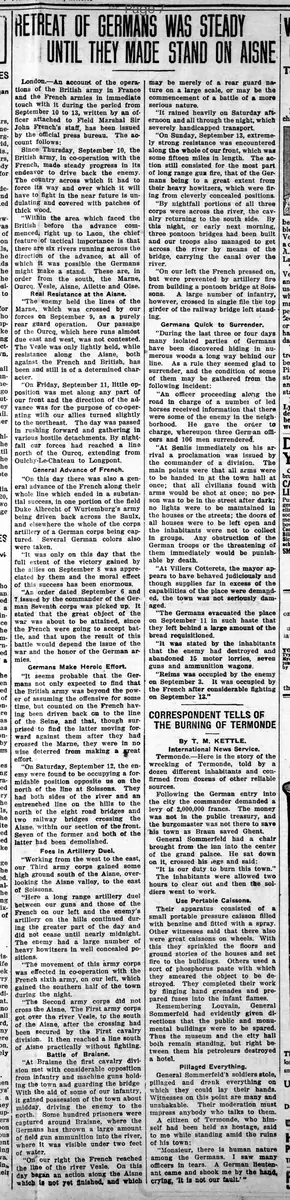
London.—An account of the operations of the British army in France and the French armies in immediate touch with it during the period from September 10 to 13, written by an officer attached to Field Marshal Sir John French's staff, has been issued by the official press bureau. The account follows:
Since Thursday, September 10, the British army, in co-operation with the French, made steady progress in its endeavor to drive back the enemy. The country across which it had to force its way and over which it will have to fight in the near future is undulating and covered with patches of thick wood.
"Within the area which faced the British before the advance commenced, right up to Laon, the chief feature of tactical importance is that there are six rivers running across the direction of the advance, at all of which it was possible the Germans might make a stand. These are, in order from the south, the Marne, Ourcq, Vesle, Aisne, Ailette and Oise.
Real Resistance at the Aisne.
"The enemy held the lines of the Marne, which was crossed by our forces on September 9, as a purely rear guard operation. Our passage of the Ourcq, which here runs almost due east and west, was not contested. The Vesle was only lightly held, while resistance along the Aisne, both against the French and British, has been and still is of a determined character.
"On Friday, September 11, little opposition was met along any part of our front and the direction of the advance was for the purpose of co-operating with our allies turned slightly to the northeast. The day was passed in rushing forward and gathering in various hostile detachments. By nightfall our forces had reached a line north of the Ourcq, extending from Oulchy-Le-Chateau to Longpont.
General Advance of French.
"On this day there was also a general advance of the French along their whole line which ended in a substantial success. In one portion of the field Duke Albrecht of Wurtemberg's army being driven back across the Saulx, and elsewhere the whole of the corps artillery of a German corps being captured. Several German colors also were taken.
"It was only on this day that the full extent of the victory gained by the allies on September 8 was appreciated by them and the moral effect of this success has been enormous.
"An order dated September 6 and 7 issued by the commander of the German Seventh corps was picked up. It stated that the great object of the war was about to be attained, since the French were going to accept battle, and that upon the result of this battle would depend the issue of the war and the honor of the German armies.
Germans Make Heroic Effort.
"It seems probable that the Germans not only expected to find that the British army was beyond the power of assuming the offensive for some time, but counted on the French having been driven back on to the line of the Seine, and that, though surprised to find the latter moving forward against them after they had crossed the Marne, they were in no wise deterred from making a great effort.
"On Saturday, September 12, the enemy were found to be occupying a formidable position opposite us on the north of the line at Soissons. They had both sides of the river and an entrenched line on the hills to the north of the eight road bridges and two railway bridges crossing the Aisne, within our section of the front. Seven of the former and both of the latter had been demolished.
Foes in Artillery Duel.
"Working from the west to the east, our Third army corps gained some high ground south of the Aisne, overlooking the Aisne valley, to the east of Soissons.
"Here a long range artillery duel between our guns and those of the French on our left and the enemy's artillery on the hills continued during the greater part of the day and did not cease until nearly midnight. The enemy had a large number of heavy howitzers in well concealed positions.
"The movement of this army corps was effected in co-operation with the French sixth army, on our left, which gained the southern half of the town during the night.
"The Second army corps did not cross the Aisne. The First army corps got over the river Vesle, to the south of the Aisne, after the crossing had been secured by the First cavalry division. It then reached a line south of Aisne practically without fighting.
Battle of Braisne.
"At Braisne the first cavalry division met with considerable opposition from infantry and machine guns holding the town and guarding the bridge. With the aid of some of our infantry, it gained possession of the town about midday, driving the enemy to the north. Some hundred prisoners were captured around Braisne, where the Germans had thrown a large amount of field gun ammunition into the river, where it was visible under two feet of water.
On our right the French reached the line of the river Vesle. On this day began an action along the Aisne which is not yet finished, and which may be merely of a rear guard nature on a large scale, or may be the commencement of a battle of a more serious nature.
"It rained heavily on Saturday afternoon and all through the night, which severely handicapped transport.
"On Sunday, September 13, extremely strong resistance was encountered along the whole of our front, which was some fifteen miles in length. The action still consisted for the most part of long range gun fire, that of the Germans being to a great extent from their heavy howitzers, which were firing from cleverly concealed positions.
"By nightfall portions of all three corps were across the river, the cavalry returning to the south side. By this night, or early next morning, three pontoon bridges had been built and our troops also managed to get across the river by means of the bridge, carrying the canal over the river.
"On our left the French pressed on, but were prevented by artillery fire from building a pontoon bridge at Soissons. A large number of infantry, however, crossed in single file the top girder of the railway bridge left standing.
Germans Quick to Surrender.
"During the last three or four days many isolated parties of Germans have been discovered hiding in numerous woods a long way behind our line. As a rule they seemed glad to surrender, and the condition of some of them may be gathered from the following incident:
"An officer proceeding along the road in charge of a number of led horses received information that there were some of the enemy in the neighborhood. He gave the order to charge, whereupon three German officers and 106 men surrendered.
"At Senlis immediately on his arrival a proclamation was issued by the commander of a division. The main points were that all arms were to be handed in at the town hall at once; that all civilians found with arms would be shot at once; no person was to be in the street after dark; no lights were to be maintained in the houses or the streets; the doors of all houses were to be left open and the inhabitants were not to collect in groups. Any obstruction of the German troops or the threatening of them immediately would be punishable by death.
"At Villers Cotterets, the mayor appears to have behaved judiciously and though supplies far in excess of the capabilities of the place were demanded, the town was not seriously damaged.
"The Germans evacuated the place on September 11 in such haste that they left behind a large amount of the bread requisitioned.
"It was stated by the inhabitants that the enemy had destroyed and abandoned 15 motor lorries, seven guns and ammunition wagons.
"Reims was occupied by the enemy on September 3. It was occupied by the French after considerable fighting on September 13."
What sub-type of article is it?
What keywords are associated?
What entities or persons were involved?
Where did it happen?
Foreign News Details
Primary Location
Aisne, France
Event Date
September 10 To 13, 1914
Key Persons
Outcome
germans driven back across saulx; capture of german corps artillery, several colors, hundreds of prisoners; reims reoccupied by french after fighting; germans abandoned equipment at villers-cotterets.
Event Details
British and French forces advanced against retreating Germans, crossing Marne, Ourcq, and Vesle with minimal resistance, but encountered strong opposition at Aisne near Soissons and Braisne. Artillery duels occurred; pontoon bridges built; isolated German parties surrendered.