Thank you for visiting SNEWPapers!
Sign up free
Editorial
August 29, 1940
Mcallen Daily Press
Mcallen, Hidalgo County, Texas
What is this article about?
Editorial by Gus W. Dyer criticizes the New Deal's plan to lend $1 billion in US taxpayer money to South American republics for preparedness and agricultural support, shifting burdens from South Americans, creating a food monopoly, and boosting the President's popularity without likely repayment.
Clipping
OCR Quality
95%
Excellent
Full Text
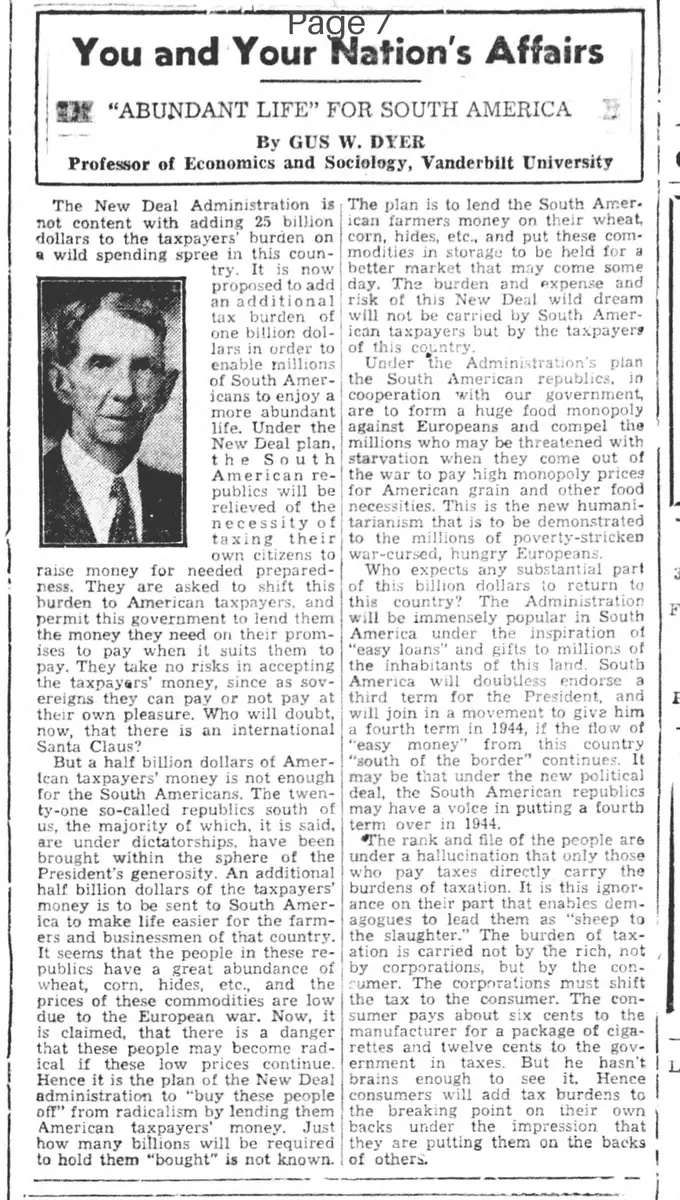
You and Your Nation's Affairs
"ABUNDANT LIFE" FOR SOUTH AMERICA
By GUS W. DYER
Professor of Economics and Sociology, Vanderbilt University
The New Deal Administration is not content with adding 25 billion dollars to the taxpayers' burden on a wild spending spree in this country. It is now proposed to add an additional tax burden of one billion dollars in order to enable millions of South Americans to enjoy a more abundant life. Under the New Deal plan, the South American republics will be relieved of the necessity of taxing their own citizens to raise money for needed preparedness. They are asked to shift this burden to American taxpayers, and permit this government to lend them the money they need on their promises to pay when it suits them to pay. They take no risks in accepting the taxpayers' money, since as sovereigns they can pay or not pay at their own pleasure. Who will doubt, now, that there is an international Santa Claus?
But a half billion dollars of American taxpayers' money is not enough for the South Americans. The twenty-one so-called republics south of us, the majority of which, it is said, are under dictatorships, have been brought within the sphere of the President's generosity. An additional half billion dollars of the taxpayers' money is to be sent to South America to make life easier for the farmers and businessmen of that country.
It seems that the people in these republics have a great abundance of wheat, corn, hides, etc. and the prices of these commodities are low due to the European war. Now, it is claimed, that there is a danger that these people may become radical if these low prices continue. Hence it is the plan of the New Deal administration to "buy these people off" from radicalism by lending them American taxpayers' money. Just how many billions will be required to hold them "bought" is not known.
The plan is to lend the South American farmers money on their wheat, corn, hides, etc., and put these commodities in storage to be held for a better market that may come some day. The burden and expense and risk of this New Deal wild dream will not be carried by South American taxpayers but by the taxpayers of this country.
Under the Administration's plan the South American republics, in cooperation with our government, are to form a huge food monopoly against Europeans and compel the millions who may be threatened with starvation when they come out of the war to pay high monopoly prices for American grain and other food necessities. This is the new humanitarianism that is to be demonstrated to the millions of poverty-stricken war-cursed, hungry Europeans.
Who expects any substantial part of this billion dollars to return to this country? The Administration will be immensely popular in South America under the inspiration of "easy loans" and gifts to millions of the inhabitants of this land. South America will doubtless endorse a third term for the President, and will join in a movement to give him a fourth term in 1944, if the flow of "easy money" from this country "south of the border" continues. It may be that under the new political deal, the South American republics may have a voice in putting a fourth term over in 1944.
The rank and file of the people are under a hallucination that only those who pay taxes directly carry the burdens of taxation. It is this ignorance on their part that enables demagogues to lead them as "sheep to the slaughter." The burden of taxation is carried not by the rich, not by corporations, but by the consumer. The corporations must shift the tax to the consumer. The consumer pays about six cents to the manufacturer for a package of cigarettes and twelve cents to the government in taxes. But he hasn't brains enough to see it. Hence consumers will add tax burdens to the breaking point on their own backs under the impression that they are putting them on the backs of others.
"ABUNDANT LIFE" FOR SOUTH AMERICA
By GUS W. DYER
Professor of Economics and Sociology, Vanderbilt University
The New Deal Administration is not content with adding 25 billion dollars to the taxpayers' burden on a wild spending spree in this country. It is now proposed to add an additional tax burden of one billion dollars in order to enable millions of South Americans to enjoy a more abundant life. Under the New Deal plan, the South American republics will be relieved of the necessity of taxing their own citizens to raise money for needed preparedness. They are asked to shift this burden to American taxpayers, and permit this government to lend them the money they need on their promises to pay when it suits them to pay. They take no risks in accepting the taxpayers' money, since as sovereigns they can pay or not pay at their own pleasure. Who will doubt, now, that there is an international Santa Claus?
But a half billion dollars of American taxpayers' money is not enough for the South Americans. The twenty-one so-called republics south of us, the majority of which, it is said, are under dictatorships, have been brought within the sphere of the President's generosity. An additional half billion dollars of the taxpayers' money is to be sent to South America to make life easier for the farmers and businessmen of that country.
It seems that the people in these republics have a great abundance of wheat, corn, hides, etc. and the prices of these commodities are low due to the European war. Now, it is claimed, that there is a danger that these people may become radical if these low prices continue. Hence it is the plan of the New Deal administration to "buy these people off" from radicalism by lending them American taxpayers' money. Just how many billions will be required to hold them "bought" is not known.
The plan is to lend the South American farmers money on their wheat, corn, hides, etc., and put these commodities in storage to be held for a better market that may come some day. The burden and expense and risk of this New Deal wild dream will not be carried by South American taxpayers but by the taxpayers of this country.
Under the Administration's plan the South American republics, in cooperation with our government, are to form a huge food monopoly against Europeans and compel the millions who may be threatened with starvation when they come out of the war to pay high monopoly prices for American grain and other food necessities. This is the new humanitarianism that is to be demonstrated to the millions of poverty-stricken war-cursed, hungry Europeans.
Who expects any substantial part of this billion dollars to return to this country? The Administration will be immensely popular in South America under the inspiration of "easy loans" and gifts to millions of the inhabitants of this land. South America will doubtless endorse a third term for the President, and will join in a movement to give him a fourth term in 1944, if the flow of "easy money" from this country "south of the border" continues. It may be that under the new political deal, the South American republics may have a voice in putting a fourth term over in 1944.
The rank and file of the people are under a hallucination that only those who pay taxes directly carry the burdens of taxation. It is this ignorance on their part that enables demagogues to lead them as "sheep to the slaughter." The burden of taxation is carried not by the rich, not by corporations, but by the consumer. The corporations must shift the tax to the consumer. The consumer pays about six cents to the manufacturer for a package of cigarettes and twelve cents to the government in taxes. But he hasn't brains enough to see it. Hence consumers will add tax burdens to the breaking point on their own backs under the impression that they are putting them on the backs of others.
What sub-type of article is it?
Foreign Affairs
Economic Policy
Taxation
What keywords are associated?
New Deal
South America
Taxpayers
Loans
Commodity Storage
Food Monopoly
Presidential Terms
Consumer Taxation
What entities or persons were involved?
New Deal Administration
President
South American Republics
Gus W. Dyer
Vanderbilt University
Editorial Details
Primary Topic
Criticism Of New Deal Financial Aid To South America
Stance / Tone
Strongly Critical Of New Deal Spending And Loans
Key Figures
New Deal Administration
President
South American Republics
Gus W. Dyer
Vanderbilt University
Key Arguments
New Deal Proposes Adding $1 Billion Tax Burden To Us Taxpayers For South American Aid
South Americans Relieved Of Taxing Their Own Citizens, Shifting Burden To Americans
Loans To South America Carry No Risk For Recipients As Sovereigns
Additional $500 Million For South American Farmers And Businessmen To Counter Low Commodity Prices
Plan To Lend Money On Wheat, Corn, Hides To Store For Better Market, Burden On Us Taxpayers
Formation Of Food Monopoly Against Europeans To Charge High Prices
Doubts On Repayment Of Loans
Popularity Boost For President In South America, Potential Endorsement For Third Or Fourth Term
Tax Burden Ultimately Carried By Consumers, Not The Rich Or Corporations