Thank you for visiting SNEWPapers!
Sign up free
Gazette Of The United States, & Philadelphia Daily Advertiser
Philadelphia, Philadelphia County, Pennsylvania
What is this article about?
U.S. House of Representatives debate on December 14 continuing discussion on the address responding to the President's speech, focusing on clauses about national prosperity and praise for the President's administration. Speakers like Harper, Giles, Nicholas, and Sitgreaves argue for and against amendments. Includes report of December 12 committee proceedings with votes on motions to strike out paragraphs.
Merged-components note: Continuation of the detailed report on the Congress debate across pages 2 and 3; merged into a single narrative story on legislative proceedings.
Clippings
1 of 2
OCR Quality
Full Text
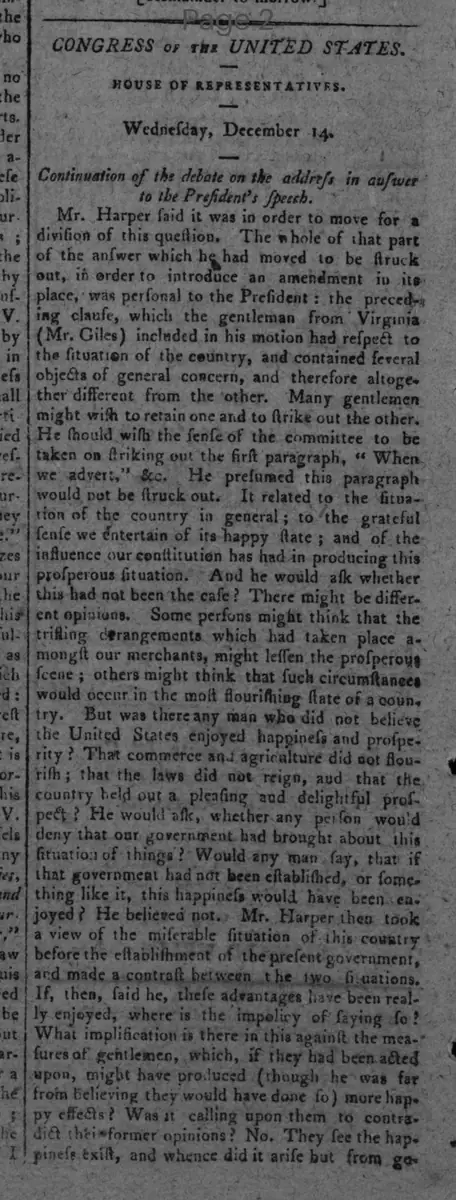
HOUSE OF REPRESENTATIVES.
Wednesday, December 14
Continuation of the debate on the address in answer to the President's speech.
Mr. Harper said it was in order to move for a division of this question. The whole of that part of the answer which he had moved to be struck out, in order to introduce an amendment in its place, was personal to the President: the preceding clause, which the gentleman from Virginia (Mr. Giles) included in his motion had respect to the situation of the country, and contained several objects of general concern, and therefore altogether different from the other. Many gentlemen might wish to retain one and to strike out the other. He should wish the sense of the committee to be taken on striking out the first paragraph, "When we advert," &c. He presumed this paragraph would not be struck out. It related to the situation of the country in general; to the grateful sense we entertain of its happy state; and of the influence our constitution has had in producing this prosperous situation. And he would ask whether this had not been the case? There might be different opinions. Some persons might think that the trifling derangements which had taken place among our merchants, might lessen the prosperous scene; others might think that such circumstances would occur in the most flourishing state of a country. But was there any man who did not believe the United States enjoyed happiness and prosperity? That commerce and agriculture did not flourish; that the laws did not reign, and that the country held out a pleasing and delightful prospect? He would ask, whether any person would deny that our government had brought about this situation of things? Would any man say, that if that government had not been established, or something like it, this happiness would have been enjoyed? He believed not. Mr. Harper then took a view of the miserable situation of this country before the establishment of the present government, and made a contrast between the two situations. If, then, said he, these advantages have been really enjoyed, where is the impolicy of saying so? What implication is there in this against the measures of gentlemen, which, if they had been acted upon, might have produced (though he was far from believing they would have done so) more happy effects? Was it calling upon them to contradict their former opinions? No. They see the happiness exist, and whence did it arise but from government?
Mr. [something] believed the gentlemen would join them in saying they concurred in these sentiments; and if so, where was the propriety of refusing to agree to this clause? He hoped they would re-consider the matter, and that by dividing the question, the clause moved to be struck out might be retained.
Mr. Nicholas said the question could not be divided; if it could, a member could never vote agreeably to his wish. For his own part, he had rather the paragraph in question should be retained, and have liked the motion better had it not included it.
Mr. Giles said gentlemen might refuse to strike out the whole, and then move to strike out a part, and so attain their object. But, said he, admitting the paragraph to be founded on truth, was it a thing they had any thing to do with as legislators? Was it proper to remind the people of Europe that they are not so happy as we? Suppose, added he, any individual was to go into the house of his neighbor, and say to him, "I am very rich and you are poor; I am very happy, but you are very miserable;" would such a conduct be well received? He believed not: and he was unwilling to do that in a national capacity, which he disapproved in an individual one.
Mr. Sitgreaves said, he felt himself perfectly indifferent as to any division of the question, because his mind was prepared to give an unqualified vote to every sentiment contained in the answer reported. He did not believe it to be either unnatural or unbecoming in us to derive happiness from a contrast of our own situation with that of other nations who were less favored. He believed it was the only way in which we could justly appreciate the value of our situation. He believed everything appeared greater or less, worthless or valuable by comparison, and that our happiness and prosperity would not appear evident, except contrasted with nations less so. He perfectly agreed with the gentleman from Virginia (Mr. Giles) that what was condemnable in private life, would be equally so in public. and he should think it wrong for a man to exult over his neighbor's poverty or misfortunes in the way he had mentioned; but though he should not choose to offend his neighbor, he saw no impropriety if he, in the bosom of his family, painted his faults and follies, in order to warn those under his care against the like, and that they might be sufficiently grateful for their superior advantages. He thought there would be nothing in such a conduct either unnatural or unbecoming, and therefore did not wish to see the paragraph struck out.
He did not in any degree doubt the wisdom and firmness of the administration of the government: in the language of the answer, he entertained "a grateful conviction, that the wise, firm and patriotic administration of the President, had been signally conducive to the success of the present form of government." This, he said, was not only his sentiment-it was the sentiment of America. -Such a sentiment was the only reward which could be given to labours like those of the President: he tho't they ought not to be withheld by that house, when every public body, from one end of the continent to the other, were pouring them forth. He saw no reason for being so very cautious of compliment, which would in effect convey reproach instead of praise. If these sentiments were universally felt, there could be no impropriety in their expressing them: but if that House, indeed, believed that the administration of the President had neither been wise, firm nor patriotic, then they would concur with the motion for striking out. It had been insinuated, that the present situation of this country, with respect to its foreign relations, was owing to the want of firmness and wisdom in the administration- His opinion was directly the contrary, and he believed that it was the opinion of America. This opinion was fully expressed by that House on a recent occasion in the last session, and he did not believe it had seen any cause for changing its opinion It was no reason for qualifying the expression relative to the prosperity of the country, because private credit had been in some degree deranged, as that derangement could not be attributed to any act of the government. He was sorry that such circumstances should have been mentioned, to tarnish the bright appearance of the country. These circumstances were but like a speck upon the sun Why were they not told of the fires which had happened at New-York and Savannah, as well as of the derangements of our merchants? Such trivial matters were not to be mentioned in a national view. If the gentleman from Virginia (Mr. Giles) did not regret the resignation of the President, he did : he believed America did, and he believed this regret was extremely natural and proper-He did not think it undignified. That gentleman had said the government would go on without him, and that there were many others capable of filling the Presidential chair. This might be so; but did it follow, that they should not regret the loss of a valuable public servant? Should we not regret him, said he, on account of the universal confidence placed in him / Confidence in the officers of government was valuable, he said, under every form, but particularly in a republican government : it was the chief principle from which it derived its energy.-- Could this be denied? If not, certainly regret was natural, because this confidence would not be so great in his successor, tho' he might be possessed of equal talents and virtues.
Mr. Sitgreaves said, he should not agree to the motion of the gentleman from S. Carolina, (Mr. Harper) because it was substituting other words in place of those used, for no good reason whatever. Those words would not change or improve the sentiment or the phraseology. and there was therefore no utility in adopting them. Upon the whole, he believed the answer reported, to be free from the charge of adulation. He believed there was not a sentiment in it, which was not justified by fact.- It was expressive of national regret at the departure of our chief magistrate from office, and of national gratitude for his services; sentiments, which he believed would not be agreeable to the American people to withhold from him.
Debate to be continued.
Monday, December 12.
The order of the day being called for on the answer to the President's Speech, the house resolved itself into a committee of the whole, Mr. Muhlenberg in the chair, when Mr. Giles's motion for striking out the last eight paragraphs of the answer being under consideration, after some observations from Mr. Nicholas, Mr. Rutherford and Mr. Livingston, the motion was put and negatived.
Mr. Harper then renewed his motion for striking out the seven last paragraphs, for the purpose of introducing a paragraph containing nearly the same sentiments, which, after a few observations, was negatived, 25 members only being in favor of it.
Mr. Parker renewed his motion for striking out the words "the freest.and most enlightened in the world, which, after considerable debate, gave way to an amendment of Mr. Thatcher to have the expression read "the spectacle of a free and enlightened nation, offering," &c. which was carried by a considerable majority.
Mr. Livingston next moved an amendment in the sixth paragraph, to strike out from the word "tranquil" to "period," and to introduce in its stead "present period with that," so as to read "to compare the present period with that immediately antecedent," &c. which was carried 42 to 37.
Mr. Livingston next moved to strike out the words "wise, firm and patriotic administration" in the next paragraph, and to introduce in their stead the words" wisdom, firmness, and patriotism,". which after much debate was lost.
The committee then rose and reported the Address with the amendments, which the house took up, and having gone through, Mr. Sitgreaves moved an amendment to strike out the "while we participate" to "countrymen,"and to insert after the words "to interest our attention, and"' to the following effect, viz. "at the same time that we assure ourselves that your just confidence in the patriotism. self-respect, and fortitude of our countrymen, will not, in any events, be disappointed, and that they will not, on any occasion, forget what is due to the character of our government and nation."
This motion occasioned considerable debate, and was at length defeated by the previous question, which was put in these words, "shall the main question now be put." The Yeas and Nays were called for, and taken as follow.
YEAS. Messrs. Ames. Bradbury, Coit, Craik, Davenport. Ege, A. Foster, D. Foster, Gilbert, Glen, Goodrich, Griswold, Harper, Hartley, Henderson, S Lyman, Malbone, Read, Sewall, Sitgreaves N. Smith, Isaac Smith, W. Smith, Swift, Thatcher, Thomas, Thompson, Van Allen, Wadsworth, Williams, Hindman-31.
NAYS. Messrs. Bailey, Baldwin, Baird, Blount, Bryan, Christie, Claiborne, Clopton, Coles, Dent, Dearborn, Franklin, Freeman, Gallatin, Giles, Gillespie, Gilman, Greenup, Gregg, Grove, Harrison, Havens, Heath, Holland, A. Jackson, G. Jackson, Kitchell, Livingston, Locke, W. Lyman, Maclay, Macon, Madison, Moore, Muhlenberg, Nicholas, Page, Parker, Patton, Richards, Sherburne, Israel Smith, Strudwick, Swanwick, R. Sprigg, Van Cortlandt, Varnum, Venable--48.
In the course of this debate, which was of a considerable length, some very warm expressions took place betwixt the Speaker, Mr. W. Smith, and Mr. Harper on. the point of order. The latter gentleman appealed from the chair to the house. and was pronounced by the house to be out of order
Mr. Blount moved to strike out the last sentence in the address, "for your country's sake, &c.-- then the Yeas and Nays were taken as follow :
YEAS. Messrs. Bailey, Baird, Blount, Christie, Clopton, Coles, Gallatin, Giles, Greenup, Heath, Holland, A. Jackson, G. Jackson, Livingston, Locke, W. Lyman, Maclay, Macon, Moore, Parker, Patton, Swanwick, Varnum, Venable--24.
NAYS. Messrs. Ames, Baldwin, Bradbury, Bryan, Claiborne, Coit, Craik, Davenport, Dearborn, Dent, Ege, A. Foster, D. Foster, Franklin, Freeman, Gilbert, Gillespie, Gilman, Glen, Goodrich, Gregg, Griswold, Grove, Harper, Hartley, Havens, Henderson, Hindman, Kitchell, S. Lyman, Madison, Malbone, Muhlenberg, Nicholas, Page, Read, Richards, Sewall, Sherburne, Sitgreaves, N. Smith, Israel Smith, Isaac Smith, W. Smith, Sprigg, Strudwick, Swift, Thatcher, Thomas, Thompson, Van Cortlandt, Van Allen, Wadsworth, Williams-54.
On the question being about to be put on the answer as amended, Mr. Blount said he wished the Yeas and Nays might be again taken that posterity might see that he was not consenting to this address. · The question was carried 67 to 12. The Noes were Messrs. Blount, Coles, Giles, Greenup, Holland, A. Jackson, Livingston, Locke W. LymanMaclay, Macon, and Venable.
Messrs. Ames, Madison and Sitgreaves were appointed a committee to wait upon the President to enquire when and where he would receive the answer to his address.
Adjourned.
What sub-type of article is it?
What themes does it cover?
What keywords are associated?
What entities or persons were involved?
Where did it happen?
Story Details
Key Persons
Location
House Of Representatives, United States Congress
Event Date
December 14; December 12
Story Details
Debate on amendments to the address in response to the President's speech, focusing on clauses praising national prosperity under the constitution and the President's wise, firm, and patriotic administration. Motions to strike out paragraphs are discussed and voted on, with arguments about propriety, comparison to other nations, and regret over the President's resignation.