Thank you for visiting SNEWPapers!
Sign up free
Editorial
April 23, 1827
Phenix Gazette
Alexandria, Virginia
What is this article about?
Editorial from Cincinnati Gazette, April 10, critiques Gen. Andrew Jackson's public expenditures in 1819-1820, accusing him of charging full military pay, subsistence, and extras while at home, plus double-dipping for Indian treaty services, contrasting with opposition figures' scrutiny.
Merged-components note: The table contains financial data that is integral to the editorial content discussing public money expenditures by Gen. Jackson.
Clipping
OCR Quality
75%
Good
Full Text
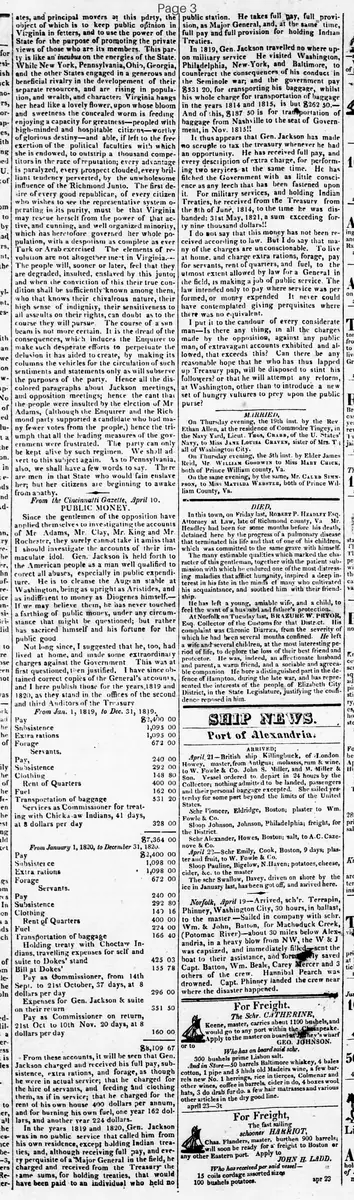
| Pay | 82,400 00 |
| Subsistence | 1,095 00 |
| Extra rations | 1,095 00 |
| Forage | 672 00 |
From the Cincinnatti Gazette, April 10.
PUBLIC MONEY.
Since the gentlemen of the opposition have applied themselves to investigating the accounts of Mr Adams, Mr. Clay, Mr. King and Mr. Rochester, they surely cannot take it amiss that I should investigate the accounts of their immaculate idol. Gen. Jackson is held forth to the American people as a man well qualified to correct all abuses, especially in public expenditure. He is to cleanse the Augean stable at Washington, being as upright as Aristides, and as indifferent to money as Diogenes himself. If we may believe them, he has never touched a farthing of public money, under any circumstance that might be questioned; but rather has sacrificed himself and his fortune for the public good
Not long since, I suggested that he, too, had lived at home, and made some extraordinary charges against the Government This was at first questioned, then justified. I have since obtained correct copies of the General's accounts, and I here publish those for the years 1819 and 1820, as they stand in the offices of the second and third Auditors of the Treasury
From Jan. 1, 1819, to Dec. 31, 1819.
Pay, 240 00
Subsistence 292 00
Clothing, 148 80
Rent of Quarters 400 00
Fuel 162 00
Transportation of baggage 531 20
Services as Commissioner for treating with Chickasaw Indians, 41 days, at 8 dollars per day 328 00
$7,364 00
From January 1, 1820, to December 31, 1820.
Pay $2,400 00
Subsistence 1,098 00
Extra rations 1,098 00
Forage 672 00
Servants.
Pay 240 00
Subsistence 292 80
Clothing 148 16
Rent of Quarters 400 00
Fuel 224 00
Transportation of baggage 166 40
Holding treaty with Choctaw Indians, traveling expenses for self and suite to Dokes's stand 425 03
Bill at Dokes' 155 78
Pay as Commissioner, from 14th Sept, to 21st October, 37 days, at 8 dollars per day 296 00
Expenses for Gen. Jackson & suite on their return $51 50
Pay as Commissioner On Return 21st Oct to 10th Nov. 20 days, at 8 dollars per day 160 00
$8,109 67
From these accounts, it will be seen that Gen. Jackson charged and received his full pay, subsistence, extra rations, and forage, as though he were in actual service; that he charged for the hire of servants, and feeding and clothing them, as if in service; that he charged for the rent of his own house 400 dollars per annum, and for burning his own fuel, one year 162 dollars, and another year 224 dollars.
In the years 1819 and 1820, Gen. Jackson was in no public service that called him from his own residence, except holding Indian treaties; and, although receiving full pay, and every perquisite of a Major General in the field, he charged and received from the Treasury the same sums, for holding treaties, that would have been paid to an individual who held no public station. He takes full pay, full provision, as Major General, and, at the same time, full pay and full provision for holding Indian Treaties.
In 1819, Gen. Jackson travelled no where upon military service He visited Washington, Philadelphia, New-York, and Baltimore, to counteract the consequences of his conduct in the Seminole war; and the government pay 531 20, for transporting his baggage, whilst his whole charge for transportation of baggage in the years 1814 and 1815, is but 262 50.— And of this, 187 50 is for transportation of baggage from Nashville to the seat of Government, in Nov. 1815!!
It thus appears that Gen. Jackson has made no scruple to tax the treasury whenever he had an opportunity. He has received full pay, and every description of extra charge, for performing two services at the same time. He has filched the Government with as little conscience as any leech that has been fastened upon it. For military services, and holding Indian Treaties, he received from the Treasury from the 8th of June, 1814, to the time he was disbanded: 31st May, 1821, a sum exceeding forty nine thousand dollars!!
I do not say that this money has not been received according to law. But I do say that many of the charges are unconscionable. To live at home, and charge extra rations, forage, pay for servants, rent of quarters, and fuel, to the utmost extent allowed by law for a General in the field, is making a job of public service. The law intended only to pay where service was performed, or money expended It never could have contemplated giving perquisites where there was no equivalent.
I put it to the candour of every considerate man—Is there any thing, in all the charges made by the opposition, against any public man, of extravagant accounts exhibited and allowed, that exceeds this? Can there be any reasonable hope that he who has thus lapped up Treasury pap, will be disposed to stint his followers? or that he will attempt any reform, at Washington, other than to introduce a new set of hungry vultures to prey upon the public purse?
What sub-type of article is it?
Partisan Politics
Economic Policy
What keywords are associated?
Public Money
Gen Jackson
Treasury Accounts
Indian Treaties
Military Pay
Extra Rations
Partisan Critique
What entities or persons were involved?
Gen. Jackson
Mr Adams
Mr. Clay
Mr. King
Mr. Rochester
Chickasaw Indians
Choctaw Indians
Editorial Details
Primary Topic
Critique Of Gen. Jackson's Public Money Expenditures
Stance / Tone
Accusatory And Critical Of Gen. Jackson
Key Figures
Gen. Jackson
Mr Adams
Mr. Clay
Mr. King
Mr. Rochester
Chickasaw Indians
Choctaw Indians
Key Arguments
Jackson Charged Full Military Pay And Perks While Residing At Home
Received Extra Charges For Servants, Quarters, Fuel Without Active Service
Double Dipped By Claiming Commissioner Pay For Indian Treaties Alongside Military Compensation
Billed Government For Personal Travel Disguised As Service
Total Receipts From 1814 1821 Exceed $49,000 For Overlapping Services
Charges Are Legal But Unconscionable, Questioning His Reform Credentials