Thank you for visiting SNEWPapers!
Sign up free
Literary
October 6, 1802
The National Intelligencer And Washington Advertiser
Washington, District Of Columbia
What is this article about?
Article praises French exile Abbé Delisle's poem 'L'Homme des Champs, ou les Georgiques Françoises,' a four-canto work on country life joys. English reviewers call him Europe's greatest poet. Features translated excerpt from fourth canto on nostalgic youthful rural memories in Auvergne.
Clipping
OCR Quality
95%
Excellent
Full Text
POETRY.
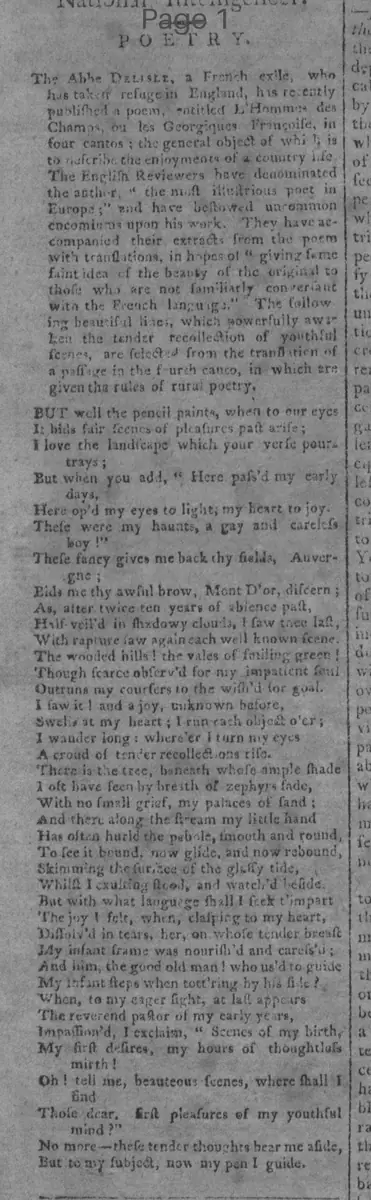
The Abbé Delisle, a French exile, who has taken a refuge in England, has recently published a poem, entitled L'Homme des Champs, ou les Georgiques Françoises, in four cantos; the general object of which is to describe the enjoyments of a country life. The English Reviewers have denominated the author, "the most illustrious poet in Europe;" and have bestowed uncommon encomiums upon his work. They have accompanied their extracts from the poem with translations, in hopes of "giving some faint idea of the beauty of the original to those who are not familiarly conversant with the French language." The following beautiful lines, which powerfully awaken the tender recollection of youthful scenes, are selected from the translation of a passage in the fourth canto, in which are given the rules of rural poetry.
BUT well the pencil paints, when to our eyes
It bids fair scenes of pleasures past arise;
I love the landscape which your verse pourtrays;
But when you add, "Here pass'd my early days,
Here op'd my eyes to light; my heart to joy.
These were my haunts, a gay and careless boy!"
Thee fancy gives me back thy fields, Auvergne;
Bids me thy awful brow, Mont D'or, discern;
As, after twice ten years of absence past,
Half veil'd in shadowy clouds, I saw thee last,
With rapture saw again each well known scene.
The wooded hills! the vales of smiling green!
Though scarce observ'd for my impatient soul
Outruns my courser to the wish'd for goal.
I saw it! and a joy, unknown before,
Swells at my heart; I run each object o'er;
I wander long: where'er I turn my eyes
A crowd of tender recollections rise.
There is the tree, beneath whose ample shade
I oft have seen by breath of zephyrs fade,
With no small grief, my palaces of sand;
and there along the stream my little hand
Has often hurl'd the pebble, smooth and round,
To see it bound, now glide, and now rebound,
Skimming the surface of the glassy tide,
While I exulting stood, and watch'd its side.
But with what language shall I seek t'impart
The joy I felt, when, clasping to my heart,
Dissolv'd in tears, her, on whose tender breast
My infant frame was nourish'd and caress'd;
And him, the good old man! who us'd to guide
My infant steps when tottering by his side?
When, to my eager sight, at last appears
The reverend pastor of my early years,
Impassion'd, I exclaim, "Scenes of my birth,
My first desires, my hours of thoughtless mirth!
Oh! tell me, beauteous scenes, where shall I find
Those dear, lost pleasures of my youthful mind?"
No more - these tender thoughts bear me aside,
But to my subject, now my pen I guide.
The Abbé Delisle, a French exile, who has taken a refuge in England, has recently published a poem, entitled L'Homme des Champs, ou les Georgiques Françoises, in four cantos; the general object of which is to describe the enjoyments of a country life. The English Reviewers have denominated the author, "the most illustrious poet in Europe;" and have bestowed uncommon encomiums upon his work. They have accompanied their extracts from the poem with translations, in hopes of "giving some faint idea of the beauty of the original to those who are not familiarly conversant with the French language." The following beautiful lines, which powerfully awaken the tender recollection of youthful scenes, are selected from the translation of a passage in the fourth canto, in which are given the rules of rural poetry.
BUT well the pencil paints, when to our eyes
It bids fair scenes of pleasures past arise;
I love the landscape which your verse pourtrays;
But when you add, "Here pass'd my early days,
Here op'd my eyes to light; my heart to joy.
These were my haunts, a gay and careless boy!"
Thee fancy gives me back thy fields, Auvergne;
Bids me thy awful brow, Mont D'or, discern;
As, after twice ten years of absence past,
Half veil'd in shadowy clouds, I saw thee last,
With rapture saw again each well known scene.
The wooded hills! the vales of smiling green!
Though scarce observ'd for my impatient soul
Outruns my courser to the wish'd for goal.
I saw it! and a joy, unknown before,
Swells at my heart; I run each object o'er;
I wander long: where'er I turn my eyes
A crowd of tender recollections rise.
There is the tree, beneath whose ample shade
I oft have seen by breath of zephyrs fade,
With no small grief, my palaces of sand;
and there along the stream my little hand
Has often hurl'd the pebble, smooth and round,
To see it bound, now glide, and now rebound,
Skimming the surface of the glassy tide,
While I exulting stood, and watch'd its side.
But with what language shall I seek t'impart
The joy I felt, when, clasping to my heart,
Dissolv'd in tears, her, on whose tender breast
My infant frame was nourish'd and caress'd;
And him, the good old man! who us'd to guide
My infant steps when tottering by his side?
When, to my eager sight, at last appears
The reverend pastor of my early years,
Impassion'd, I exclaim, "Scenes of my birth,
My first desires, my hours of thoughtless mirth!
Oh! tell me, beauteous scenes, where shall I find
Those dear, lost pleasures of my youthful mind?"
No more - these tender thoughts bear me aside,
But to my subject, now my pen I guide.
What sub-type of article is it?
Poem
What themes does it cover?
Agriculture Rural
Nature
What keywords are associated?
Pastoral Poetry
Rural Life
Youthful Memories
Nostalgia
Auvergne Landscapes
Country Enjoyments
What entities or persons were involved?
The Abbé Delisle
Literary Details
Title
L'homme Des Champs, Ou Les Georgiques Françoises
Author
The Abbé Delisle
Subject
Rules Of Rural Poetry
Form / Style
Pastoral Verse Translation
Key Lines
But Well The Pencil Paints, When To Our Eyes
It Bids Fair Scenes Of Pleasures Past Arise;
I Love The Landscape Which Your Verse Pourtrays;
But When You Add, "Here Pass'd My Early Days,
Here Op'd My Eyes To Light; My Heart To Joy.
These Were My Haunts, A Gay And Careless Boy!"
Thee Fancy Gives Me Back Thy Fields, Auvergne;
Bids Me Thy Awful Brow, Mont D'or, Discern;
As, After Twice Ten Years Of Absence Past,
Half Veil'd In Shadowy Clouds, I Saw Thee Last,
With Rapture Saw Again Each Well Known Scene.
There Is The Tree, Beneath Whose Ample Shade
I Oft Have Seen By Breath Of Zephyrs Fade,
With No Small Grief, My Palaces Of Sand;
But With What Language Shall I Seek T'impart
The Joy I Felt, When, Clasping To My Heart,
Dissolv'd In Tears, Her, On Whose Tender Breast
My Infant Frame Was Nourish'd And Caress'd;
Impassion'd, I Exclaim, "Scenes Of My Birth,
My First Desires, My Hours Of Thoughtless Mirth!
Oh! Tell Me, Beauteous Scenes, Where Shall I Find
Those Dear, Lost Pleasures Of My Youthful Mind?"