Thank you for visiting SNEWPapers!
Sign up free
Clinch Valley News
Tazewell, Jeffersonville, Tazewell County, Virginia
What is this article about?
Overview of dentistry's evolution from ancient crude methods to a specialized US profession by 1800, with first school in 1840 and growth to 72,000 practitioners by 1940; local history in Tazewell County post-Civil War, highlighting early dentists like Dr. Cooley and Dr. Thompson.
Clipping
OCR Quality
Full Text
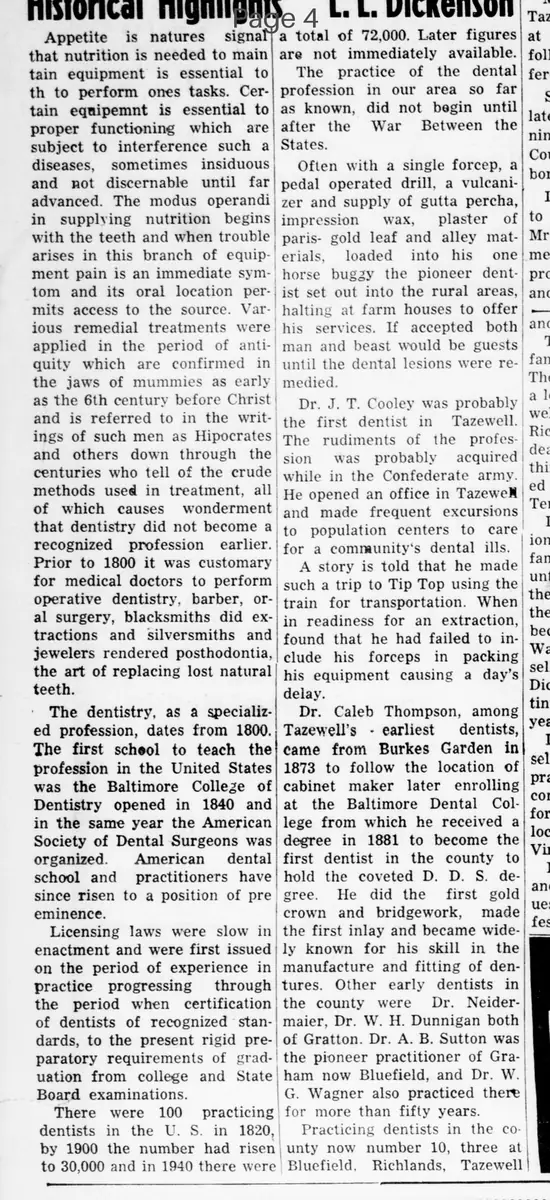
Prior to 1800 it was customary for medical doctors to perform operative dentistry. Barbers, oral surgery, blacksmiths did extractions and silversmiths and jewelers rendered prosthodontia, the art of replacing lost natural teeth.
The dentistry, as a specialized profession, dates from 1800. The first school to teach the profession in the United States was the Baltimore College of Dentistry opened in 1840 and in the same year the American Society of Dental Surgeons was organized.
American dental school and practitioners have since risen to a position of preeminence.
Licensing laws were slow in enactment and were first issued on the period of experience in practice progressing through the period when certification of dentists of recognized standards, to the present rigid preparatory requirements of graduation from college and State Board examinations.
There were 100 practicing dentists in the U. S. in 1820 by 1900 the number had risen to 30,000 and in 1940 there were a total of 72,000. Later figures are not immediately available.
The practice of the dental profession in our area so far as known, did not begin until after the War Between the States.
Often with a single forceps, a pedal operated drill, a vulcanizer and supply of gutta percha, impression wax, plaster of paris- gold leaf and alloy materials, loaded into his one horse buggy the pioneer dentist set out into the rural areas, halting at farm houses to offer his services. If accepted both man and beast would be guests until the dental lesions were remedied.
Dr. J. T. Cooley was probably the first dentist in Tazewell. The rudiments of the profession was probably acquired while in the Confederate army. He opened an office in Tazewell and made frequent excursions to population centers to care for a community's dental ills.
A story is told that he made such a trip to Tip Top using the train for transportation. When in readiness for an extraction, found that he had failed to include his forceps in packing his equipment causing a day's delay.
Dr. Caleb Thompson, among Tazewell's earliest dentists, came from Burkes Garden in 1873 to follow the location of cabinet maker later enrolling at the Baltimore Dental College from which he received a degree in 1881 to become the first dentist in the county to hold the coveted D. D. S. degree.
He did the first gold crown and bridgework, made the first inlay and became widely known for his skill in the manufacture and fitting of dentures. Other early dentists in the county were Dr. Neiderman, Dr. W. H. Dunnigan both of Gratton. Dr. A. B. Sutton was the pioneer practitioner of Graham now Bluefield. and Dr. W. G. Wagner also practiced there for more than fifty years.
Practicing dentists in the county now number 10, three at Bluefield. Richlands. Tazewell and one at Pocahontas.
What sub-type of article is it?
What themes does it cover?
What keywords are associated?
What entities or persons were involved?
Where did it happen?
Story Details
Key Persons
Location
Tazewell County, United States
Event Date
6th Century Bc To 1940
Story Details
History of dentistry from ancient times through its professionalization in the US in 1800, first school in 1840, growth in practitioners, and local development in Tazewell area after Civil War, featuring pioneer dentists like Dr. Cooley and Dr. Thompson, the first DDS in the county in 1881.