Thank you for visiting SNEWPapers!
Sign up free
Trainman News
Indianapolis, Marion County, Indiana
What is this article about?
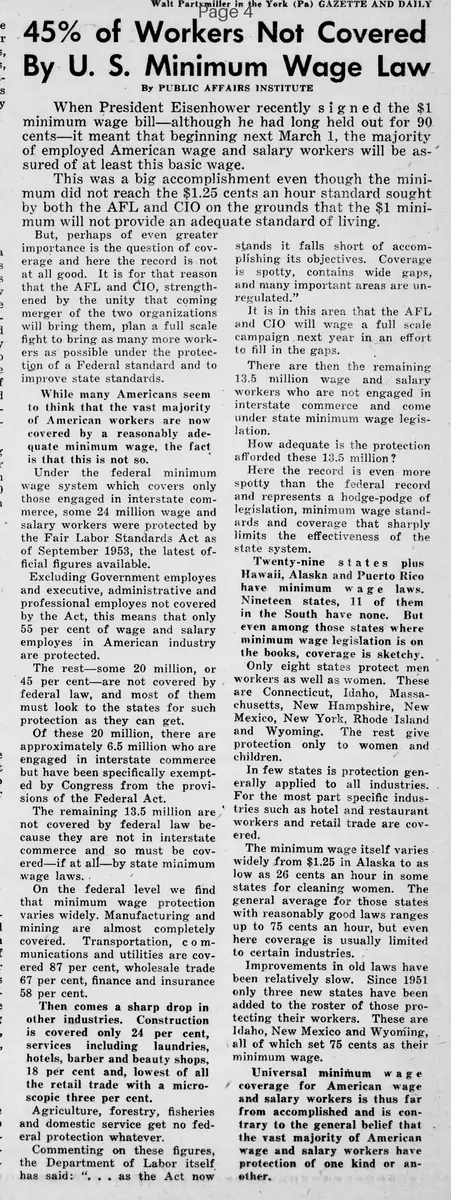
President Eisenhower signed a $1 minimum wage bill, effective March 1, covering 55% of US workers. 45% remain uncovered by federal law, relying on patchy state protections. AFL and CIO plan to expand coverage.
Clipping
OCR Quality
Full Text
By U. S.
Minimum
Wage Law
By
PUBLIC AFFAIRS INSTITUTE
When President Eisenhower recently signed the $1
minimum wage bill -although he had long held out for 90
cents--it meant that beginning next March 1, the majority
of employed American wage and salary workers will be as-
sured of at least this basic wage.
This was a big accomplishment even though the mini-
mum did not reach the $1.25 cents an hour standard sought
by both the AFL and CIO on the grounds that the $1 mini-
mum will not provide an adequate standard of living.
But. perhaps of even greater
importance is the question of coy-
erage and here the record is not
at all good. It is for that reason
that the AFL and CIO, strength-
ened by the unity that coming
merger of the two organizations
will bring them, plan a full scale
fight to bring as many more work-
ers as possible under the protec-
tion of a Federal standard and to
improve state standards.
While many Americans seem
to think that the vast majority
of American workers are now
covered by a reasonably ade-
quate minimum wage, the fact
is that this is not so.
Under the federal
minimum
wage system which covers only
those engaged in interstate com-
merce, some 24 million wage and
salary workers were protected by
the Fair Labor Standards Act as
of September 1953. the latest of-
ficial figures available.
Excluding Government employes
and executive. administrative and
professional employes not covered
by the Act, this means that only
55 per cent of wage and salary
employes 'in American industry
are protected.
The rest some
20 million, or
45 per cent-are not covered by
federal law, and most of them
must look to the states for such
protection as they can get.
Of these 20 million, there are
approximately 6.5 million who are
engaged in interstate commerce
but have been specifically exempt-
ed by Congress from the provi-
sions of the Federal Act.
The remaining 13.5 million are
not covered by federal law be-
cause they are not in interstate
commerce and so must be cov-
ered--if at all-by state minimum
wage laws. :
On the federal level
we
find
that minimum
wage
protection
varies widely. Manufacturing and
mining
are
almost
completely
covered.
Transportation, c o m-
munications and utilities are cov-
ered 87 per cent, wholesale trade
67 per cent, finance and insurance
58 per cent.
Then comes a sharp drop in
other industries. Construction
is covered only 24
per
cent,
services
including
laundries,
hotels, barber and beauty shops,
18 per cent and, lowest of all
the retail trade with a micro-
scopic three per cent.
Agriculture, forestry, fisheries
and domestic service get no fed-
eral protection whatever.
Commenting on these figures,
the Department of Labor itself
has said: "... as the Act now
stands it falls short of accom-
plishing its objectives. Coverage
is
spotty, contains wide gaps,
and many important areas are un-
regulated."
It is in this area that the AFL
and CIO will wage a full scale
campaign .next year in an effort
to fill in the gaps.
There are then the remaining
13.5 million
wage
and
salary
workers who are not engaged in
interstate commerce and
come
under state minimum wage legis-
lation.
How adequate is the protection
afforded these 13.5 million?
Here the record is even more
spotty
than the federal record
and represents a hodge-podge of
legislation, minimum wage stand-
ards and coverage
that sharply
limits the effectiveness of the
state system.
Twenty-nine states plus
Hawaii. Alaska and Puerto Rico
have minimum
wage
laws.
Nineteen states, 11 of them
in the South have none.
But
even among those states where
minimum wage legislation is on
the books, coverage is sketchy.
Only eight states protect men
workers as well as women. These
are
Connecticut, Idaho, Massa-
chusetts, New Hampshire, New
Mexico, New York, Rhode Island
and
Wyoming.
The
rest
give
protection only
to
women
and
children.
In few states is protection gen-
erally applied to all industries.
For the most part specific indus-
tries such as hotel and restaurant
workers and retail trade are cov-
ered.
The minimum wage itself varies
widely from $1.25 in Alaska to as
low as 26 cents an hour in some
states for cleaning women.
The
general average for those states
with reasonably good laws ranges
up to 75 cents an hour, but even
here coverage is usually limited
to certain industries.
Improvements in old laws have
been relatively slow.
Since 1951
only three new states have been
added to the roster of those pro-
tecting their workers. These are
Idaho, New Mexico and Wyoming,
all of which set 75 cents as their
minimum wage.
Universal minimum
wage
coverage
for American wage
and salary workers is thus far
from accomplished and is con-
trary to the general belief that
the vast majority of American
wage and salary workers have
protection of one kind or an-
other.
What sub-type of article is it?
What keywords are associated?
What entities or persons were involved?
Where did it happen?
Domestic News Details
Primary Location
United States
Event Date
Recently; Beginning Next March 1
Key Persons
Outcome
55% of wage and salary workers covered by federal minimum wage; 45% not covered, relying on state laws which vary widely; afl and cio plan campaign to expand coverage
Event Details
President Eisenhower signed $1 minimum wage bill despite preferring 90 cents. Covers majority but only 55% of workers under federal law due to interstate commerce limits. Coverage spotty across industries; states provide uneven protection to remaining workers. 29 states plus territories have laws, but many exclude men or limit industries.