Thank you for visiting SNEWPapers!
Sign up free
Editorial
March 10, 1808
Alexandria Daily Advertiser
Alexandria, Virginia
What is this article about?
Attorney General C.A. Rodney's letter dated December 2, 1807, responds to queries on revising U.S. penal laws. He advocates punishing conspiracies to commit treason to safeguard public peace, suggests incapacitating offenders from office, recommends clarifying laws on enterprises against peaceful nations, and proposes requiring security for good behavior to prevent crimes.
Clipping
OCR Quality
95%
Excellent
Full Text
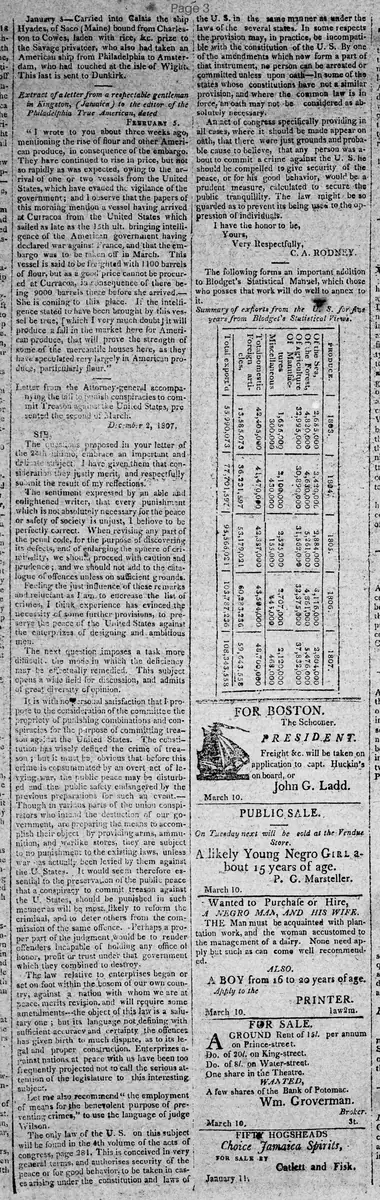
Letter from the Attorney-general accompanying the bill to punish conspiracies to commit Treason against the United States, presented the second of March.
December 2, 1807.
SIR.
The questions proposed in your letter of the 24th ultimo, embrace an important and delicate subject. I have given them that consideration they justly merit, and respectfully submit the result of my reflections.
The sentiment expressed by an able and enlightened writer, that every punishment which is not absolutely necessary for the peace or safety of society is unjust, I believe to be perfectly correct. When revising any part of the penal code, for the purpose of discovering its defects, and of enlarging the sphere of criminality, we should proceed with caution and prudence; and we should not add to the catalogue of offences unless on sufficient grounds. Feeling the just influence of these remarks and reluctant as I am to encrease the list of crimes, I think experience has evinced the necessity of some further provisions, to preserve the peace of the United States against the enterprizes of designing and ambitious men.
The next question imposes a task more difficult. the mode in which the deficiency may be effectually remedied. This subject opens a wide field for discussion, and admits of great diversity of opinion.
It is with no personal satisfaction that I propose to the consideration of the committee the propriety of punishing combinations and conspiracies for the purpose of committing treason against the United States. The constitution has wisely defined the crime of treason; but it must be obvious that before this crime is consummated by an overt act of levying war, the public peace may be disturbed and the public safety endangered by the previous preparations for such an event.
Though in various parts of the union conspirators who intend the destruction of our government, are preparing the means to accomplish their object by providing arms, ammunition, and warlike stores, they are subject to no punishment to the existing laws, unless war has actually been levied by them against the U. States. It would seem therefore essential to the preservation of the public peace that a conspiracy to commit treason against the U. States, should be punished in such manner as will be most likely to reform the criminal, and to deter others from the commission of the same offence. Perhaps a proper part of the judgment would be to render offenders incapable of holding any office of honor, profit or trust under that government which they combined to destroy.
The law relative to enterprizes begun or set on foot within the bosom of our own country, against a nation with whom we are at peace, merits revision. and will require some amendments. The object of this law is a salutary one; but its language not defining with sufficient accuracy and certainty the offences has given birth to much dispute, as to its legal and proper construction. Enterprizes against nations at peace with us have been too frequently projected not to call the serious attention of the legislature to this interesting subject.
Let me also recommend the employment of means for the benevolent purpose of preventing crimes, to use the language of judge Wilson.
The only law of the U. S. on this subject will be found in the 4th volume of the acts of congress, page 281. This is conceived in very general terms, and authorises security of the peace or for good behavior, to be taken in cases arising under the constitution and laws of the U. S. in the same manner as under the laws of the several states. In some respects the provision may, in practice, be incompatible with the constitution of the U. S. By one of the amendments which now form a part of that instrument, no person can be arrested or committed unless upon oath. In some of the states whose constitutions have not a similar provision, and where the common law is in force, an oath may not be considered as absolutely necessary An act of congress specifically providing in all cases, where it should be made appear on oath, that there were just grounds and probable cause to believe, that any person was about to commit a crime against the U. S. he should be compelled to give security of the peace, or for his good behavior, would be a prudent measure, calculated to secure the public tranquillity. The law might be so guarded as to prevent its being used to the oppression of individuals.
I have the honor to be,
Yours,
Very Respectfully,
C.A. RODNEY
December 2, 1807.
SIR.
The questions proposed in your letter of the 24th ultimo, embrace an important and delicate subject. I have given them that consideration they justly merit, and respectfully submit the result of my reflections.
The sentiment expressed by an able and enlightened writer, that every punishment which is not absolutely necessary for the peace or safety of society is unjust, I believe to be perfectly correct. When revising any part of the penal code, for the purpose of discovering its defects, and of enlarging the sphere of criminality, we should proceed with caution and prudence; and we should not add to the catalogue of offences unless on sufficient grounds. Feeling the just influence of these remarks and reluctant as I am to encrease the list of crimes, I think experience has evinced the necessity of some further provisions, to preserve the peace of the United States against the enterprizes of designing and ambitious men.
The next question imposes a task more difficult. the mode in which the deficiency may be effectually remedied. This subject opens a wide field for discussion, and admits of great diversity of opinion.
It is with no personal satisfaction that I propose to the consideration of the committee the propriety of punishing combinations and conspiracies for the purpose of committing treason against the United States. The constitution has wisely defined the crime of treason; but it must be obvious that before this crime is consummated by an overt act of levying war, the public peace may be disturbed and the public safety endangered by the previous preparations for such an event.
Though in various parts of the union conspirators who intend the destruction of our government, are preparing the means to accomplish their object by providing arms, ammunition, and warlike stores, they are subject to no punishment to the existing laws, unless war has actually been levied by them against the U. States. It would seem therefore essential to the preservation of the public peace that a conspiracy to commit treason against the U. States, should be punished in such manner as will be most likely to reform the criminal, and to deter others from the commission of the same offence. Perhaps a proper part of the judgment would be to render offenders incapable of holding any office of honor, profit or trust under that government which they combined to destroy.
The law relative to enterprizes begun or set on foot within the bosom of our own country, against a nation with whom we are at peace, merits revision. and will require some amendments. The object of this law is a salutary one; but its language not defining with sufficient accuracy and certainty the offences has given birth to much dispute, as to its legal and proper construction. Enterprizes against nations at peace with us have been too frequently projected not to call the serious attention of the legislature to this interesting subject.
Let me also recommend the employment of means for the benevolent purpose of preventing crimes, to use the language of judge Wilson.
The only law of the U. S. on this subject will be found in the 4th volume of the acts of congress, page 281. This is conceived in very general terms, and authorises security of the peace or for good behavior, to be taken in cases arising under the constitution and laws of the U. S. in the same manner as under the laws of the several states. In some respects the provision may, in practice, be incompatible with the constitution of the U. S. By one of the amendments which now form a part of that instrument, no person can be arrested or committed unless upon oath. In some of the states whose constitutions have not a similar provision, and where the common law is in force, an oath may not be considered as absolutely necessary An act of congress specifically providing in all cases, where it should be made appear on oath, that there were just grounds and probable cause to believe, that any person was about to commit a crime against the U. S. he should be compelled to give security of the peace, or for his good behavior, would be a prudent measure, calculated to secure the public tranquillity. The law might be so guarded as to prevent its being used to the oppression of individuals.
I have the honor to be,
Yours,
Very Respectfully,
C.A. RODNEY
What sub-type of article is it?
Legal Reform
Crime Or Punishment
Constitutional
What keywords are associated?
Treason Conspiracies
Penal Code Revision
Public Peace
Preventive Security
U.S. Constitution
Attorney General Rodney
What entities or persons were involved?
C.A. Rodney
United States Congress
Conspirators
Judge Wilson
Editorial Details
Primary Topic
Punishing Conspiracies To Commit Treason
Stance / Tone
Cautious Advocacy For Stricter Penal Provisions
Key Figures
C.A. Rodney
United States Congress
Conspirators
Judge Wilson
Key Arguments
Punishments Should Only Be Necessary For Society's Peace And Safety.
Existing Laws Fail To Punish Preparations For Treason Before Overt Acts.
Propose Punishing Conspiracies To Treason To Deter And Reform Offenders.
Incapacitate Convicted Conspirators From Holding Public Office.
Revise Laws On Enterprises Against Nations At Peace With The U.S.
Enact Measures Requiring Security For Good Behavior To Prevent Crimes, Based On Oath.