Thank you for visiting SNEWPapers!
Sign up free
Editorial
September 14, 1803
Alexandria Advertiser And Commercial Intelligencer
Alexandria, Virginia
What is this article about?
An editorial quotes essays by 'Amdrabal' in the Litchfield Monitor, analogizing Thomas Jefferson's acquisition and use of power to the tyrant Lysias of Samos, who deceived the people, misused public funds, and established despotism, warning against the perils of democracy.
Clipping
OCR Quality
98%
Excellent
Full Text
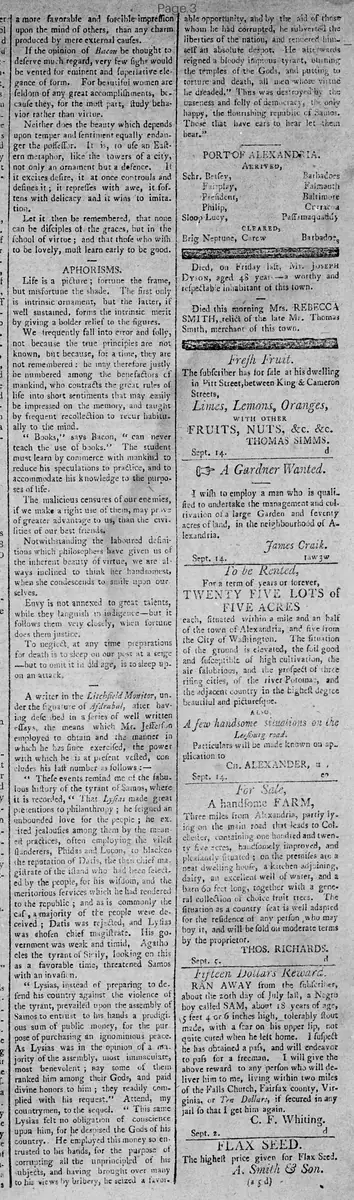
A writer in the Litchfield Monitor, under the signature of Amdrabal, after having described in a series of well written essays, the means which Mr. Jefferson employed to obtain and the manner in which he has since exercised, the power with which he is at present vested, concludes his last number as follows:—
"These events remind me of the fabulous history of the tyrant of Samos, where it is recorded, "That Lysias made great pretensions to philanthropy; he feigned an unbounded love for the people: he excited jealousies among them by the meanest practices, often employing the vilest Slanderers, Phidias and Lucon, to blacken the reputation of Datis, the then chief magistrate of the island who had been selected by the people, for his wisdom, and the meritorious services which he had rendered to the republic; and as is commonly the case, a majority of the people were deceived: Datis was rejected, and Lysias was chosen chief magistrate. His government was weak and timid, Agathocles the tyrant of Sicily, looking on this as a favorable time, threatened Samos with an invasion.
"Lysias, instead of preparing to defend his country against the violence of the tyrant, prevailed upon the assembly of Samos to entrust to his hands a prodigious sum of public money, for the purpose of purchasing an ignominious peace. As Lysias was in the opinion of a majority of the assembly, most immaculate, most benevolent; nay some of them ranked him among their Gods, and paid divine honors to him; they readily complied with his request." Attend, my countrymen, to the sequel. "This same Lysias felt no obligation of conscience upon him, for he despised the Gods of his country. He employed this money so entrusted to his hands, for the purpose of corrupting all the unprincipled of his subjects, and having brought over many to his views by bribery, he seized a favorable opportunity, and by the aid of those whom he had corrupted, he subverted the liberties of the nation, and rendered himself an absolute despot. He afterwards reigned a bloody impious tyrant, ruining the temples of the Gods, and putting to torture and death, all men whose virtue he dreaded." Thus was destroyed by the baseness and folly of democracy, the only happy, the flourishing republic of Samos. Those that have ears to hear let them hear."
"These events remind me of the fabulous history of the tyrant of Samos, where it is recorded, "That Lysias made great pretensions to philanthropy; he feigned an unbounded love for the people: he excited jealousies among them by the meanest practices, often employing the vilest Slanderers, Phidias and Lucon, to blacken the reputation of Datis, the then chief magistrate of the island who had been selected by the people, for his wisdom, and the meritorious services which he had rendered to the republic; and as is commonly the case, a majority of the people were deceived: Datis was rejected, and Lysias was chosen chief magistrate. His government was weak and timid, Agathocles the tyrant of Sicily, looking on this as a favorable time, threatened Samos with an invasion.
"Lysias, instead of preparing to defend his country against the violence of the tyrant, prevailed upon the assembly of Samos to entrust to his hands a prodigious sum of public money, for the purpose of purchasing an ignominious peace. As Lysias was in the opinion of a majority of the assembly, most immaculate, most benevolent; nay some of them ranked him among their Gods, and paid divine honors to him; they readily complied with his request." Attend, my countrymen, to the sequel. "This same Lysias felt no obligation of conscience upon him, for he despised the Gods of his country. He employed this money so entrusted to his hands, for the purpose of corrupting all the unprincipled of his subjects, and having brought over many to his views by bribery, he seized a favorable opportunity, and by the aid of those whom he had corrupted, he subverted the liberties of the nation, and rendered himself an absolute despot. He afterwards reigned a bloody impious tyrant, ruining the temples of the Gods, and putting to torture and death, all men whose virtue he dreaded." Thus was destroyed by the baseness and folly of democracy, the only happy, the flourishing republic of Samos. Those that have ears to hear let them hear."
What sub-type of article is it?
Partisan Politics
Constitutional
What keywords are associated?
Jefferson Critique
Samos Tyranny
Lysias Analogy
Democracy Warning
Political Deception
Public Funds Misuse
What entities or persons were involved?
Thomas Jefferson
Amdrabal
Lysias
Datis
Agathocles
Phidias
Lucon
Litchfield Monitor
Editorial Details
Primary Topic
Critique Of Jefferson's Power Via Samos Tyrant Analogy
Stance / Tone
Strongly Anti Jefferson, Cautionary Against Democratic Folly
Key Figures
Thomas Jefferson
Amdrabal
Lysias
Datis
Agathocles
Phidias
Lucon
Litchfield Monitor
Key Arguments
Jefferson's Methods Mirror Lysias's Feigned Philanthropy And Slander To Gain Power
Like Lysias, Jefferson May Misuse Entrusted Power For Personal Gain
Warning That Democracy Can Lead To Tyranny Through Deception And Bribery
Jefferson's Exercise Of Power Risks Subverting National Liberties