Thank you for visiting SNEWPapers!
Sign up free
Editorial
June 2, 1846
The Somerset Herald And Farmers' And Mechanics' Register
Somerset, Somerset County, Pennsylvania
What is this article about?
An editorial letter defends the protective tariff, arguing it lowers consumer prices through increased American manufacturing competition, benefits farmers and workers by boosting demand, and counters British interests aiming to repeal it for foreign monopoly gains.
Clipping
OCR Quality
95%
Excellent
Full Text
[From the National Intelligencer.
The National Fair and the Tariff.
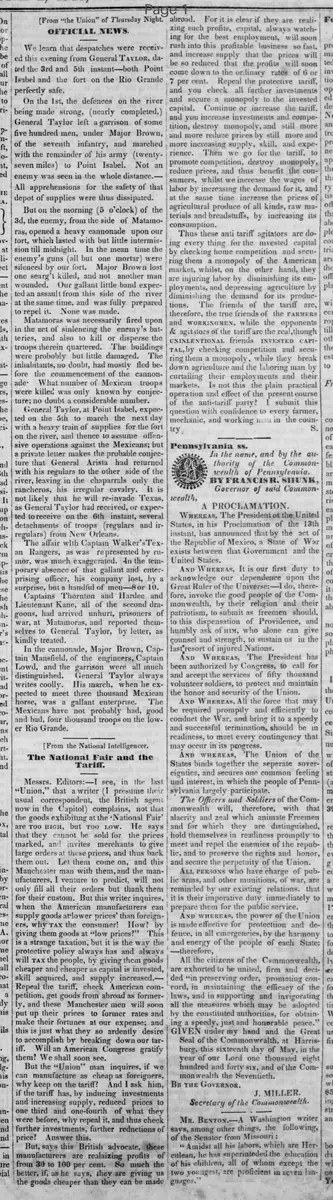
Messrs. Editors:—I see, in the last "Union," that a writer (I presume their usual correspondent, the British agent now in the Capitol) complains, not that the goods exhibiting at the 'National Fair' are TOO HIGH, but TOO LOW. He says that they cannot be sold for the prices marked, and invites merchants to give large orders at these prices, and thus back them out. Let them come on, and this Manchester man with them, and the manufacturers, I venture to predict, will not only fill all their orders but thank them for their custom. But this writer inquires, when the American manufacturers can supply goods at lower prices than foreigners, why Tax the consumer! How? by giving them goods at "low prices?" This is a strange taxation, but it is the way the protective policy always has and always will Tax the people, by giving them goods cheaper and cheaper as capital is invested, skill acquired, and supply increased.— Repeal the tariff, check American competition, get goods from abroad as formerly, and these Manchester men will soon put up their prices to former rates and make their fortunes at our expense; and this is just what they so ardently desire to accomplish by breaking down our tariff. Will an American Congress gratify them? We shall soon see.
But the "Union" man inquires, if we can manufacture as cheap as foreigners, why keep on the tariff? And I ask him, if the tariff has, by inducing investments and increasing supply, reduced prices to one third and one-fourth of what they were before, why repeal it, and thus check further investments, further reductions of price? Answer this.
But, says this British advocate, these manufacturers are realizing profits of from 30 to 100 per cent. So much the better, if, as he says, they are giving us the goods cheaper than they can be made abroad. For it is clear if they are realizing such profits, capital, always watching for the best employment, will soon rush into this profitable business so fast, and increase supply that the prices will be so reduced that the profits will soon come down to the ordinary rates of 6 or 7 per cent. Repeal the protective tariff, and you check all further investments and secure a monopoly to the invested capital. Continue or increase the tariff, and you increase investments and competition, destroy monopoly, and still more and more reduce prices by still more and more increasing supply, skill, and experience. Then we go for the tariff, to promote competition, destroy monopoly, reduce prices, and thus benefit the consumers, whilst we increase the wages of labor by increasing the demand for it, and at the same time increase the prices of agricultural produce of all kinds, raw materials and breadstuffs, by increasing its consumption.
Thus these anti tariff agitators are doing every thing for the invested capital by checking home competition and securing them a monopoly of the American market, whilst, on the other hand, they are injuring labor by diminishing its employments, and depressing agriculture by diminishing the demand for its productions. The friends of the tariff are, therefore, the true friends of the FARMERS and WORKINGMEN, while the opponents & agitators of the tariff are the real, though UNINTENTIONAL, friends of INVESTED CAPITAL, by checking competition and securing them a monopoly, while they break down agriculture and the laboring man by curtailing their employments and their markets. Is not this the plain practical operation and effect of the present course of the anti-tariff party? I submit this question with confidence to every farmer, mechanic, and working man in the country
S.
The National Fair and the Tariff.
Messrs. Editors:—I see, in the last "Union," that a writer (I presume their usual correspondent, the British agent now in the Capitol) complains, not that the goods exhibiting at the 'National Fair' are TOO HIGH, but TOO LOW. He says that they cannot be sold for the prices marked, and invites merchants to give large orders at these prices, and thus back them out. Let them come on, and this Manchester man with them, and the manufacturers, I venture to predict, will not only fill all their orders but thank them for their custom. But this writer inquires, when the American manufacturers can supply goods at lower prices than foreigners, why Tax the consumer! How? by giving them goods at "low prices?" This is a strange taxation, but it is the way the protective policy always has and always will Tax the people, by giving them goods cheaper and cheaper as capital is invested, skill acquired, and supply increased.— Repeal the tariff, check American competition, get goods from abroad as formerly, and these Manchester men will soon put up their prices to former rates and make their fortunes at our expense; and this is just what they so ardently desire to accomplish by breaking down our tariff. Will an American Congress gratify them? We shall soon see.
But the "Union" man inquires, if we can manufacture as cheap as foreigners, why keep on the tariff? And I ask him, if the tariff has, by inducing investments and increasing supply, reduced prices to one third and one-fourth of what they were before, why repeal it, and thus check further investments, further reductions of price? Answer this.
But, says this British advocate, these manufacturers are realizing profits of from 30 to 100 per cent. So much the better, if, as he says, they are giving us the goods cheaper than they can be made abroad. For it is clear if they are realizing such profits, capital, always watching for the best employment, will soon rush into this profitable business so fast, and increase supply that the prices will be so reduced that the profits will soon come down to the ordinary rates of 6 or 7 per cent. Repeal the protective tariff, and you check all further investments and secure a monopoly to the invested capital. Continue or increase the tariff, and you increase investments and competition, destroy monopoly, and still more and more reduce prices by still more and more increasing supply, skill, and experience. Then we go for the tariff, to promote competition, destroy monopoly, reduce prices, and thus benefit the consumers, whilst we increase the wages of labor by increasing the demand for it, and at the same time increase the prices of agricultural produce of all kinds, raw materials and breadstuffs, by increasing its consumption.
Thus these anti tariff agitators are doing every thing for the invested capital by checking home competition and securing them a monopoly of the American market, whilst, on the other hand, they are injuring labor by diminishing its employments, and depressing agriculture by diminishing the demand for its productions. The friends of the tariff are, therefore, the true friends of the FARMERS and WORKINGMEN, while the opponents & agitators of the tariff are the real, though UNINTENTIONAL, friends of INVESTED CAPITAL, by checking competition and securing them a monopoly, while they break down agriculture and the laboring man by curtailing their employments and their markets. Is not this the plain practical operation and effect of the present course of the anti-tariff party? I submit this question with confidence to every farmer, mechanic, and working man in the country
S.
What sub-type of article is it?
Economic Policy
Agriculture
Labor
What keywords are associated?
Protective Tariff
American Manufacturing
Tariff Repeal Opposition
British Interests
Farmer Benefits
Labor Wages
Economic Competition
What entities or persons were involved?
American Manufacturers
British Agent
Manchester Men
American Congress
Farmers
Workingmen
Editorial Details
Primary Topic
Defense Of Protective Tariff Against Repeal
Stance / Tone
Strongly Pro Tariff, Anti British Free Trade Advocacy
Key Figures
American Manufacturers
British Agent
Manchester Men
American Congress
Farmers
Workingmen
Key Arguments
Tariff Enables American Manufacturers To Supply Goods Cheaper Than Foreigners By Increasing Investment And Supply
Repealing The Tariff Would Allow Foreign Producers To Raise Prices And Secure Monopoly Profits At American Expense
High Manufacturer Profits Will Attract More Capital, Increasing Competition And Further Reducing Prices To Normal Levels
Tariff Benefits Consumers By Lowering Prices, Boosts Labor Wages Through Higher Demand, And Raises Agricultural Prices Via Increased Consumption
Anti Tariff Agitators Unintentionally Aid Invested Foreign Capital While Harming Labor And Agriculture