Thank you for visiting SNEWPapers!
Sign up free
Richmond Enquirer
Richmond, Richmond County, Virginia
What is this article about?
Dr. Jeremiah Van Rensselaer's 1819 letter details his adventurous night on erupting Mount Vesuvius, observing lava flows and craters by torchlight, then explores ancient sites like Pompeii and Herculaneum, and travels through Italian cities including Florence and Rome, witnessing Easter ceremonies.
Clipping
OCR Quality
Full Text
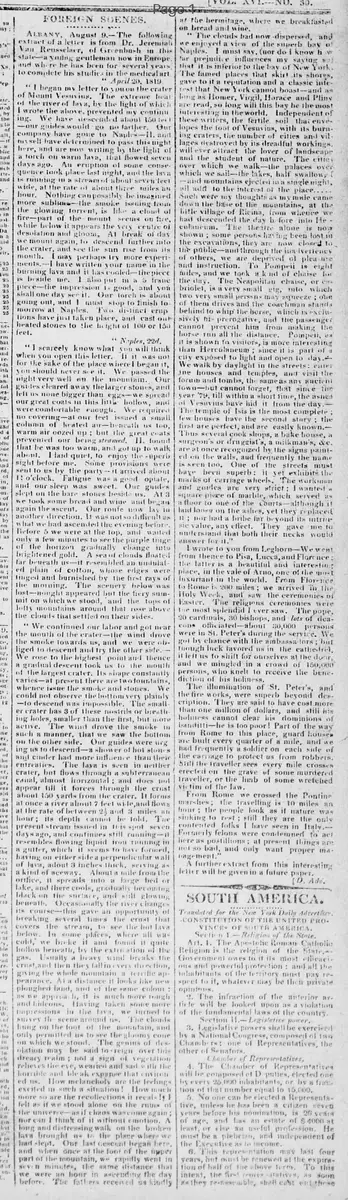
ALBANY, August 9.—The following extract of a letter is from Dr. Jeremiah Van Rensselaer, of Greenbush in this state—a young gentleman now in Europe, and where he has been for several years, to complete his studies in the medical art
"April 20. 1819
"I began my letter to you on the crater of Mount Vesuvius. The extreme heat of the river of lava, by the light of which I wrote the above, prevented my continuing. We have descended about 150 feet —our guides would go no farther. Our company have gone to Naples—H. and my self have determined to pass this night here, and are now writing by the light of a torch on warm lava, that flowed seven days ago. An eruption of some consequence took place last night, and the lava is running in a stream of about seventy feet wide, at the rate of about three miles an hour. Nothing can possibly be imagined more sublime—the smoke issuing from the glowing torrent, is like a cloud of fire—part of the mount seems on fire, while below it appears the very centre of desolation and gloom. At break of day we mount again, to descend farther into the crater, and see the sun rise from its mouth. I may perhaps try more experiments.—I have written your name in the burning lava and it has cooled—the piece is beside me. I also put in a 5 franc piece—the impression is good, and you shall one day see it. Our torch is about going out, and I must stop to finish to-morrow at Naples. Two distinct eruptions have just taken place, and cast off heated stones to the height of 100 or 150 feet.
"Naples, 22d.
"I scarcely know what you will think when you open this letter. If it was not for the sake of the place where I began it, you should never see it. We passed the night very well on the mountain. Our guides cleared away the larger stones, and left us none bigger than eggs—we spread our great coats in this little hollow, and were comfortable enough. We required no covering—at our feet issued a small column of heated air—beneath us too, warm air oozed up : but the great coats prevented our being steamed." H. found that he was too warm, and got up to walk about. I laid quiet, to enjoy the superb sight before me. Some provisions were sent to us by the party—it arrived about 1 o'clock. Fatigue was a good opiate, and our sleep was sweet. Our guides slept on the bare stones beside us. At 3 we took some bread and wine and began again the ascent. Our route now lay in another direction. I was not so difficult as what we had ascended the evening before. Before 5 we were at the top, and waited only a few minutes to see the purple tinge of the horizon gradually change into brightened gold. "A sea of clouds floated far beneath us—it resembled an undulated plain of cotton, whose edges were tinged and burnished by the first rays of the morning. The scenery below was lost—though appeared but the fiery summit on which we stood, and the tops of lofty mountains around that rose above the clouds that settled on their sides.
"We continued our labor and got near the mouth of the crater—the wind drove the smoke towards us, and we were obliged to descend and try the other side.— We rose to the highest point and thence a gradual descent took us to the mouth of the largest crater. Its shape constantly varies—at present there are two fountains, whence issue the smoke and stones. We could not observe the bottom very plainly —to descend was impossible. The smaller crater has 3 of these nostrils or breathing holes, smaller than the first, but more active. The wind drove the smoke in such a manner, that we saw the bottom on the other side. Our guides were urging us to descend—a shower of hot stones and cinders had more influence than their entreaties. The lava is seen in neither crater, but flows through a subterranean canal, almost horizontal; and does not appear til it forces through the crust about 100 yards from the crater. It forms at once a river about 7 feet wide, and flows at the rate of between 2 and 3 miles an hour; its depth cannot be told. The present stream issued from its spot seven days ago, and continues still running—it resembles flowing liquid iron running in a gutter, which it seems to have formed, having on either side a perpendicular wall of lava, about 3 inches thick, serving as a kind of raceway. About a mile from the orifice, it spreads into a large bed or lake, and there cools, gradually becoming black on the surface, and still glowing beneath. Occasionally the river changes its course—this gave an opportunity of breaking several times the crust that covers the stream, to see the hot lava below. In some places, where all was cold, we broke in and found quite hollow beneath, by the extraction of the gas. Usually a heavy wind breaks the crust, and then they fall in every direction, giving the whole mountain a terrible appearance. At a distance it looks like new ploughed land, and of the same color : as we approach, it is much more rough and hideous. Having taken some more impressions in the lava, we turned to survey the scene around us. The clouds hung on the foot of the mountain, and only permitted us to see the gloomy cone on which we stood. The genius of desolation may be said to reign over this dreary realm ; not a sign of vegetation relieves the eye, wearied and sad with the horrible and bleak expanse that environed us. How melancholy are the feelings excited in such a situation! How much more so are the recollections it recalls! I felt as if we stood alone on the ruins of the universe—as if chaos was come again; nor can I think of it without emotion. A long and distressing walk on the broken lava brought us to the place where we had slept." Our last descent began here, and when once at the foot of the upper part of the mountain, we rapidly went in seven minutes, the same distance that we were an hour in ascending the day before. The fathers received us kindly at the hermitage, where we breakfasted on bread and wine.
"The clouds had now dispersed, and we enjoyed a view of the superb bay of Naples." I must say, (nor do I know how far prejudice influences my saying so) that it is inferior to the bay of New York. The famed places that skirt its shores, gave to it a reputation and a classic interest that New York cannot boast—and as long as Homer, Virgil, Horace and Pliny are read, so long will this bay be the most interesting in the world. Independent of these writers, the fertile soil that envelopes the foot of Vesuvius, with its burning craters, the number of cities and villages destroyed by its dreadful workings, will ever attract the lover of landscape and the student of nature. The cities over which we walk—the palaces over which we sail—the lakes, half swallowed— and mountains ejected in a single night, all add to the interest of the place..... Such were my thoughts as my mule came down the base of the mountains, at the little village of Resina, from whence we had descended the day before into Herculaneum. The theatre alone is now shown ; some persons having been lost in the excavations, they are now closed to the public—and through the inadvertency of others, we are deprived of pleasure and instruction. To Pompeii is eight miles, and we took a kind of chaise for the day. The Neapolitan chaise, or cabriolet, is a very small gig, into which two very small persons may squeeze; one of them drives and the coachman stands behind to whip the horse, which is exclusively his prerogative, and the passenger cannot prevent him from making the horse run all the distance. Pompeii, as it is shown to visitors, is more interesting than Herculaneum : since it is part of a city exposed to light and open to day.— We walk by daylight in the streets: enter the houses and temples, and visit the forum and tombs, the same as any ancient town—but cannot forget, that since the year 79, till within a short time, the ashes of Vesuvius have hid it from the day.— The temple of Isis is the most complete; few houses have the second story: the first are perfect, and are easily known.— Thus several cook shops, a bake house, a surgeon's or druggist's, a milkman's, &c. are at once recognized by the signs painted on the walls, and frequently the name is seen too. One of the streets must have been superb: it yet exhibits the marks of carriage wheels. The workmen and guides are very strict: I wanted a square piece of marble, which served as a floor to one of the courts—although it lay long on the ashes, yet they replaced it: nor had a bribe far beyond its intrinsic value, any effect. They gave me to understand that both their necks would answer for it."
I wrote to you from Leghorn—We went from thence to Pisa, Lucca, and Florence; the latter is a beautiful and interesting place, in the vale of Arno, one of the most luxuriant in the world. From Florence to Rome is 200 miles ; we arrived in the Holy Week, and saw the ceremonies of Easter. The religious ceremonies were the most splendid I ever saw. The pope, 20 cardinals, 30 bishops, and lots of deacons officiated—about 50,000 persons were in St. Peter's during the service. We got by chance with the ambassadors; but though luck favored us in the cathedral, it left us to shift for ourselves at the door, and we mingled in a crowd of 150,000 persons, who knelt to receive the benediction of his holiness.
The illumination of St. Peter's, and the fire works, were superb beyond description. They are said to have cost more than one million of dollars, and still his holiness cannot clear his dominions of banditti—he is too poor! Part of the way from Rome to this place, guard houses are built every quarter of a mile, and we had frequently a soldier on each side of the carriage to protect us from robbers. Still the traveller sees every mile crosses erected on the grave of some murdered traveller, or the tomb of some wretched victim of the law.
From Rome we crossed the Pontine marshes; the travelling is at 10 miles an hour : the people look as if nature was sinking to rest ; still they are the only contented folks I have seen in Italy.— Formerly felons were condemned to act here as postillions; at present things are not so bad, and only want proper management."
A further extract from this interesting letter will be given in a future paper.
[D. Adv.
What sub-type of article is it?
What themes does it cover?
What keywords are associated?
What entities or persons were involved?
Where did it happen?
Story Details
Key Persons
Location
Mount Vesuvius, Naples, Pompeii, Herculaneum, Florence, Rome, Italy
Event Date
April 20 22, 1819
Story Details
Dr. Van Rensselaer and companion H. spend a night on erupting Mount Vesuvius, observing lava flows and craters, then visit ancient ruins at Pompeii and Herculaneum, and travel through Italian cities, witnessing Easter ceremonies in Rome amid bandit threats.