Thank you for visiting SNEWPapers!
Sign up free
The New Hampshire Gazette And General Advertiser
Portsmouth, Exeter, Rockingham County, New Hampshire
What is this article about?
A member of the New Hampshire convention defends an alternative government plan featuring a President over a Governor, arguing it better limits executive power and secures liberty. Criticizes the accompanying address for misrepresenting the convention's sincere recommendation and biasing against the new plan.
Merged-components note: This is a continuation of the same letter to the editor across pages 1 and 2, as the text flows directly from the end of the first component to the start of the second.
Clippings
1 of 2
OCR Quality
Full Text
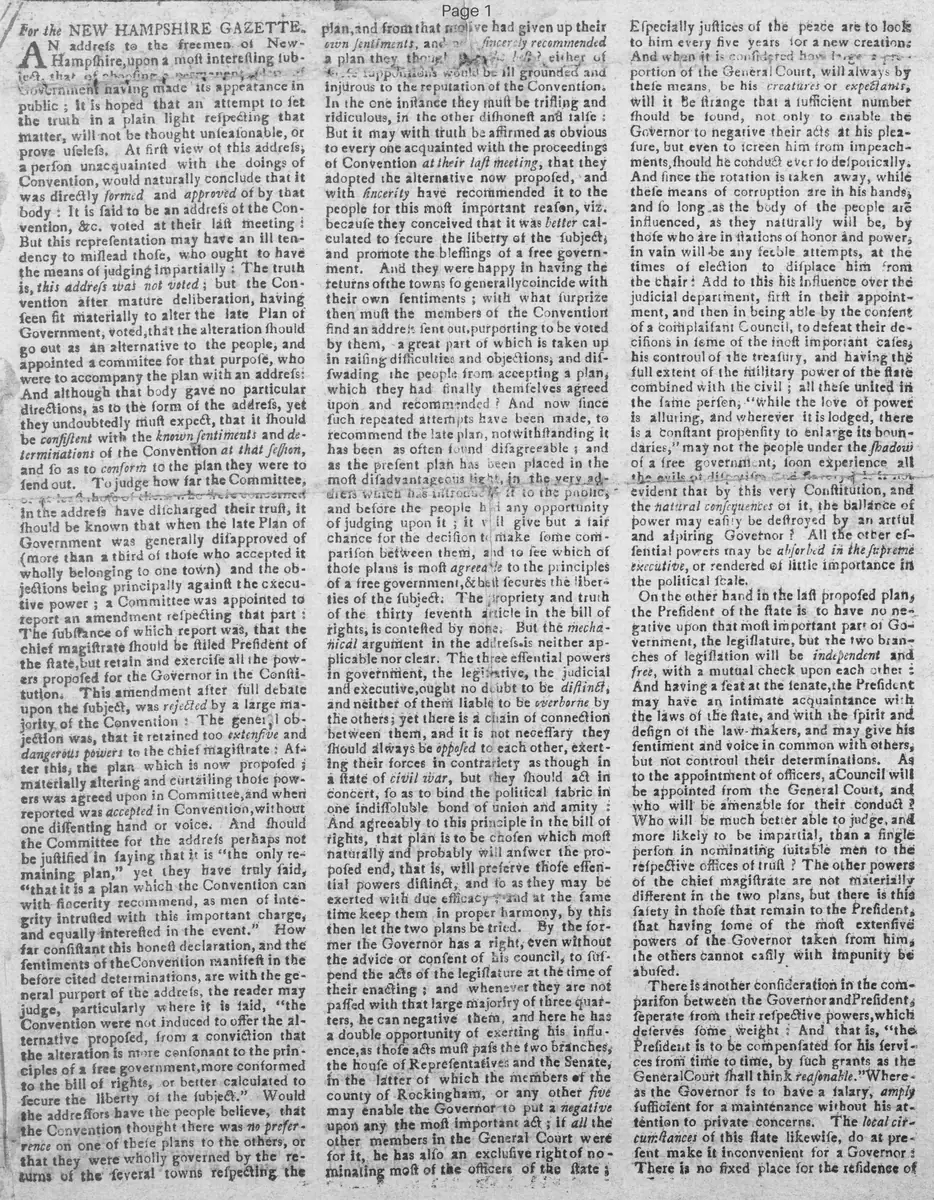
An address to the freemen of New-Hampshire, upon a most interesting subject. that of choosing members permanently in force
Government having made its appearance in public; it is hoped that an attempt to set the truth in a plain light respecting that matter, will not be thought unreasonable, or prove useless. At first view of this address, a person unacquainted with the doings of Convention, would naturally conclude that it was directly formed and approved of by that body: It is said to be an address of the Convention, &c. voted at their last meeting: But this representation may have an ill tendency to mislead those, who ought to have the means of judging impartially: The truth is, this address was not voted; but the Convention after mature deliberation, having seen fit materially to alter the late Plan of Government; voted that the alteration should go out as an alternative to the people, and appointed a committee for that purpose, who were to accompany the plan with an address: And although that body gave no particular directions, as to the form of the address, yet they undoubtedly must expect, that it should be consistent with the known sentiments and determinations of the Convention at that session, and so as to conform to the plan they were to send out. To judge how far the Committee, or at least those who have since had a hand in the address have discharged their trust, it should be known that when the late Plan of Government was generally disapproved of (more than a third of those who accepted it wholly belonging to one town) and the objections being principally against the executive power; a Committee was appointed to report an amendment respecting that part: The substance of which report was, that the chief magistrate should be styled President of the state, but retain and exercise all the powers proposed for the Governor in the Constitution. This amendment after full debate upon the subject, was rejected by a large majority of the Convention: The general objection was, that it retained too extensive and dangerous powers to the chief magistrate: After this, the plan which is now proposed materially altering and curtailing those powers was agreed upon in Committee, and when reported was accepted in Convention, without one dissenting hand or voice. And should the Committee for the address perhaps not be justified in saying that it is "the only remaining plan," yet they have truly said, "that it is a plan which the Convention can with sincerity recommend, as men of integrity intrusted with this important charge, and equally interested in the event." How far consistent this honest declaration, and the sentiments of the Convention manifest in the before cited determinations, are with the general purport of the address, the reader may judge, particularly where it is said, "the Convention were not induced to offer the alternative proposed, from a conviction that the alteration is more consonant to the principles of a free government, more conformed to the bill of rights, or better calculated to secure the liberty of the subject." Would the addressors have the people believe, that the Convention thought there was no preference on one of these plans to the others, or that they were wholly governed by the returns of the several towns respecting the plan, and from that motive had given up their own sentiments, and sincerely recommended a plan they thought bad? either of &. & Tappuniions would be ill grounded and injurious to the reputation of the Convention. In the one instance they must be trifling and ridiculous, in the other dishonest and false: But it may with truth be affirmed as obvious to every one acquainted with the proceedings of Convention at their last meeting, that they adopted the alternative now proposed, and with sincerity have recommended it to the people for this most important reason, viz. because they conceived that it was better calculated to secure the liberty of the subject, and promote the blessings of a free government. And they were happy in having the returns of the towns so generally coincide with their own sentiments: with what surprise then must the members of the Convention find an address sent out, purporting to be voted by them, a great part of which is taken up in raising difficulties and objections; and dissuading the people from accepting a plan, which they had finally themselves agreed upon and recommended? And now since such repeated attempts have been made, to recommend the late plan, notwithstanding it has been as often found disagreeable; and as the present plan has been placed in the most disadvantageous light, in the very address which was introduced it to the public, and before the people had any opportunity of judging upon it; it will give but a fair chance for the decision to make some comparison between them, and to see which of those plans is most agreeable to the principles of a free government, & best secures the liberties of the subject: The propriety and truth of the thirty seventh article in the bill of rights, is contested by none: But the mechanical argument in the address, is neither applicable nor clear. The three essential powers in government, the legislative, the judicial and executive, ought no doubt to be distinct, and neither of them liable to be overborne by the others: yet there is a chain of connection between them, and it is not necessary they should always be opposed to each other, exerting their forces in contrariety as though in a state of civil war, but they should act in concert, so as to bind the political fabric in one indissoluble bond of union and amity: And agreeably to this principle in the bill of rights, that plan is to be chosen which most naturally and probably will answer the proposed end, that is, will preserve those essential powers distinct, and to as they may be exerted with due efficacy: and at the same time keep them in proper harmony, by this then let the two plans be tried. By the former the Governor has a right, even without the advice or consent of his council, to suspend the acts of the legislature at the time of their enacting: and whenever they are not passed with that large majority of three quarters, he can negative them, and here he has a double opportunity of exerting his influence, as those acts must pass as the two branches, the house of Representatives and the Senate, in the latter of which the members of the county of Rockingham, or any other five may enable the Governor to put a negative upon any the most important act; if all the other members in the General Court were for it. he has also an exclusive right of nominating most of the officers of the state; Especially justices of the peace are to look to him every five years for a new creation. And when it is considered how large a proportion of the General Court, will always by these means, be his creatures or expectants; will it be strange that a sufficient number should be found, not only to enable the Governor to negative their acts at his pleasure, but even to screen him from impeachments, should he conduct ever so despotically: And since the rotation is taken away, while these means of corruption are in his hands; and so long as the body of the people are influenced, as they naturally will be, by those who are in stations of honor and power; in vain will be any feeble attempts, at the times of election to displace him from the chair: Add to this his influence over the judicial department, first in their appointment, and then in being able by the consent of a compliant Council, to defeat their decisions in some of the most important cases his control of the treasury, and having the full extent of the military power of the state combined with the civil: all these united in the same person; "while the love of power is alluring, and wherever it is lodged, there is a constant propensity to enlarge its boundaries," may not the people under the shadow of a free government; soon experience all the evils of despotism and fear - tyranny evident that by this very Constitution, and the natural consequences of it, the balance of power may easily be destroyed by an artful and aspiring Governor? All the other essential powers may be absorbed in the supreme executive, or rendered of little importance in the political scale. On the other hand in the last proposed plan, the President of the state is to have no negative upon that most important part of Government, the legislature, but the two branches of legislation will be independent and free, with a mutual check upon each other: And having a seat at the senate, the President may have an intimate acquaintance with the laws of the state, and with the spirit and design of the law-makers, and may give his sentiment and voice in common with others, but not control their determinations. As to the appointment of officers, a Council will be appointed from the General Court, and who will be amenable for their conduct? Who will be much better able to judge, and more likely to be impartial, than a single person in nominating suitable men to the respective offices of trust? The other powers of the chief magistrate are not materially different in the two plans, but there is this safety in those that remain to the President, that having some of the most extensive powers of the Governor taken from him- the others cannot easily with impunity be abused. There is another consideration in the comparison between the Governor and President, separate from their respective powers, which deserves some weight: And that is, "the President is to be compensated for his services from time to time, by such grants as the General Court shall think reasonable." Whereas the Governor is to have a salary, amply sufficient for a maintenance without his attention to private concerns. The local circumstances of this state likewise, do at present make it inconvenient for a Governor There is no fixed place for the residence of
his Excellency. and the transacting the principal business of government : And as he must always attend the General Court during their Sessions, and at other times frequently meet his Council upon matters of importance, and as it would be inconsistent with his character not to appear in state and dignity, as one supported with an independent salary ; so many inconveniences must arise herefrom. unless he resided in the capital of the state and the business of the General Court and Council was transacted there ; but it is quite agreeable to our ideas of dignity in a President to attend the General Court, and take his lodgings wherever the situation and convenience of the state require they should convene.
There is one circumstance more, which perhaps may with propriety be mentioned at this time in favor of a President, that is, the experience we have had of his answering our expectations and wishes for several years: We have seen a worthy President cheerfully serving the public, without grasping at wealth or power, or priding himself in vain Ostentation, and whose amiable conduct has not only endeared to us his person, but in some measure his name and office. And it is to be hoped that his good example will be copied by his successors, when his advanced life and health will permit his services no longer. I shall only add my most fervent wishes, that the good people of this state, who have this precious opportunity of judging and choosing for themselves, would take the pains of comparing the plans, and give their sentiments without a careless indifference, in favor of that which shall best conduce to perpetuate freedom and happiness to themselves and posterity.
A MEMBER OF CONVENTION.
What sub-type of article is it?
What themes does it cover?
What keywords are associated?
What entities or persons were involved?
Letter to Editor Details
Author
A Member Of Convention
Recipient
Freemen Of New Hampshire
Main Argument
the alternative plan establishing a president with curtailed powers is superior to the original governor plan, as it better preserves the balance of powers, secures liberty, and aligns with the convention's sincere recommendation, contrary to the misleading accompanying address.
Notable Details