Thank you for visiting SNEWPapers!
Sign up free
The Coolidge Examiner
Coolidge, Pinal County, Arizona
What is this article about?
Walter Trumbull reflects on New York's vast size, endless crowds, multicultural enclaves representing global races, and abundance of goods from every corner of the world, arguing that exploring the city provides more knowledge than a world tour, while discussing local foods and dietary excesses with examples from famous figures.
Clipping
OCR Quality
Full Text
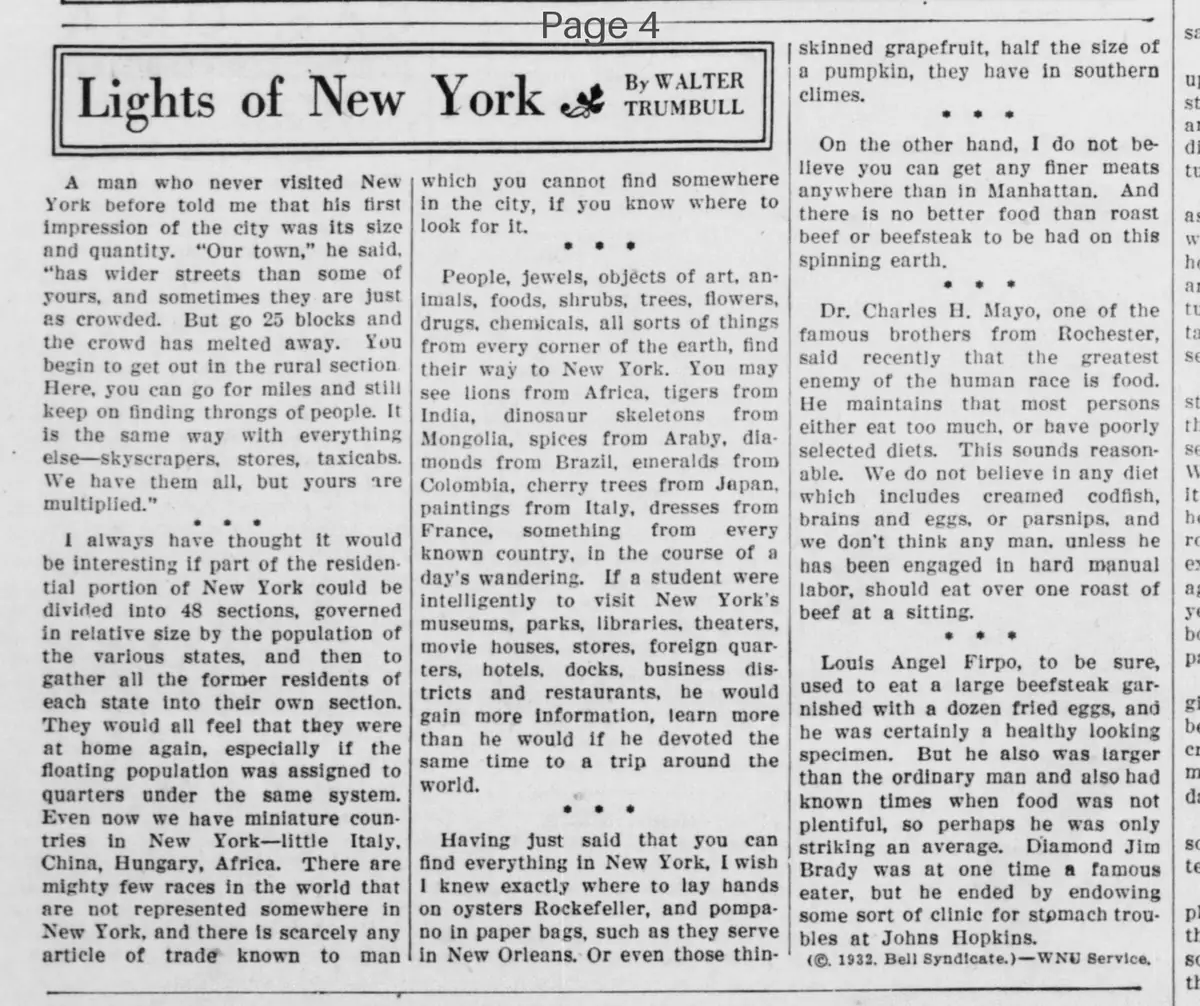
By WALTER TRUMBULL
A man who never visited New York before told me that his first impression of the city was its size and quantity. "Our town," he said, "has wider streets than some of yours, and sometimes they are just as crowded. But go 25 blocks and the crowd has melted away. You begin to get out in the rural section. Here, you can go for miles and still keep on finding throngs of people. It is the same way with everything else—skyscrapers, stores, taxicabs. We have them all, but yours are multiplied."
I always have thought it would be interesting if part of the residential portion of New York could be divided into 48 sections, governed in relative size by the population of the various states, and then to gather all the former residents of each state into their own section. They would all feel that they were at home again, especially if the floating population was assigned to quarters under the same system.
Even now we have miniature countries in New York—little Italy, China, Hungary, Africa. There are mighty few races in the world that are not represented somewhere in New York, and there is scarcely any article of trade known to man which you cannot find somewhere in the city, if you know where to look for it.
People, jewels, objects of art, animals, foods, shrubs, trees, flowers, drugs, chemicals, all sorts of things from every corner of the earth, find their way to New York. You may see lions from Africa, tigers from India, dinosaur skeletons from Mongolia, spices from Araby, diamonds from Brazil, emeralds from Colombia, cherry trees from Japan, paintings from Italy, dresses from France, something from every known country, in the course of a day's wandering.
If a student were intelligently to visit New York's museums, parks, libraries, theaters, movie houses, stores, foreign quarters, hotels, docks, business districts and restaurants, he would gain more information, learn more than he would if he devoted the same time to a trip around the world.
Having just said that you can find everything in New York, I wish I knew exactly where to lay hands on oysters Rockefeller, and pompano in paper bags, such as they serve in New Orleans. Or even those thin-skinned grapefruit, half the size of a pumpkin, they have in southern climes.
On the other hand, I do not believe you can get any finer meats anywhere than in Manhattan. And there is no better food than roast beef or beefsteak to be had on this spinning earth.
Dr. Charles H. Mayo, one of the famous brothers from Rochester, said recently that the greatest enemy of the human race is food. He maintains that most persons either eat too much, or have poorly selected diets. This sounds reasonable.
We do not believe in any diet which includes creamed codfish, brains and eggs, or parsnips, and we don't think any man, unless he has been engaged in hard manual labor, should eat over one roast of beef at a sitting.
Louis Angel Firpo, to be sure, used to eat a large beefsteak garnished with a dozen fried eggs, and he was certainly a healthy looking specimen. But he also was larger than the ordinary man and also had known times when food was not plentiful, so perhaps he was only striking an average.
Diamond Jim Brady was at one time a famous eater, but he ended by endowing some sort of clinic for stomach troubles at Johns Hopkins.
(© 1932, Bell Syndicate.)—WNU Service.
What sub-type of article is it?
What themes does it cover?
What keywords are associated?
What entities or persons were involved?
Where did it happen?
Story Details
Key Persons
Location
New York
Event Date
1932
Story Details
The author describes New York's immense scale and diversity, with neighborhoods mimicking countries and global goods available everywhere; suggests exploring the city educates more than world travel; laments missing some regional foods but praises local meats; critiques overeating, citing Mayo's views and examples of big eaters like Firpo and Brady.