Thank you for visiting SNEWPapers!
Sign up free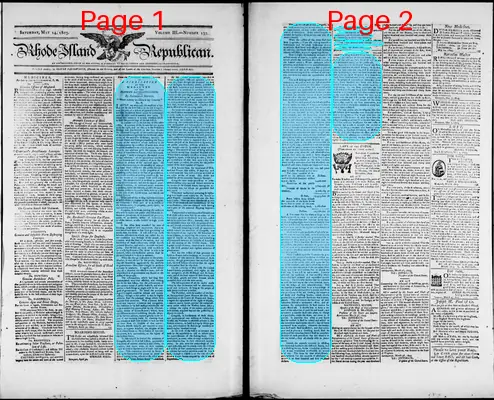
Rhode Island Republican
Newport, Newport County, Rhode Island
What is this article about?
Editorial vindicating Jefferson's administration against Federalist criticisms, detailing Congress's 1802 session actions on finances, debt reduction, tax repeals, foreign relations including Louisiana and Tripoli, and contrasting fiscal improvements with prior administration's policies.
Merged-components note: Continuation of the editorial piece 'A VINDICATION OF THE MEASURES OF THE PRESENT ADMINISTRATION' across pages 1 and 2. Original label on first component was 'story', changed to 'editorial' as it is an opinion piece defending the administration.
Clippings
1 of 2
OCR Quality
Full Text
A VINDICATION
OF THE
MEASURES
OF THE
PRESENT ADMINISTRATION
By ALGERNON SIDNEY.
"Where Liberty is—there is my Country."
No. N.
LASTLY were but part of a system of general destruction, and that the federal fabric would be undermined piece by piece until it tumbled into ruins. To refute this calumny it is only necessary briefly to state the proceedings of the last session.
It commenced on the 6th day of December 1802. A quorum of the Senate did not appear until the 14th, and on the 15th the President's Message was transmitted to the two Houses.
He informed Congress of the conditional repeal of the countervailing duties by the British parliament, of the amicable settlement between the United States and Georgia respecting the Yazoo lands, of the extension of our territory in the Indian country by a cession of more than three hundred thousand acres of land, and an improvement in our relations with the natives, of the cession of Louisiana to France, which he remarked, might "make a change in the aspect of our foreign relations," of the prosperous condition of our finances and the payment of more than 8 millions of dollars of the national debt. He called their attention to the necessity of procuring some small vessels for the public service in the war with Tripoli; to the propriety of establishing a dry dock at the seat of government, and to the necessity of making provision by law for the return of our seamen from other countries. He recommended it to them to practice every useful economy, and not to impose unnecessary burdens, to cultivate peace, maintain commerce, foster the fisheries, protect the manufactures, preserve the public faith, to keep within the pale of the Constitution and cherish the federal Union.
What part of this message exhibits evidence of a disposition to engage in the labors of general destruction? What part of it is hostile to the federal union, to property, peace, quiet, or national happiness?
Congress, so far from proving the existence of a wish to render the public establishments insecure or precarious, or to hazard the property, peace, or prosperity, either of individuals, or of the nation, is also entitled to high confidence.
It has often been remarked by men of learning, judgment and experience, that a nation has always more to fear from governing too much, than too little. A vast difference exists between reformations which are called for by the condition and feelings of the people, and comport with the taste of the nation, and the subversion of those institutions, which furnish personal security, and tend to increase our prosperity. For the first we look with confidence to a wise legislature— The latter is only to be dreaded, where the legislative powers shall be (if ever) intrusted to fools or madmen.
When the change took place in the administration, it was effected by the people, because they felt themselves aggrieved by the measures of government—Men were changed to produce a change in measures. Congress, in the winter 1801 & 2, repealed the offensive laws; and the administration of government was shaped to the wishes of the people.
The reformations, which had long been contemplated, were then effected, and nothing left for the late session, but the performance of the common routine of public business, and an attention to such things as might arise in the progress of government. To detail the proceedings of Congress would be tedious and uninteresting; though to the public it may be highly useful to state the principal things which have received their attention. With a sincere desire to aid and improve commerce and navigation, the President in his first message represented the evils to which they are exposed by the discriminating duties of Great-Britain; which, from the different modes of collecting imposts adopted by the two nations, operate greatly to the injury of our carrying trade, by drawing from our citizens at least three dollars to each one that we draw from the subjects of that nation: Whereby British subjects are enabled to command, in a great measure, the freights of the Six southern States to the exclusion of our own merchants, and, particularly, to the injury of the Eastern States.
To this subject he invited the attention of Congress, who at their last session, appointed a committee of eminent merchants and others, to consider, and report what, in their opinion, could be done in furtherance of trade and navigation. This committee reported in favor of vesting the Executive with power to annul our discriminating duties, whenever the discriminating duties of Great-Britain should be abolished.
By the persons immediately interested in the carrying trade, different opinions were entertained; some thought the proposed measure would be highly beneficial; others, possessed of equal skill, experience and interest, believed it would have a tendency to produce an injury. To furnish evidence to our merchants, of a disposition on the part of government, as well to consult their feeling, as to promote their interests the consideration of the report was deferred, and probably will be until experience shall shew that, in time of peace, the proposed measure is essential to the carrying trade.
To avoid the waste of our national resources, the President recommended the establishment of a dry dock, to preserve our vessels, sheltered from the weather, and to secure them from the rapid decay unavoidable to timbers daily experiencing the vicissitudes of heat and moisture.
The unexpected and serious aspect of things on the Mississippi rendering it possible, that both our money and our ships might be employed in a more active manner, and for purposes more pressing, this useful proposition was with great propriety, postponed for future consideration. Much pains have been taken to represent this as a visionary project of the Executive to squander, of the public property, millions of dollars. To save money—not to squander it away was his design: The expense instead of being millions, was not to exceed four hundred thousand dollars. Which sum is annually necessary to keep twelve frigates in repair, while lying in water; the single expenditure of that sum upon a dry dock would make provision, for years, for the preservation of the same number of frigates.
It is known from the experience of Holland and Venice that vessels, if kept dry and covered from the sun, will continue as sound as any other works of wood. Dry docks are erected by all the maritime States in Europe.
Congress have made provisions to compensate persons who received known wounds in the service of the United States, during the revolutionary war, for whom no provision had been made.
They have authorized procuring & equipping four small armed vessels for the service against Tripoli; calculated for use near the Barbary Coasts. This has been represented as evidence of the weakness and inconsistency of the administration; who are charged with having sold a part of the national shipping improvidently.
Two conclusive answers present themselves: First these vessels were sold by an order of the Executive given in obedience to a law, passed before he came into office; secondly, they were not calculated for a war with the pirates of Africa, and would not answer for the public service.
The only remaining subject of importance which claimed the attention of Congress, was the violation of our rights by the Intendant at New-Orleans, in depriving our citizens of the right of deposit at that place, and forbidding all intercourse between the subjects of Louisiana and the citizens of the United States. This flagrant breach of treaty, received as it demanded, the most prompt and vigilant attention of government.
Nor has the cession of that province by Spain to France had a tendency to increase the confidence of this nation in the views of those powers; though government has received from both, the most solemn assurances that the rights of this nation shall be respected.
On the 20th day of May 1786 the United States solemnly proclaimed their rights to the free navigation of the Mississippi and St. Lawrence, and of the headwaters of these rivers, and all the lakes, gulphs and other streams which connected them with the main ocean.
The full enjoyment of all the rights made known by that declaration will be maintained, sacred and inviolate, as long as the people of these States constitute a nation.
The President, with the consent of the Senate, has appointed James Monroe Minister Extraordinary to the Courts of France and Spain, to regain the enjoyment of the right of deposit, to remove, and in future, prevent the embarrassments under which the Western States labor; to enlarge the rights of the nation, and ensure those already acquired beyond the possibility of dispute or contest.
Congress, in furtherance of these views, have appropriated two millions of dollars, authorized the President to establish arsenals in the Western country, to build and equip sixteen gun boats, and whenever he shall judge necessary to detach eighty thousand troops.
At the close of the session an attempt was made by the opposition to cast an odium upon the commissioners of the sinking fund. This terminated, as every other attempt to injure the administration has, in their defeat and mortification. So ably were the proceedings of that board defended, and so clearly were the wisdom and utility of their measures proved, that of the opposition but twelve members could be found hardy enough to dissent from the vote of confidence and approbation adopted by the House of Representatives.
This was the last act of that Congress, under whose authority, no monies were borrowed, no taxes increased, no laws passed restricting the liberty of the citizen. Every other Congress increased the burthen of the people—by this they were removed.
When the passions of the times shall have been forgotten.—When the warring interests of individuals and the petty bickerings of rival candidates shall have been assigned to the tomb of oblivion, the future historian shall faithfully record these facts, as a rich legacy to posterity.
Here I might triumphantly demand of the restless enemy of liberty, to point out that act, which proves the existence of a wish to destroy the federal union: which threatens private property, or personal security and respectability; which can reasonably create any fear or jealousy in the mind of the most suspicious politician; which was not required by the state of the country, and does not merit the approbation of the people.
The most striking and efficacious mode of contrasting the present with the last administration, is by an attention to their fiscal concerns. In the two last years of the last administration the Executive was authorized to borrow nine millions eight hundred thousand dollars; a part of which was actually loaned at 8 per centum interest—For the two last years, no loan has been made or authorized.
In the two first years of the last administration an additional duty of 8 cents per bushel on salt, the stamp duty and a land tax of two millions of dollars were levied—During the present, no tax has been levied; the land tax is discontinued: and the stamp tax, with all the other internal taxes, has been abolished. During the last administration, in three years, the national debt was increased three millions three hundred and ninety four thousand three hundred and seventeen dollars and forty two cents—Since the present, in two years, the national debt has been reduced seven millions eight hundred and forty nine thousand four hundred and thirty-seven dollars and thirty-eight cents.
During the last administration no payments were made on the deferred debt—On the 1st of April last interest first fell due on that debt, and the present administration have annually paid thereon twelve-hundred thousand dollars—Once more, when the last administration retired, there were one million seven hundred and ninety-four thousand and forty four dollars in the treasury—Now in the same treasury there are five millions and seventy thousand two hundred and thirty dollars and sixty-two cents.
The actual savings of the two last years may be justly estimated as follows:
Two years payment of interest on the deferred debt at twelve hundred thousand dollars per year, equal,
2,400,000
Reduction of the public debt,
7,849,437.38
Increase of specie in the treasury,
3,226,185.32
Dollars,
13,475,622.76
From which sum deduct the proceeds of the bank shares lately sold by order of the commissioners of the sinking fund, 1,287,600
Dollars,
12,188,022.76
A sum more than six times as large as the land tax levied in 1800 by the last administration. Of which sum nine millions seven hundred and eighty-eight thousand and twenty-two dollars and seventy-six cents have actually been, and are in train to be, applied to the reduction of the national debt.
With such bright prospects of a speedy extinction of the national debt, without additional burthens, how careful should government be to avoid every thing tending to increase our expenditures? When that debt shall have been extinguished, the present revenues of government will be equal to its maintenance and to the support of any unnecessary wars in which this nation can be engaged.
When I reflect upon the surrender by government to the people of a million of dollars annually, in abolishing the excise: upon the rapid reduction of the public debt, and upon the specie in the treasury, and call to mind the avowed and known determination of the late administration, not only to continue, but to double the land tax. I am lost in amazement. I cannot discover the existence of that necessity which demanded such repeated and oppressive contributions. Yet I boldly declare that to continue as well the land tax as the other internal taxes, was the design of that administration. This declaration is made both from a knowledge of the views of the persons then in power and from the provisions of the act directing the valuation of lands and dwelling houses; which clearly proves that a permanent direct tax was contemplated. That act creates the surveyor of each valuation district a permanent officer, and ascertains the compensation he shall receive for each official act. It directs him to keep a record of the valuation of each lot and house; and whenever a transfer shall take place, to charge the purchaser, credit the seller, and enter it of record. It provides that when a new house shall be erected, it shall be valued and added to the valuations made under the act; that all lands exempted from taxation, whenever the exemption shall cease, shall be assessed; and that whenever and so often as a dwelling house shall be destroyed the valuation thereof shall be cancelled.
Neither of these provisions has any relation to the tax levied; they all clearly refer to future taxes.
Indeed, the expense incurred in assessing the lands and houses in the different States, and in collecting the tax, forms conclusive evidence that it was determined to establish an annual land tax. The sum by that administration appropriated, for the expense of assessments amounted to four hundred and five thousand dollars.
The real expense may be estimated at
The commissions to the various officers for collections and the contingent expenses, as stationery, printing, advertising, &c. will amount at least to
The sums derived from various causes exceed
125,000
Making the whole loss and expenditure amount
to
Dollars
705,000
which sum being deducted from two millions of dollars, the amount of the tax leaves only the sum of one million, two hundred and ninety five thousand dollars, for the public use.
Apportion to the several States this seven hundred and five thousand dollars, in the same ratio as they paid that tax, and it will appear, that by levying it, there has been expended and lost to the people of Maryland, fifty three thousand, seven hundred and ninety one dollars, and to the people of Connecticut forty-five thousand, seven hundred and forty two dollars:
which sums are equal to the yearly expenses of these States. On the same principles the loss to North Carolina was sixty eight thousand two hundred and seventy eight dollars—nearly equal to the expenses of that State for two years.
These were the real losses to the people of the States mentioned. to the people of the other States, they were in the same proportion, and exceed a loss of thirty five dollars on every hundred dollars collected.
Can any person who investigates this subject believe these expenses were incurred with a view to bring the tax of a single year into the treasury? I think not: It must have been the design to make provision for a durable land tax. No other cause can be assigned for this waste of property, but a wish to increase the executive power, by the appointment of a hundred commissioners, a thousand surveyors of assessment districts with established fees of office, and twice that number of assessors and collectors amongst whom should be divided the five hundred and eighty thousand dollars expended.
What sub-type of article is it?
What keywords are associated?
What entities or persons were involved?
Editorial Details
Primary Topic
Vindication Of Jefferson Administration Measures
Stance / Tone
Strongly Supportive Of Present Administration, Critical Of Previous
Key Figures
Key Arguments