Thank you for visiting SNEWPapers!
Sign up free
Editorial
October 7, 1796
Gazette Of The United States, & Philadelphia Daily Advertiser
Philadelphia, Philadelphia County, Pennsylvania
What is this article about?
This editorial reports on French General Bonaparte's decisive victories over Austrian forces in Italy, leading to the rout of 60,000 Austrians, capture of Mantua region, and broader implications for European subjugation. It critiques the war's futility, the humiliation of the German Diet, and British PM Pitt's policies, advocating peace despite dire terms.
Clipping
OCR Quality
98%
Excellent
Full Text
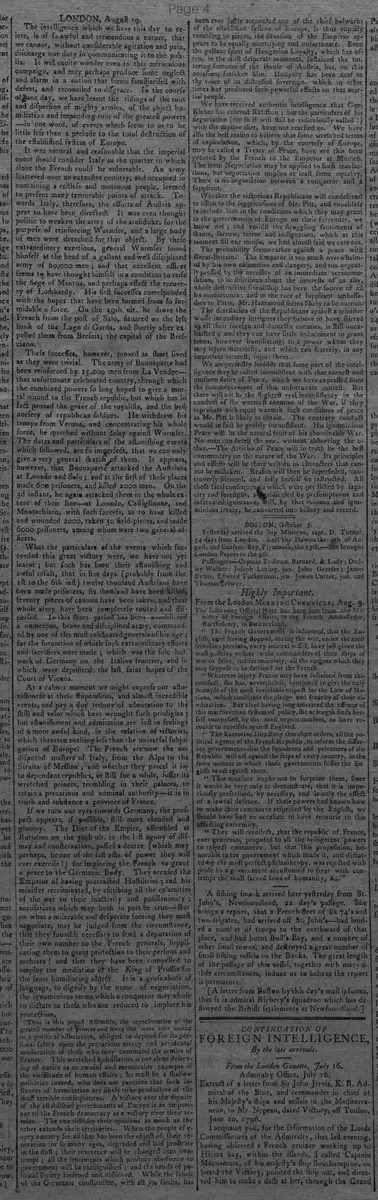
LONDON, August 10.
The intelligence which we have this day to relate, is of so awful and tremendous a nature, that we cannot, without considerable agitation and pain, discharge our duty in communicating it to the public. It will excite wonder even in this miraculous campaign, and may perhaps produce some neglect and alarm in a nation that seems familiarized with defeat, and reconciled to disgrace. In the course of one day, we have learnt the tidings of the rout and dispersion of mighty armies, of the abject humiliation and impending ruin of the greatest powers—in one word, of events which seem to us to be little less than a prelude to the total destruction of the established system of Europe.
It was natural and reasonable that the imperial court should consider Italy as the quarter in which alone the French could be vulnerable. An army scattered over an extensive country, and occupied in containing a restless and mutinous people, seemed to present many favourable points of attack. Towards Italy, therefore, the efforts of Austria appear to have been directed. It was even thought politic to weaken the army of the archduke, for the purpose of reinforcing Wurmser, and a large body of men were detached for that object. By these extraordinary exertions, general Wurmser found himself at the head of a gallant and well disciplined army of 60,000 men; and that excellent officer seems to have thought himself in a condition to raise the siege of Mantua, and perhaps effect the recovery of Lombardy. His first successes corresponded with the hopes that have been formed from so formidable a force. On the 29th ult. he drove the French from the post of Salo, situated on the left bank of the Lago di Garda, and shortly after expelled them from Brescia; the capital of the Bresciano.
These successes, however, proved as short lived as they were trivial. The army of Buonaparte had been reinforced by 25,000 men from La Vendee—that unfortunate celebrated country, through which the combined powers so long hoped to give a mortal wound to the French republic, but which has in fact proved the grave of the royalists, and the best nursery of republican soldiers. He withdrew his troops from Verona, and concentrating his whole force, he marched without delay against Wurmser. The dates and particulars of the astonishing events which followed, are so imperfect, that we can only give a very general sketch of them. It appears, however, that Buonaparte attacked the Austrians at Lonato and Salo: and at the first of these places made 600 prisoners, and killed 2000 men. On the 3d instant, he again attacked them in the whole extent of their line—at Lonato, Castiglione, and Montechiaro, with such success, as to have killed and wounded 2000, taken 30 field-pieces, and made 6000 prisoners, among whom were two general officers.
What the particulars of the events which succeeded this great victory were, we have not yet learnt; but such has been their astonishing and awful result, that in five days (probably from the 1st to the 6th inst.) twelve thousand Austrians have been made prisoners, six thousand have been killed, seventy pieces of cannon have been taken, and their whole army have been completely routed and dispersed. In this short period has been annihilated a numerous, brave and disciplined army, commanded by one of the most celebrated generals of his age; for the formation of which such extraordinary efforts and sacrifices were made; which was the sole bulwark of Germany on the Italian frontier, and in which were deposited the last faint hopes of the Court of Vienna.
At a calmer moment we might express our astonishment at these stupendous, and almost incredible events, and pay a due tribute of admiration to the skill and valor which have wrought such prodigies; but astonishment and admiration are lost in feelings of a more awful kind, in the relation of victories, which threaten nothing less than the universal subjugation of Europe. The French are now the undisputed masters of Italy, from the Alps to the Straits of Messina; and whether they parcel it into dependant republics, or still for a while, suffer its wretched princes, trembling in their palaces, to retain a precarious and nominal authority it is in truth and substance a province of France.
If we turn our eyes towards Germany, the prospect appears, if possible, still more clouded and gloomy. The Diet of the Empire, assembled at Ratisbon on the 30th ult. in the last agony of dismay and consternation, passed a decree (which may perhaps, be one of the last acts of power they will ever exercise!) for imploring the French to grant a peace to the Germanic Body. They accused the Emperor of having protracted hostilities; and his minister recriminated, by ascribing all the calamities of the war to their inactivity and pusillanimity; accusations which may both in part be true—But on what a miserable and desperate footing they must negotiate, may be judged from the circumstance, that they found it necessary to send a deputation of their own number to the French generals, supplicating them to grant protection to their persons and archives! and that they have been compelled to employ the mediation of the King of Prussia for the same humiliating object. It is a gross abuse of language, to dignify by the name of negociation, the ignominious terms which a conqueror may choose to dictate to those who are reduced to implore his protection.
Thus is this proud Assembly, the representative of the greatest number of princes and states that were ever united in a political association, obliged to depend for its personal safety upon the precarious mercy and accidental moderation of those who may command the armies of France. This wretched humiliation is not alone deserving of notice as an awful and memorable example of the vicissitude of human affairs; he must be a shallow politician indeed, who does not perceive that such instances of humiliation are likely to be productive of the most terrible consequences. A victory over the dignity of the established governments of Europe is as important to the French democracy as a victory over their armies. The one diffuses their opinions as much as the other extends their territories. When the people of every country see all that has been the object of their veneration for so many ages, degraded and laid prostrate in the dust; their reverence will be changed into contempt; all the sentiments which produce obedience to government will be extinguished; and the bands of political society loosened and dissolved. While the fabric of this Germanic constitution, with all its faults, has been ever justly accounted one of the chief bulwarks of the established system of Europe, is thus rapidly tumbling to pieces, the situation of the Emperor appears to be equally mortifying and unfortunate. Even the gallant spirit of Hungarian Loyalty, which has often, in the most desperate moments, sustained the tottering fortunes of the House of Austria, has, on this occasion, forsaken him. Hungary has been deaf to the voice of its distressed sovereign, which in other times has produced such powerful effects on that martial people.
We have received authentic intelligence that Gen. Kleber has entered Ratisbon; but the particulars of his negociation (for so it will still be ridiculously called!) with the captive diet, have not reached us. We have also the best reason to believe that some wretched terms of capitulation, which, by the courtesy of Europe, may be called a Treaty of Peace, have ere this been granted by the French to the Emperor at Munich. The term Negociation may be applied to such transactions, but negociation implies at least some equality. There is no negociation between a conqueror and a supplicant.
Whether the victorious Republicans will condescend to listen to the supplications of Mr. Pitt, and vouchsafe to include him in the conditions which they may grant to the governments of Europe on their surrender, we know not; and amidst the struggling sentiments of shame, sorrow, terror and indignation, which at this moment fill our minds, we had almost said we care not. The probability seems rather against a peace with Great-Britain. The Emperor is too much overwhelmed by his own calamities and dangers, and too urgently pressed by the necessity of an immediate accommodation, to be solicitous about the interests of an ally, whose destructive friendship has been the source of all his misfortunes: and in the race of suppliant ambassadors to Paris, Mr. Hammond seems likely to be outrun. The detestation of the Republicans against a minister whose incendiary intrigues they believe to have stirred up all their foreign and domestic enemies, is still unexhausted; and they can have little inducement to grant terms, however humiliating, to a power whom they may injure materially, and which can scarcely, in any important interest, injure them.
We are perfectly sensible that some part of the intelligence may be called inconsistent with that earnest and uniform desire of Peace, which we have expressed since the commencement of this, unfortunate contest. But there will not be the slightest real inconsistency in the conduct of the warmest enemies of the War, if they reprobate with equal warmth such conditions of peace as Mr. Pitt is likely to obtain. The contrary conduct would in fact be grossly inconsistent. His ignominious Peace will be the natural fruit of his abominable War. No man can detest the one, without abhorring the other.—The Articles of Peace will in truth be the best commentary on the nature of the War. Its principles and effects will be there written in characters that cannot be mistaken. Reason will then be superseded, controversy silenced, and folly herself be instructed. All those fatal consequences which were predicted by sagacity and foresight, and ridiculed by presumptuous and infatuated ignorance, will, by that ruinous, and ignominious treaty, be converted into history and record.
The intelligence which we have this day to relate, is of so awful and tremendous a nature, that we cannot, without considerable agitation and pain, discharge our duty in communicating it to the public. It will excite wonder even in this miraculous campaign, and may perhaps produce some neglect and alarm in a nation that seems familiarized with defeat, and reconciled to disgrace. In the course of one day, we have learnt the tidings of the rout and dispersion of mighty armies, of the abject humiliation and impending ruin of the greatest powers—in one word, of events which seem to us to be little less than a prelude to the total destruction of the established system of Europe.
It was natural and reasonable that the imperial court should consider Italy as the quarter in which alone the French could be vulnerable. An army scattered over an extensive country, and occupied in containing a restless and mutinous people, seemed to present many favourable points of attack. Towards Italy, therefore, the efforts of Austria appear to have been directed. It was even thought politic to weaken the army of the archduke, for the purpose of reinforcing Wurmser, and a large body of men were detached for that object. By these extraordinary exertions, general Wurmser found himself at the head of a gallant and well disciplined army of 60,000 men; and that excellent officer seems to have thought himself in a condition to raise the siege of Mantua, and perhaps effect the recovery of Lombardy. His first successes corresponded with the hopes that have been formed from so formidable a force. On the 29th ult. he drove the French from the post of Salo, situated on the left bank of the Lago di Garda, and shortly after expelled them from Brescia; the capital of the Bresciano.
These successes, however, proved as short lived as they were trivial. The army of Buonaparte had been reinforced by 25,000 men from La Vendee—that unfortunate celebrated country, through which the combined powers so long hoped to give a mortal wound to the French republic, but which has in fact proved the grave of the royalists, and the best nursery of republican soldiers. He withdrew his troops from Verona, and concentrating his whole force, he marched without delay against Wurmser. The dates and particulars of the astonishing events which followed, are so imperfect, that we can only give a very general sketch of them. It appears, however, that Buonaparte attacked the Austrians at Lonato and Salo: and at the first of these places made 600 prisoners, and killed 2000 men. On the 3d instant, he again attacked them in the whole extent of their line—at Lonato, Castiglione, and Montechiaro, with such success, as to have killed and wounded 2000, taken 30 field-pieces, and made 6000 prisoners, among whom were two general officers.
What the particulars of the events which succeeded this great victory were, we have not yet learnt; but such has been their astonishing and awful result, that in five days (probably from the 1st to the 6th inst.) twelve thousand Austrians have been made prisoners, six thousand have been killed, seventy pieces of cannon have been taken, and their whole army have been completely routed and dispersed. In this short period has been annihilated a numerous, brave and disciplined army, commanded by one of the most celebrated generals of his age; for the formation of which such extraordinary efforts and sacrifices were made; which was the sole bulwark of Germany on the Italian frontier, and in which were deposited the last faint hopes of the Court of Vienna.
At a calmer moment we might express our astonishment at these stupendous, and almost incredible events, and pay a due tribute of admiration to the skill and valor which have wrought such prodigies; but astonishment and admiration are lost in feelings of a more awful kind, in the relation of victories, which threaten nothing less than the universal subjugation of Europe. The French are now the undisputed masters of Italy, from the Alps to the Straits of Messina; and whether they parcel it into dependant republics, or still for a while, suffer its wretched princes, trembling in their palaces, to retain a precarious and nominal authority it is in truth and substance a province of France.
If we turn our eyes towards Germany, the prospect appears, if possible, still more clouded and gloomy. The Diet of the Empire, assembled at Ratisbon on the 30th ult. in the last agony of dismay and consternation, passed a decree (which may perhaps, be one of the last acts of power they will ever exercise!) for imploring the French to grant a peace to the Germanic Body. They accused the Emperor of having protracted hostilities; and his minister recriminated, by ascribing all the calamities of the war to their inactivity and pusillanimity; accusations which may both in part be true—But on what a miserable and desperate footing they must negotiate, may be judged from the circumstance, that they found it necessary to send a deputation of their own number to the French generals, supplicating them to grant protection to their persons and archives! and that they have been compelled to employ the mediation of the King of Prussia for the same humiliating object. It is a gross abuse of language, to dignify by the name of negociation, the ignominious terms which a conqueror may choose to dictate to those who are reduced to implore his protection.
Thus is this proud Assembly, the representative of the greatest number of princes and states that were ever united in a political association, obliged to depend for its personal safety upon the precarious mercy and accidental moderation of those who may command the armies of France. This wretched humiliation is not alone deserving of notice as an awful and memorable example of the vicissitude of human affairs; he must be a shallow politician indeed, who does not perceive that such instances of humiliation are likely to be productive of the most terrible consequences. A victory over the dignity of the established governments of Europe is as important to the French democracy as a victory over their armies. The one diffuses their opinions as much as the other extends their territories. When the people of every country see all that has been the object of their veneration for so many ages, degraded and laid prostrate in the dust; their reverence will be changed into contempt; all the sentiments which produce obedience to government will be extinguished; and the bands of political society loosened and dissolved. While the fabric of this Germanic constitution, with all its faults, has been ever justly accounted one of the chief bulwarks of the established system of Europe, is thus rapidly tumbling to pieces, the situation of the Emperor appears to be equally mortifying and unfortunate. Even the gallant spirit of Hungarian Loyalty, which has often, in the most desperate moments, sustained the tottering fortunes of the House of Austria, has, on this occasion, forsaken him. Hungary has been deaf to the voice of its distressed sovereign, which in other times has produced such powerful effects on that martial people.
We have received authentic intelligence that Gen. Kleber has entered Ratisbon; but the particulars of his negociation (for so it will still be ridiculously called!) with the captive diet, have not reached us. We have also the best reason to believe that some wretched terms of capitulation, which, by the courtesy of Europe, may be called a Treaty of Peace, have ere this been granted by the French to the Emperor at Munich. The term Negociation may be applied to such transactions, but negociation implies at least some equality. There is no negociation between a conqueror and a supplicant.
Whether the victorious Republicans will condescend to listen to the supplications of Mr. Pitt, and vouchsafe to include him in the conditions which they may grant to the governments of Europe on their surrender, we know not; and amidst the struggling sentiments of shame, sorrow, terror and indignation, which at this moment fill our minds, we had almost said we care not. The probability seems rather against a peace with Great-Britain. The Emperor is too much overwhelmed by his own calamities and dangers, and too urgently pressed by the necessity of an immediate accommodation, to be solicitous about the interests of an ally, whose destructive friendship has been the source of all his misfortunes: and in the race of suppliant ambassadors to Paris, Mr. Hammond seems likely to be outrun. The detestation of the Republicans against a minister whose incendiary intrigues they believe to have stirred up all their foreign and domestic enemies, is still unexhausted; and they can have little inducement to grant terms, however humiliating, to a power whom they may injure materially, and which can scarcely, in any important interest, injure them.
We are perfectly sensible that some part of the intelligence may be called inconsistent with that earnest and uniform desire of Peace, which we have expressed since the commencement of this, unfortunate contest. But there will not be the slightest real inconsistency in the conduct of the warmest enemies of the War, if they reprobate with equal warmth such conditions of peace as Mr. Pitt is likely to obtain. The contrary conduct would in fact be grossly inconsistent. His ignominious Peace will be the natural fruit of his abominable War. No man can detest the one, without abhorring the other.—The Articles of Peace will in truth be the best commentary on the nature of the War. Its principles and effects will be there written in characters that cannot be mistaken. Reason will then be superseded, controversy silenced, and folly herself be instructed. All those fatal consequences which were predicted by sagacity and foresight, and ridiculed by presumptuous and infatuated ignorance, will, by that ruinous, and ignominious treaty, be converted into history and record.
What sub-type of article is it?
War Or Peace
Foreign Affairs
Partisan Politics
What keywords are associated?
French Victories
Austrian Rout
Italian Campaign
European Subjugation
Peace Negotiations
Pitt Critique
German Diet Humiliation
What entities or persons were involved?
Buonaparte
Wurmser
Emperor Of Austria
Mr. Pitt
Diet Of The Empire
French Republicans
King Of Prussia
Gen. Kleber
Mr. Hammond
Editorial Details
Primary Topic
French Victories Over Austria In Italy And Implications For European Peace Negotiations
Stance / Tone
Alarmed Critique Of War Policies And Advocacy For Peace Despite Humiliating Terms
Key Figures
Buonaparte
Wurmser
Emperor Of Austria
Mr. Pitt
Diet Of The Empire
French Republicans
King Of Prussia
Gen. Kleber
Mr. Hammond
Key Arguments
French Forces Under Buonaparte Routed 60,000 Austrians In Italy, Capturing Thousands And Artillery
Austrian Army Annihilation Signals Prelude To Europe's Destruction
German Diet Humiliated, Imploring French Protection And Peace
Critique Of Emperor's Prolongation Of War And Diet's Inactivity
French Mastery Of Italy Threatens Subjugation Of Europe
British Pm Pitt's War Policies Lead To Inevitable Ignominious Peace
Humiliation Of Governments Spreads Revolutionary Ideas
Peace With Britain Unlikely Due To Republican Detestation