Thank you for visiting SNEWPapers!
Sign up free
Poem
March 1, 1837
The North Carolina Standard
Raleigh, Wake County, North Carolina
What is this article about?
An elegy mourning the death of Lord Byron, celebrating his enduring poetic spirit, role in inspiring Greek liberty, and lasting fame as a great poet and exile.
Clipping
OCR Quality
98%
Excellent
Full Text
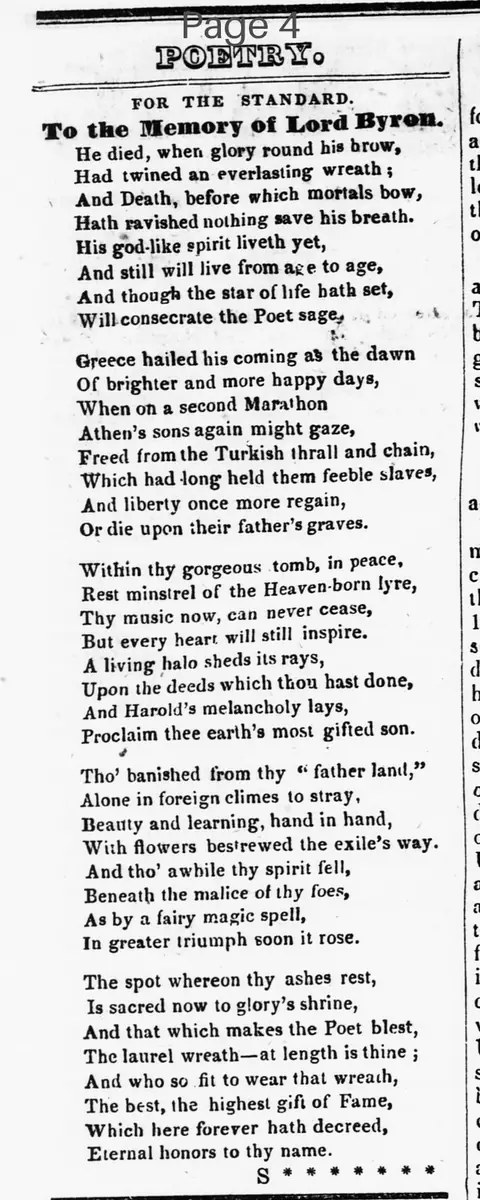
POETRY.
FOR THE STANDARD.
To the Memory of Lord Byron.
He died, when glory round his brow,
Had twined an everlasting wreath;
And Death, before which mortals bow,
Hath ravished nothing save his breath.
His god-like spirit liveth yet,
And still will live from age to age,
And though the star of life hath set,
Will consecrate the Poet sage.
Greece hailed his coming as the dawn
Of brighter and more happy days,
When on a second Marathon
Athen's sons again might gaze,
Freed from the Turkish thrall and chain,
Which had long held them feeble slaves,
And liberty once more regain,
Or die upon their father's graves.
Within thy gorgeous tomb, in peace,
Rest minstrel of the Heaven-born lyre,
Thy music now, can never cease,
But every heart will still inspire.
A living halo sheds its rays,
Upon the deeds which thou hast done,
And Harold's melancholy lays,
Proclaim thee earth's most gifted son.
Tho' banished from thy "father land,"
Alone in foreign climes to stray,
Beauty and learning, hand in hand,
With flowers bestrewed the exile's way.
And tho' awhile thy spirit fell,
Beneath the malice of thy foes,
As by a fairy magic spell,
In greater triumph soon it rose.
The spot whereon thy ashes rest,
Is sacred now to glory's shrine,
And that which makes the Poet blest,
The laurel wreath—at length is thine;
And who so fit to wear that wreath,
The best, the highest gift of Fame
Which here forever hath decreed,
Eternal honors to thy name.
FOR THE STANDARD.
To the Memory of Lord Byron.
He died, when glory round his brow,
Had twined an everlasting wreath;
And Death, before which mortals bow,
Hath ravished nothing save his breath.
His god-like spirit liveth yet,
And still will live from age to age,
And though the star of life hath set,
Will consecrate the Poet sage.
Greece hailed his coming as the dawn
Of brighter and more happy days,
When on a second Marathon
Athen's sons again might gaze,
Freed from the Turkish thrall and chain,
Which had long held them feeble slaves,
And liberty once more regain,
Or die upon their father's graves.
Within thy gorgeous tomb, in peace,
Rest minstrel of the Heaven-born lyre,
Thy music now, can never cease,
But every heart will still inspire.
A living halo sheds its rays,
Upon the deeds which thou hast done,
And Harold's melancholy lays,
Proclaim thee earth's most gifted son.
Tho' banished from thy "father land,"
Alone in foreign climes to stray,
Beauty and learning, hand in hand,
With flowers bestrewed the exile's way.
And tho' awhile thy spirit fell,
Beneath the malice of thy foes,
As by a fairy magic spell,
In greater triumph soon it rose.
The spot whereon thy ashes rest,
Is sacred now to glory's shrine,
And that which makes the Poet blest,
The laurel wreath—at length is thine;
And who so fit to wear that wreath,
The best, the highest gift of Fame
Which here forever hath decreed,
Eternal honors to thy name.
What sub-type of article is it?
Elegy
Ode
What themes does it cover?
Death Mourning
Liberty Independence
Patriotism
What keywords are associated?
Lord Byron
Elegy
Greek Liberty
Poetic Legacy
Exile
Marathon
Poem Details
Title
To The Memory Of Lord Byron.
Subject
Memory Of Lord Byron
Key Lines
He Died, When Glory Round His Brow,
Had Twined An Everlasting Wreath;
And Death, Before Which Mortals Bow,
Hath Ravished Nothing Save His Breath.
Greece Hailed His Coming As The Dawn
Of Brighter And More Happy Days,
When On A Second Marathon
Athen's Sons Again Might Gaze,