Thank you for visiting SNEWPapers!
Sign up free
The New Hampshire Gazette And General Advertiser
Portsmouth, Exeter, Rockingham County, New Hampshire
What is this article about?
Benjamin Thurston defends the charter of Philips Exeter Academy against a petition to tax its lands in Sandwich, NH. He argues that the legislature cannot revoke tax exemptions without violating civil rights and constitutional principles, drawing on natural rights, common law, and the American Revolution.
Merged-components note: This is a single letter to the editor continued across pages 1 and 2, as indicated by sequential reading order and flowing text content.
Clippings
1 of 2
OCR Quality
Full Text
Friends and Fellow-Citizens,
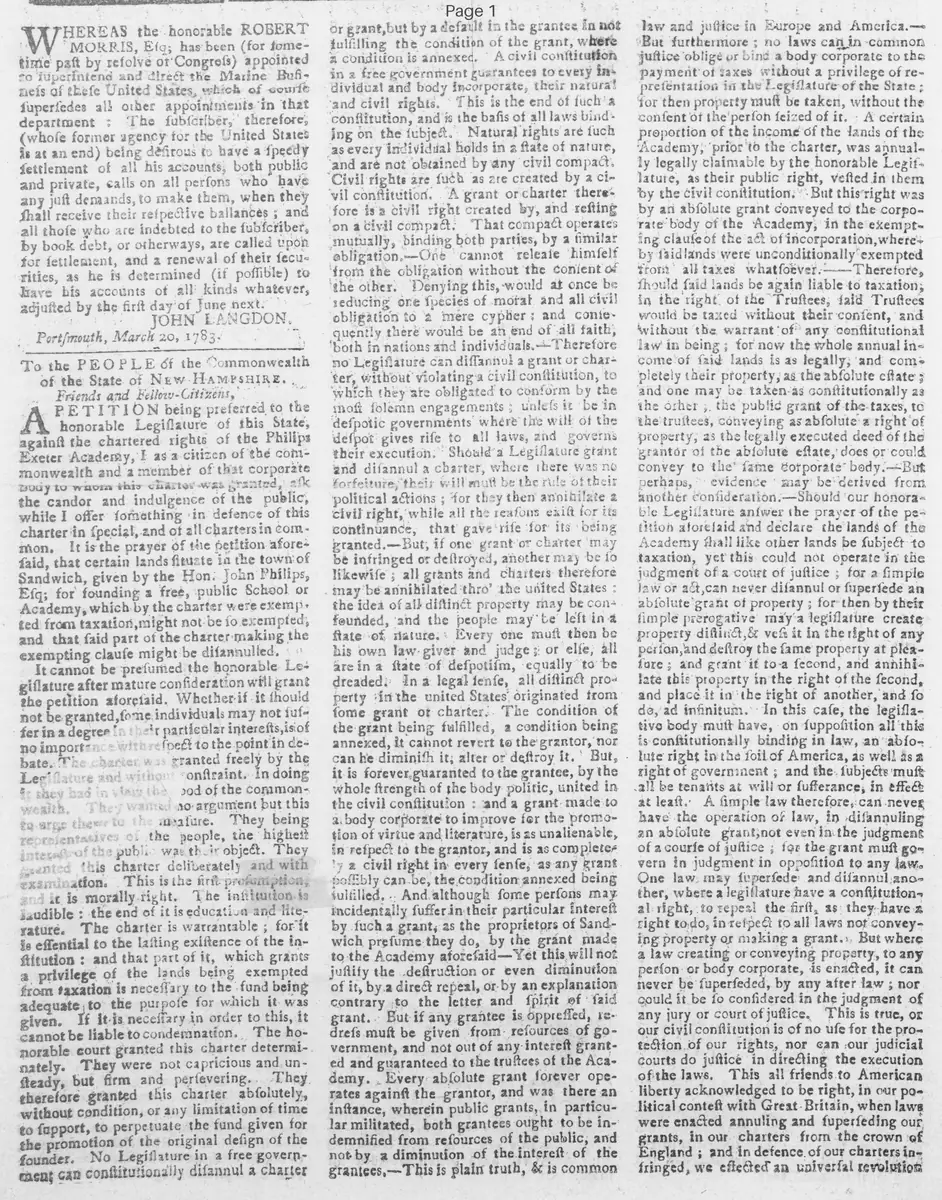
A PETITION being preferred to the honorable Legislature of this State, against the chartered rights of the Philips Exeter Academy. I as a citizen of the commonwealth and a member of that corporate Body to whom this charter was granted, ask the candor and indulgence of the public, while I offer something in defence of this charter in special, and of all charters in common. It is the prayer of the petition aforesaid, that certain lands situate in the town of Sandwich, given by the Hon: John Philips, Esq; for founding a free, public School or Academy, which by the charter were exempted from taxation, might not be so exempted; and that said part of the charter making the exempting clause might be disannulled. It cannot be presumed the honorable Legislature after mature consideration will grant the petition aforesaid. Whether, if it should not be granted, some individuals may not suffer in a degree in their particular interests, is of no importance with respect to the point in debate. The charter was granted freely by the Legislature and without constraint. In doing they had in view the good of the commonwealth. They wanted no argument but this to urge them to the measure. They being representatives of the people, the highest interest of the public was their object. They granted this charter deliberately and with examination. This is the first proposition, and it is morally right. The institution is laudable: the end of it is education and literature. The charter is warrantable: for it is essential to the lasting existence of the institution: and that part of it, which grants a privilege of the lands being exempted from taxation is necessary to the fund being adequate, to the purpose for which it was given. If it is necessary in order to this, it cannot be liable to condemnation. The honorable court granted this charter determinedly. They were not capricious and unsteady, but firm and persevering. They therefore granted this charter absolutely, without condition, or any limitation of time to support, to perpetuate the fund given for the promotion of the original design of the founder. No Legislature in a free government can constitutionally disannul a charter or grant, but by a default in the grantee in not fulfilling the condition of the grant, where a condition is annexed. A civil constitution in a free government guarantees to every individual and body incorporate, their natural and civil rights. This is the end of such a constitution, and is the basis of all laws binding on the subject. Natural rights are such as every individual holds in a state of nature, and are not obtained by any civil compact. Civil rights are such as are created by a civil constitution. A grant or charter therefore is a civil right created by, and resting on a civil compact: That compact operates mutually, binding both parties, by a similar obligation. One cannot release himself from the obligation without the consent of the other. Denying this, would at once be reducing one species of moral and all civil obligation to a mere cypher: and consequently there would be an end of all faith, both in nations and individuals. Therefore no Legislature can disannul a grant or charter, without violating a civil constitution, to which they are obligated to conform by the most solemn engagements: unless it be in despotic governments where the will of the despot gives rise to all laws, and governs their execution. Should a Legislature grant and disannul a charter, where there was no forfeiture, their will must be the rule of their political actions; for they then annihilate a civil right, while all the reasons exist for its continuance, that gave rise for its being granted. But, if one grant or charter may be infringed or destroyed, another may be so likewise: all grants and charters therefore may be annihilated thro' the united States: the idea of all distinct property may be confounded, and the people may be left in a state of nature. Every one must then be his own law giver and judge: or else, all are in a state of despotism, equally to be dreaded: In a legal sense, all distinct property in the united States originated from some grant or charter. The condition of the grant being fulfilled, a condition being annexed, it cannot revert to the grantor, nor can he diminish it; alter or destroy it. But, it is forever guaranteed to the grantee, by the whole strength of the body politic, united in the civil constitution: and a grant made to a body corporate to improve for the promotion of virtue and literature, is as unalienable, in respect to the grantor, and is as completely a civil right in every one, as any grant possibly can be, the condition annexed being fulfilled. And although some persons may incidentally suffer in their particular interest by such a grant; as the proprietors of Sandwich presume they do, by the grant made to the Academy aforesaid--Yet this will not justify the destruction or even diminution of it, by a direct repeal, or by an explanation contrary to the letter and spirit of said grant. But if any grantee is oppressed, redress must be given from resources of government, and not out of any interest granted and guaranteed to the trustees of the Academy. Every absolute grant forever operates against the grantor, and were there an instance, wherein public grants, in particular militated, both grantees ought to be indemnified from resources of the public; and not by a diminution of the interest of the grantees. This is plain truth, & is common law and justice in Europe and America.
But furthermore: no laws can in common justice oblige or bind a body corporate to the payment of taxes without a privilege of representation in the Legislature of the State; for then property must be taken, without the consent of the person seized of it. A certain proportion of the income of the lands of the Academy, prior to the charter, was annually legally claimable by the honorable Legislature, as their public right, vested in them by the civil constitution. But this right was by an absolute grant conveyed to the corporate body of the Academy, in the exempting clause of the act of incorporation, whereby said lands were unconditionally exempted from all taxes whatsoever. Therefore, should said lands be again liable to taxation: in the right of the Trustees, said Trustees would be taxed without their consent, and without the warrant of any constitutional law in being: for now the whole annual income of said lands is as legally, and completely their property, as the absolute estate is and one may be taken as constitutionally as the other. the public grant of the taxes, to the trustees, conveying as absolute a right of property, as the legally executed deed of the grantor of the absolute estate, does or could convey to the same corporate body. But perhaps, evidence may be derived from another consideration. Should our honorable Legislature answer the prayer of the petition aforesaid and declare the lands of the Academy shall like other lands be subject to taxation, yet this could not operate in the judgment of a court of justice; for a simple law or act, can never disannul or supersede an absolute grant of property; for then by their simple prerogative may a legislature create property distinct, & vest it in the right of any person, and destroy the same property at pleasure; and grant it to a second, and annihilate this property in the right of the second, and place it in the right of another, and so do, ad infinitum. In this case, the legislative body must have, on supposition all this is constitutionally binding in law, an absolute right in the soil of America, as well as a right of government: and the subjects must all be tenants at will or sufferance, in effect at least. A simple law therefore, can never have the operation of law, in disannulling an absolute grant, not even in the judgment of a court of justice; for the grant must govern in judgment in opposition to any law. One law, may supersede and disannul another, where a legislature have a constitutional right, to repeal the first, as they have a right to do, in respect to all laws not conveying property or making a grant. But where a law creating or conveying property, to any person or body corporate, is enacted, it can never be superseded, by any after law; nor could it be so considered in the judgment of any jury or court of justice. This is true, or our civil constitution is of no use for the protection of our rights, nor can our judicial courts do justice in directing the execution of the laws. This all friends to American liberty acknowledged to be right, in our political contest with Great-Britain, when laws were enacted annulling and superseding our grants, in our charters from the crown of England; and in defence of our charters infringed, we effected an universal revolution.
in the whole system of our governments.
I shall add no more, but shall leave the issue of the petition aforesaid, to the wisdom and justice of that honorable body, raised up to encourage the means of knowledge, and to protect the rights of a free people.
BENJAMIN THURSTON
Exeter, March 8, 1783.
What sub-type of article is it?
What themes does it cover?
What keywords are associated?
What entities or persons were involved?
Letter to Editor Details
Author
Benjamin Thurston
Recipient
To The People Of The Commonwealth Of The State Of New Hampshire
Main Argument
the legislature cannot constitutionally disannul the tax exemption in the philips exeter academy's charter, as it would violate civil rights, natural rights, and the principles established in the american revolution, ensuring the perpetuity of grants for public good like education.
Notable Details