Thank you for visiting SNEWPapers!
Sign up free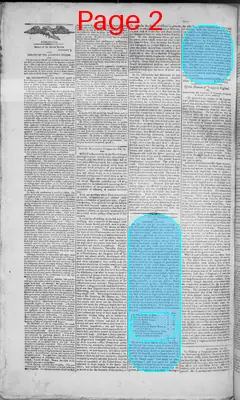
Editorial
March 8, 1802
Jenks's Portland Gazette
Portland, Cumberland County, Maine
What is this article about?
An anonymous farmer critiques Jefferson's administration for proposing repeal of internal taxes like the stamp act, whisky excise, and carriage tax, arguing it would burden farmers more through higher import duties on essentials like salt, tea, and sugar.
Merged-components note: The table details the tax calculations on goods consumed by a farmer, directly supporting and continuing the editorial's argument on the impact of tax repeals.
Clipping
OCR Quality
70%
Good
Full Text
From the Poughkeepsie Journal.
FARMERS ATTEND!
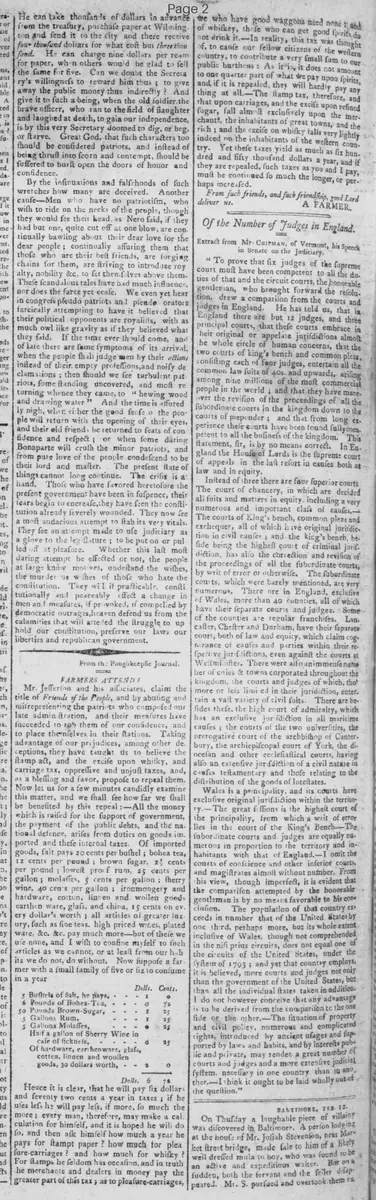
Mr. Jefferson and his associates, claim the title of Friends of the People, and by abusing and misrepresenting the patriots who composed our late administration, and their measures have succeeded to rob them of our confidence, and to place themselves in their stations. Taking advantage of our prejudices, among other deceptions, they have taught us to believe the stamp act, and the excise upon whisky, and carriage tax, oppressive and unjust taxes, and, as a blessing and favor, propose to repeal them.
Now let us for a few minutes candidly examine this matter, and we shall see how far we shall be benefited by this repeal:-All the money which is raised for the support of government, the payment of the public debts, and the national defence, arises from duties on goods imported and these internal taxes. Of imported goods, salt pays 20 cents per bushel; bohea tea, 12 cents per pound; brown sugar, 2½ cents per pound; lowest proof rum, 25 cents per gallon; molasses, 5 cents per gallon: sherry wine, 40 cents per gallon; ironmongery and hardware, cotton, linen and woolen goods earthen ware, glass, and china, 15 cents on every dollar's worth; all articles of greater luxury, such as fine teas, high priced wines, plated ware, &c. &c. pay much more-but of these we use none, and I wish to confine myself to such articles as we cannot, or at least from our habits we do not, do without. Now suppose a farmer with a small family of five or six to consume in a year
Hence it is clear, that he will pay six dollars and seventy two cents a year in taxes; if he uses less he will pay less, if more, so much the more; every man, therefore, may make a calculation for himself. and it is hoped he will do so, and then ask himself how much a year he pays for stamp paper? how much for pleasure-carriages? and how much for whisky? For stamps he seldom has occasion, and in truth the merchants and dealers in money pay the greater part of this tax; as to pleasure-carriages, we who have good wagons need none; and of whiskey, those who can get good spirits do not drink it.-In reality, this tax was thought of, to cause our fellow citizens of the western country, to contribute a very small sum to our public burdens: As it is, it does not amount to one quarter part of what we pay upon spirits, and if it is repealed, they will hardly pay anything at all.-The stamp tax, therefore, and that upon carriages, and the excise upon refined sugar, fall almost exclusively upon the merchants, the inhabitants of great towns, and the rich; and the excise on whisky falls very lightly indeed on the inhabitants of the western country. Yet these taxes yield as much as six hundred and fifty thousand dollars a year, and if they are repealed, such taxes as you and I pay, must be continued so much the longer, or perhaps increased.
From such friends, and such friendship, good Lord deliver us.
A FARMER.
FARMERS ATTEND!
Mr. Jefferson and his associates, claim the title of Friends of the People, and by abusing and misrepresenting the patriots who composed our late administration, and their measures have succeeded to rob them of our confidence, and to place themselves in their stations. Taking advantage of our prejudices, among other deceptions, they have taught us to believe the stamp act, and the excise upon whisky, and carriage tax, oppressive and unjust taxes, and, as a blessing and favor, propose to repeal them.
Now let us for a few minutes candidly examine this matter, and we shall see how far we shall be benefited by this repeal:-All the money which is raised for the support of government, the payment of the public debts, and the national defence, arises from duties on goods imported and these internal taxes. Of imported goods, salt pays 20 cents per bushel; bohea tea, 12 cents per pound; brown sugar, 2½ cents per pound; lowest proof rum, 25 cents per gallon; molasses, 5 cents per gallon: sherry wine, 40 cents per gallon; ironmongery and hardware, cotton, linen and woolen goods earthen ware, glass, and china, 15 cents on every dollar's worth; all articles of greater luxury, such as fine teas, high priced wines, plated ware, &c. &c. pay much more-but of these we use none, and I wish to confine myself to such articles as we cannot, or at least from our habits we do not, do without. Now suppose a farmer with a small family of five or six to consume in a year
| 5 | Bushels of Salt, he pays, - - - 1 | 0 |
| 6 | Pounds of Bohea-Tea, - - - 0 | 72 |
| 50 | Pounds Brown-Sugar, - - - 1 | 25 |
| 5 | Gallons Rum, - - - 1 | 25 |
| 5 | Gallons Molasses, - - - 0 | 25 |
| Half a gallon of Sherry Wine in case of sickness, - - - 0 | 20 | |
| Of hardware, earthenware, glass, cotton, linen and woollen goods, 30 dollars worth, - - 4 | 50 |
Hence it is clear, that he will pay six dollars and seventy two cents a year in taxes; if he uses less he will pay less, if more, so much the more; every man, therefore, may make a calculation for himself. and it is hoped he will do so, and then ask himself how much a year he pays for stamp paper? how much for pleasure-carriages? and how much for whisky? For stamps he seldom has occasion, and in truth the merchants and dealers in money pay the greater part of this tax; as to pleasure-carriages, we who have good wagons need none; and of whiskey, those who can get good spirits do not drink it.-In reality, this tax was thought of, to cause our fellow citizens of the western country, to contribute a very small sum to our public burdens: As it is, it does not amount to one quarter part of what we pay upon spirits, and if it is repealed, they will hardly pay anything at all.-The stamp tax, therefore, and that upon carriages, and the excise upon refined sugar, fall almost exclusively upon the merchants, the inhabitants of great towns, and the rich; and the excise on whisky falls very lightly indeed on the inhabitants of the western country. Yet these taxes yield as much as six hundred and fifty thousand dollars a year, and if they are repealed, such taxes as you and I pay, must be continued so much the longer, or perhaps increased.
From such friends, and such friendship, good Lord deliver us.
A FARMER.
What sub-type of article is it?
Taxation
Economic Policy
Partisan Politics
What keywords are associated?
Taxation
Jefferson Administration
Stamp Act
Whisky Excise
Carriage Tax
Import Duties
Farmers
What entities or persons were involved?
Mr. Jefferson And His Associates
Late Administration
Farmers
Merchants
Western Country Citizens
Editorial Details
Primary Topic
Critique Of Jefferson's Proposed Repeal Of Internal Taxes
Stance / Tone
Defensive Of Internal Taxes And Critical Of Jefferson Administration
Key Figures
Mr. Jefferson And His Associates
Late Administration
Farmers
Merchants
Western Country Citizens
Key Arguments
Jefferson's Group Misrepresents Patriots And Taxes To Gain Power
Repeal Of Stamp Act, Whisky Excise, And Carriage Tax Shifts Burden To Import Duties Paid By Farmers
Farmers Pay More In Import Taxes (E.G., Salt, Tea, Sugar, Rum) Than In Internal Taxes
Internal Taxes Mainly Affect Merchants, Rich, And Town Dwellers, Not Farmers
Repeal Would Prolong Or Increase Import Duties For Public Revenue