Thank you for visiting SNEWPapers!
Sign up free
The Newport Gazette
Newport, Newport County, Rhode Island
What is this article about?
In September 1777, British Lt. Gen. Burgoyne writes to American Maj. Gen. Gates from Hudson's River headquarters, arranging a surgeon and aid for wounded prisoners via Stillwater, and vehemently denying accusations of paying Indians for scalps. He explains Jane McCrea's death as an unintended act of passion among Indian allies, leading to the murderer's pardon to prevent future atrocities. Gates confirms the arrangement.
Clipping
OCR Quality
Full Text
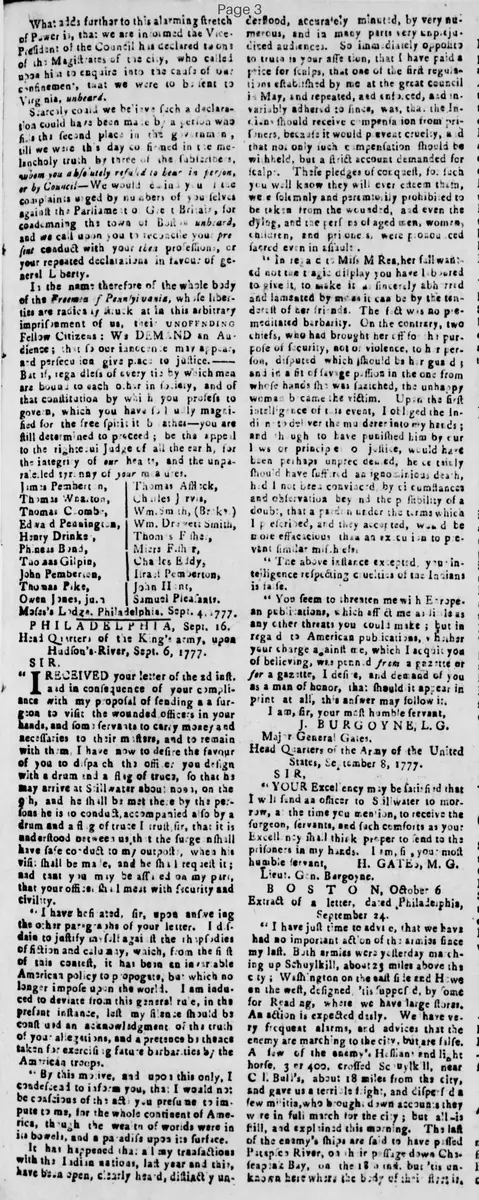
PHILADELPHIA, Sept. 16.
Head Quarters of the King's army, upon Hudson's River, Sept. 6, 1777.
SIR,
RECEIVED your letter of the 2d inst. I said in consequence of your compliance with my proposal of sending a surgeon to visit the wounded officers in your hands, and some servants to carry money and necessaries to their masters, and to remain with them, I have now to desire the favour of you to dispatch the officer you design with a drum and a flag of truce, so that he may arrive at Stillwater about noon, on the 8th, and he shall be met there by the persons he is to conduct, accompanied also by a drum and a flag of truce. I trust, sir, that it is understood between us that the surgeon shall have safe conduct to my outpost, when his visit shall be made, and he shall require it; and that you may be assured on my part, that your officer shall meet with Security and civility.
I have hesitated, sir, upon arriving at the other paragraph of your letter. I disdain to justify myself against the reproaches of faction and calumny, which, from the first of this contest, it has been an invariable American policy to propagate, but which no longer impose upon the world. I am induced to deviate from this general rule, in the present instance, lest my silence should be construed an acknowledgment of the truth of your allegations, and a pretence be thence taken for exercising future barbarities by the American troops.
By this motive, and upon this only, I condescend to inform you, that I would not be conscious of the act you presume to impute to me, for the whole continent of America, though the wealth of worlds were in its bowels, and a paradise upon its surface. It has happened that all my transactions with the Indian nations, last year and this, have been open, clearly heard, distinctly understood, accurately minuted, by very numerous, and in many parts very unprejudiced audiences. So immediately opposite to truth is your assertion, that I have paid a price for scalps, that one of the first regulations established by me at the great council in May, and repeated, and enforced, and invariably adhered to since, was, that the Indians should receive no compensation from private persons, because it would prevent cruelty, and that not only such compensation should be withheld, but a strict account demanded for every scalp. These pledges of conquest, for such you well know they will ever esteem them, were solemnly and peremptorily prohibited to be taken from the wounded, and even the dying, and the remains of aged men, women, children, and prisoners, were pronounced sacred even in battle.
In respect to Miss McRea's fate I want words to display you have laboured to give it, to make it an incidently abhorred and lamented by me as it can be by the tendere st of her friends. The fact was no premeditated barbarity. On the contrary, two chiefs, who had brought her off for the purpose of security, not of violence, to her person, disputed which should be her guard; and in a fit of savage passion in the one from whose hands she was snatched, the unhappy woman became the victim. Upon the first intelligence of this event, I obliged the Indians to deliver the murderer into my hands; and though to have punished him by our principles of justice, would have been perhaps unprecedented, he certainly should have suffered an ignominious death, had I not been convinced, by circumstances and observation beyond the possibility of a doubt, that a pardon under the terms which I prescribed, and they accepted, would be more efficacious than an execution to prevent similar mischiefs.
The above instance excepted. your intelligence repeating cruelties of the Indians is in fact.
You seem to threaten me with Europe. an public publications, which affect me as little as any other threats you could make; but in regard to American publications, whatever your charge against me, which I acquit you of believing, was penned from a gazette or for a gazette, I deny, and demand of you as a man of honor, that should it appear in print at all, this answer may follow it.
I am, sir, your most humble servant,
J. BURGOYNE, L.G.
Maj r General Gates.
Head Quarters of the Army of the United States, September 8, 1777.
SIR,
YOUR Excellency may be assured that I will send an officer to Stillwater tomorrow, at the time you mention, to receive the surgeon, servants, and such comforts as your Excellency shall think proper to send to the prisoners in my hands. I am, sir, your most humble servant,
H. GATES, M. G.
Lieut. Gen. Burgoyne.
What sub-type of article is it?
What themes does it cover?
What keywords are associated?
What entities or persons were involved?
Where did it happen?
Story Details
Key Persons
Location
Hudson's River, Stillwater
Event Date
September 1777
Story Details
Burgoyne arranges for a surgeon and servants to aid British prisoners held by Americans, refutes Gates' accusations of paying Indians for scalps, and explains Jane McCrea's death as an accidental act of passion among Indian allies, resulting in the murderer's conditional pardon to deter future violence. Gates confirms the aid exchange.