Thank you for visiting SNEWPapers!
Sign up free
Letter to Editor
October 6, 1774
The Massachusetts Spy, Or, Thomas's Boston Journal
Boston, Suffolk County, Massachusetts
What is this article about?
Anonymous letter to Massachusetts Spy editor Thomas criticizes a proposed colonial poll tax tied to Britain's land tax, warning of its exponential growth with population and urging colonists to reject it as exploitative.
Clipping
OCR Quality
95%
Excellent
Full Text
For the MASSACHUSETTS SPY.
Mr. Thomas,
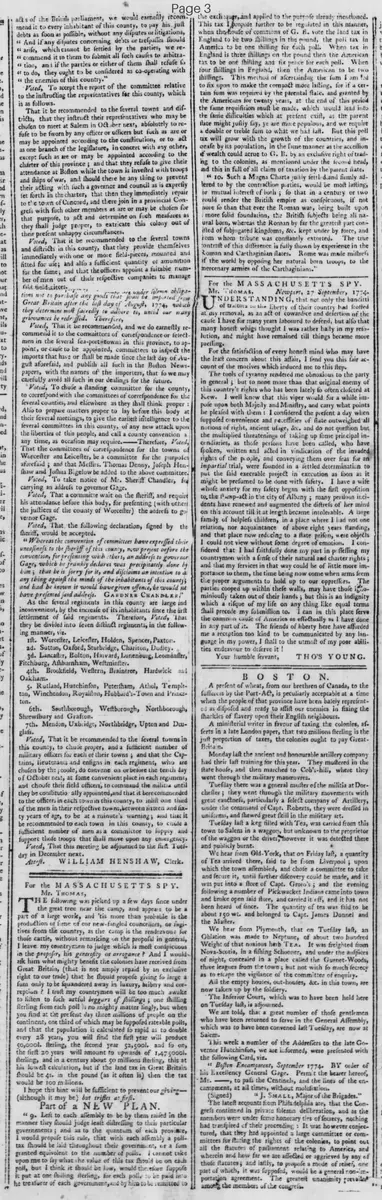
THE following was picked up a few days since under the great tree near the camp, and appears to be a part of a large work, and 'tis more than probable is the production of some of our new-fangled counsellors, or fugitives from the country, as the camp is the rendezvous for those cattle, without remarking on the proposal in general, I leave my countrymen to judge which is most conspicuous in the proposer, his generosity or arrogance? And I would ask him what mighty benefit the colonies have received from Great Britain, (that is not amply repaid by an exclusive right to our trade) that he should propose giving so large a sum only to be squandered away in luxury, bribery and corruption? I trust my countrymen will be too much awake to listen to such artful beggars of billings; one shilling sterling from each poll is no mighty matter singly, but when you find at the present day three millions of people on the continent, one third of which may be supposed rateable polls, and that the population is calculated so rapid as to double every 28 years, you will find the first year will produce 50,000l. sterling, the second year 52,500l. and so on, the first 20 years will amount to upwards of 1,475,000l. sterling, and in a century about 50 millions sterling, this at his lowest calculation, but if the land tax in Great Britain should be 4s. in the pound (as it often is) then the tax would be 100 millions.
I hope this hint will be sufficient to prevent our giving (although it may be) but trifles at first.
Part of a NEW PLAN
"g. Left to each assembly to be by them raised in the manner they should judge least distressing to their particular governments; and as to the quantum of each province. I would propose this rule, that with each assembly a poll-tax should be laid throughout their government, or a sum granted equivalent to the number of polls. I cannot take upon me to say what the value of this tax should be on each poll, but I think it should be low, would therefore suppose it put at one shilling sterling, for each poll, to be paid into the treasurer of each government, and by him to be remitted to the exchequer, and applied to the purpose already mentioned. This tax I propose further to be regulated in this manner, when the house of commons of G. B. vote the land tax in England to be two shillings in the pound, the poll tax in America to be one shilling for each poll. When tax in England is three shillings on the pound then the American tax to be one shilling and six pence for each poll. When four Shillings in England, then the American to be two shillings. This method of ascertaining the sum I am led to fix upon to make the compact more lasting, for if a certain sum was required by the parental state, and granted by the Americans for twenty years, at the end of this period the same requisition must be made, which would lead into the same difficulties which at present exist, as the parent state might justly say, ye are more populous, and we require a double or treble sum to what we had last. But this poll tax will grow with the growth of the countries, and increase by its population, in the same manner as the accession of wealth could accrue to G. B. by an exclusive right of trading to the colonies, as mentioned under the second head, and this in full of all claim of taxation by the parent state.
"10. Such a Magna Charta justly settled, and firmly adhered to by the contracting parties, would be most lasting by mutual interest of both; so that in a century or two would render the British empire as conspicuous, if not more so than that ever the Roman was, being built upon more solid foundation, the British subjects being all natural born, whereas the Roman by far the greatest part consisted of subjugated kingdoms, &c. kept under by force, and from whom tribute was constantly extorted. The true contrast of this difference is fully shown by experience in the Roman and Carthaginian states. Rome was made mistress of the world by opposing her natural born troops, to the mercenary armies of the Carthaginians."
Mr. Thomas,
THE following was picked up a few days since under the great tree near the camp, and appears to be a part of a large work, and 'tis more than probable is the production of some of our new-fangled counsellors, or fugitives from the country, as the camp is the rendezvous for those cattle, without remarking on the proposal in general, I leave my countrymen to judge which is most conspicuous in the proposer, his generosity or arrogance? And I would ask him what mighty benefit the colonies have received from Great Britain, (that is not amply repaid by an exclusive right to our trade) that he should propose giving so large a sum only to be squandered away in luxury, bribery and corruption? I trust my countrymen will be too much awake to listen to such artful beggars of billings; one shilling sterling from each poll is no mighty matter singly, but when you find at the present day three millions of people on the continent, one third of which may be supposed rateable polls, and that the population is calculated so rapid as to double every 28 years, you will find the first year will produce 50,000l. sterling, the second year 52,500l. and so on, the first 20 years will amount to upwards of 1,475,000l. sterling, and in a century about 50 millions sterling, this at his lowest calculation, but if the land tax in Great Britain should be 4s. in the pound (as it often is) then the tax would be 100 millions.
I hope this hint will be sufficient to prevent our giving (although it may be) but trifles at first.
Part of a NEW PLAN
"g. Left to each assembly to be by them raised in the manner they should judge least distressing to their particular governments; and as to the quantum of each province. I would propose this rule, that with each assembly a poll-tax should be laid throughout their government, or a sum granted equivalent to the number of polls. I cannot take upon me to say what the value of this tax should be on each poll, but I think it should be low, would therefore suppose it put at one shilling sterling, for each poll, to be paid into the treasurer of each government, and by him to be remitted to the exchequer, and applied to the purpose already mentioned. This tax I propose further to be regulated in this manner, when the house of commons of G. B. vote the land tax in England to be two shillings in the pound, the poll tax in America to be one shilling for each poll. When tax in England is three shillings on the pound then the American tax to be one shilling and six pence for each poll. When four Shillings in England, then the American to be two shillings. This method of ascertaining the sum I am led to fix upon to make the compact more lasting, for if a certain sum was required by the parental state, and granted by the Americans for twenty years, at the end of this period the same requisition must be made, which would lead into the same difficulties which at present exist, as the parent state might justly say, ye are more populous, and we require a double or treble sum to what we had last. But this poll tax will grow with the growth of the countries, and increase by its population, in the same manner as the accession of wealth could accrue to G. B. by an exclusive right of trading to the colonies, as mentioned under the second head, and this in full of all claim of taxation by the parent state.
"10. Such a Magna Charta justly settled, and firmly adhered to by the contracting parties, would be most lasting by mutual interest of both; so that in a century or two would render the British empire as conspicuous, if not more so than that ever the Roman was, being built upon more solid foundation, the British subjects being all natural born, whereas the Roman by far the greatest part consisted of subjugated kingdoms, &c. kept under by force, and from whom tribute was constantly extorted. The true contrast of this difference is fully shown by experience in the Roman and Carthaginian states. Rome was made mistress of the world by opposing her natural born troops, to the mercenary armies of the Carthaginians."
What sub-type of article is it?
Persuasive
Political
What themes does it cover?
Taxation
Economic Policy
Constitutional Rights
What keywords are associated?
Poll Tax
American Colonies
British Taxation
Population Growth
Magna Carta
Roman Empire
What entities or persons were involved?
Mr. Thomas
Letter to Editor Details
Recipient
Mr. Thomas
Main Argument
the letter criticizes a proposed poll tax on american colonies, proportional to britain's land tax, arguing it would generate enormous sums over time due to population growth and should be rejected as it benefits britain unduly without true reciprocity.
Notable Details
Picked Up Under A Tree Near The Camp
References Population Doubling Every 28 Years
Quotes 'Part Of A New Plan' Proposing Poll Tax Structure
Compares To Magna Charta And Roman Empire