Thank you for visiting SNEWPapers!
Sign up free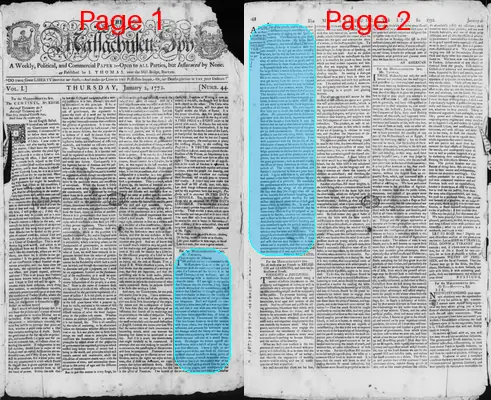
The Massachusetts Spy
Boston, Suffolk County, Massachusetts
What is this article about?
A letter to the Massachusetts Spy editor doubting 'Chronus''s account of a conversation with a western farmer, defending press liberty against restraint, asserting real colonial grievances, and criticizing Chronus's moral views and censure of the clergy.
Merged-components note: Continuation of the same letter to the editor across pages, sequential reading order.
Clippings
1 of 2
OCR Quality
Full Text
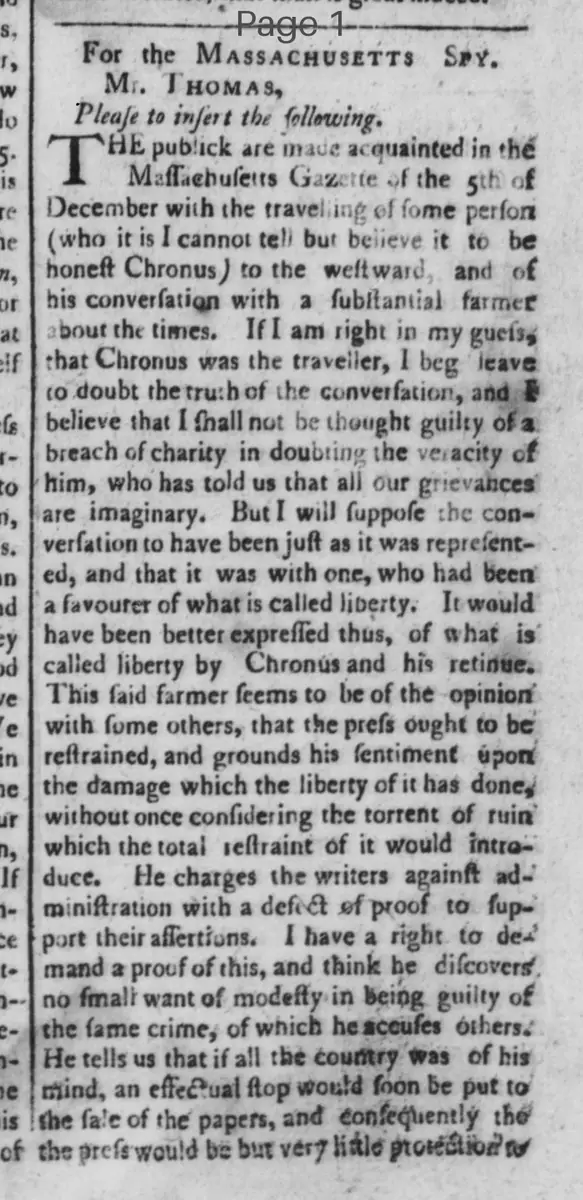
Mr. THOMAS,
Please to insert the following.
The public in the December with the traveling of some person (who it is I cannot tell but believe it to be honest Chronus) to the westward, and of his conversation with a substantial farmer about the times. If I am right in my guess that Chronus was the traveler, I beg leave to doubt the truth of the conversation, and I believe that I shall not be thought guilty of a breach of charity in doubting the veracity of him, who has told us that all our grievances are imaginary. But I will suppose the conversation to have been just as it was represented, and that it was with one, who had been a favorer of what is called liberty. It would have been better expressed thus, of what is called liberty by Chronus and his retinue. This said farmer seems to be of the opinion with some others, that the press ought to be restrained, and grounds his sentiment upon the damage which the liberty of it has done, without once considering the torrent of ruin which the total restraint of it would introduce. He charges the writers against administration with a defect of proof to support their assertions. I have a right to demand a proof of this, and think he discovers no small want of modesty in being guilty of the same crime, of which he accuses others. He tells us that if all the country was of his mind, an effectual stop would soon be put to the sale of the papers, and consequently the press would be but very little troublesome to public offices of the people, and he among many substantial rogues would have a glorious opportunity of rioting on the spoils of premiums for a hundred prisoners of this farmer. He is no small country. This leads me to give some notice of this country, so far as it coincides with his. The love of money, that root of all evil; he loves that above his own interest; he will get an estate honestly if he can, but he will be sure to obtain it; it is an invariable maxim with him to love and to put to pursue. He is an invariable maxim with him to love and obey all rulers (bad as well as good) and to urge obedience to them from every one, and to stigmatize those who cry aloud when they see large strides towards despotism, and consequently view liberty tottering from its basis. He is no enemy to idleness, if he can in any way get money from the people to support him in it; and from hence he may be looked upon as one of that number, whom Philanthrop formerly called the better sort of people. The traveller tells us during the rest of his journey he discovered the same temper in general, in every town as far as he went: But did not meet again with the frank ingenuous confession of the farmer. His own expression leads me to doubt the truth of what he asserts. He acknowledges that he did not again meet with the frank, ingenuous confession of the farmer; from hence it may be inferred that he had at that time an admirable faculty of determining the temper of the people by their countenances. His mode of expression is not the only thing which induces me to doubt the truth of what he says. I am well acquainted with the sentiments of the inhabitants of many of the towns in the western part of this province, and from this knowledge undertake to declare that the people in general in that part of the province are of opinion, that the whole continent labour under great grievances; such as are well worthy the efforts of every American to obtain the redress of. The crime of detraction and slander is represented by him as a great moral evil. I agree with him in it, and wish he had painted in the same lively colours the enormous guilt of a parricide. He concludes his performance with a censure upon that venerable body the clergy of this province. He says that they (the clergy) often tell us of the horrible sins of Sabbath-breaking, non-attendance upon publick worship &c. and wishes they would oftener tell us of such gross immoralities as calumny, &c. It needs no great share of sagacity to determine that he views every effort to stop the progress of tyrants to be slander, calumny and detraction, and in short to be the most gross immorality: And, that he looks upon Sabbath-breaking and non-attendance upon the publick worship as sins that need but a very slight repentance, which a very few tears will wash away. The clergy I do not doubt esteem his censure praise. Instead of the papers having no sale, I hope and wish that ten may be taken in a town where one is at present, and that every other encouragement may be given to the press, and that the liberty of it may end with time.
PHILO VERITATIS.
What sub-type of article is it?
What themes does it cover?
What keywords are associated?
What entities or persons were involved?
Letter to Editor Details
Author
Philo Veritatis
Recipient
Mr. Thomas
Main Argument
the letter doubts the accuracy of chronus's reported conversation with a farmer, defends the liberty of the press as essential against tyranny, asserts that colonial grievances are real and widespread, and criticizes chronus's views on morality and the clergy.
Notable Details