Thank you for visiting SNEWPapers!
Sign up free
Workmen's Advocate
New Haven, New Haven County, Connecticut
What is this article about?
Report from Pittsburg Bethel Association notes shift from tramps to workingmen seeking aid due to unemployment caused by labor-saving machinery, displacing 1,250 men in mills. Mr. McMahon links this to social issues; commentary critiques Andrew Carnegie's prosperity amid worker distress in Pittsburg.
Clipping
OCR Quality
Full Text
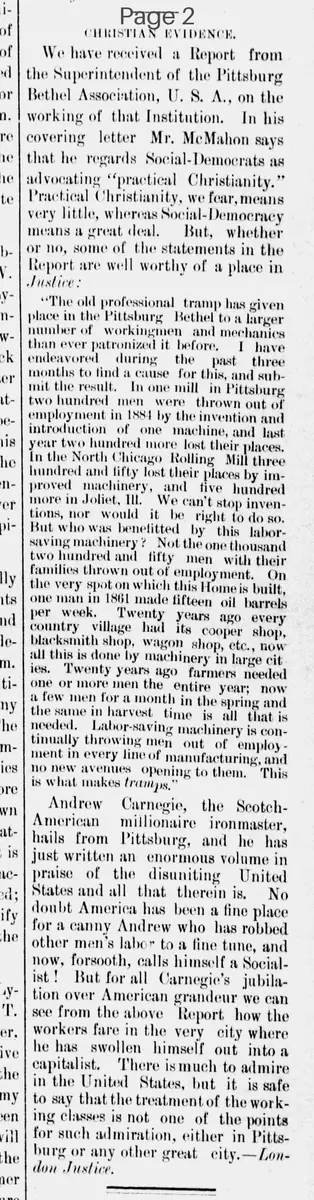
We have received a Report from
the Superintendent of the Pittsburg
Bethel Association, U. S. A., on the
working of that Institution. In his
covering letter Mr. McMahon says
that he regards Social-Democrats as
advocating "practical Christianity."
Practical Christianity, we fear, means
very little, whereas Social-Democracy
means a great deal. But, whether
or no, some of the statements in the
Report are well worthy of a place in
Justice:
"The old professional tramp has given
place in the Pittsburg Bethel to a larger
number of workingmen and mechanics
than ever patronized it before. I have
endeavored during the past three
months to find a cause for this, and sub-
mit the result. In one mill in Pittsburg
two hundred men were thrown out of
employment in 1884 by the invention and
introduction of one machine, and last
year two hundred more lost their places.
In the North Chicago Rolling Mill three
hundred and fifty lost their places by im-
proved machinery, and five hundred
more in Joliet, Ill. We can't stop inven-
tions, nor would it be right to do so.
But who was benefited by this labor-
saving machinery? Not the one thousand
two hundred and fifty men with their
families thrown out of employment. On
the very spot on which this Home is built,
one man in 1861 made fifteen oil barrels
per week. Twenty years ago every
country village had its cooper shop,
blacksmith shop, wagon shop, etc., now
all this is done by machinery in large cit-
ies. Twenty years ago farmers needed
one or more men the entire year; now
a few men for a month in the spring and
the same in harvest time is all that is
needed. Labor-saving machinery is con-
tinually throwing men out of employ.
ment in every line of manufacturing, and
no new avenues opening to them. "This
is what makes tramps.
Andrew Carnegie, the Scotch-
American millionaire ironmaster.
hails from Pittsburg, and he has
just written an enormous volume in
praise of the disuniting United
States and all that therein is. No
doubt America has been a fine place
for a canny Andrew who has robbed
other men's labor to a fine tune, and
now, forsooth, calls himself a Social-
ist! But for all Carnegie's jubila-
tion over American grandeur we can
see from the above Report how the
workers fare in the very city where
he has swollen himself out into a
capitalist. There is much to admire
in the United States, but it is safe
to say that the treatment of the work-
ing classes is not one of the points
for such admiration, either in Pitts-
burg or any other great city.—London
Justice.
What sub-type of article is it?
What keywords are associated?
What entities or persons were involved?
Where did it happen?
Domestic News Details
Primary Location
Pittsburg
Key Persons
Outcome
two hundred men thrown out of employment in 1884 by one machine in a pittsburg mill, two hundred more last year; three hundred and fifty in north chicago rolling mill; five hundred in joliet, ill.; total one thousand two hundred and fifty men with families out of employment.
Event Details
Report from Superintendent of Pittsburg Bethel Association on increased patronage by workingmen and mechanics due to unemployment from labor-saving machinery in mills and manufacturing; historical examples of job displacement in cooper shops, blacksmith shops, farming; links to rise in tramps; commentary on Social-Democracy and criticism of Andrew Carnegie's views on America.