Thank you for visiting SNEWPapers!
Sign up free
Story
March 24, 1939
The Midland Journal
Rising Sun, Cecil County, Maryland
What is this article about?
An informative article explains the biology of sponges, their life cycle, historical scientific misconceptions, and varieties including fascinating glass sponges found in eastern waters.
Clipping
OCR Quality
98%
Excellent
Full Text
There's More to Sponge
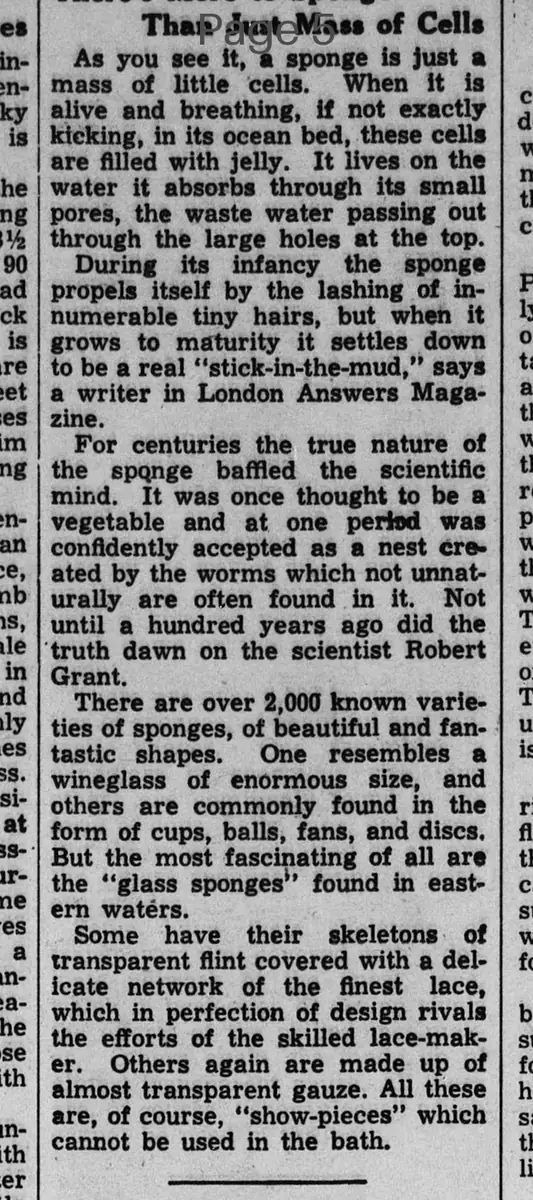
As you see it, a sponge is just a mass of little cells. When it is alive and breathing, if not exactly kicking, in its ocean bed, these cells are filled with jelly. It lives on the water it absorbs through its small pores, the waste water passing out through the large holes at the top.
During its infancy the sponge propels itself by the lashing of innumerable tiny hairs, but when it grows to maturity it settles down to be a real "stick-in-the-mud," says a writer in London Answers Magazine.
For centuries the true nature of the sponge baffled the scientific mind. It was once thought to be a vegetable and at one period was confidently accepted as a nest created by the worms which not unnaturally are often found in it. Not until a hundred years ago did the truth dawn on the scientist Robert Grant.
There are over 2,000 known varieties of sponges, of beautiful and fantastic shapes. One resembles a wineglass of enormous size, and others are commonly found in the form of cups, balls, fans, and discs. But the most fascinating of all are the "glass sponges" found in eastern waters.
Some have their skeletons of transparent flint covered with a delicate network of the finest lace, which in perfection of design rivals the efforts of the skilled lace-maker. Others again are made up of almost transparent gauze. All these are, of course, "show-pieces" which cannot be used in the bath.
As you see it, a sponge is just a mass of little cells. When it is alive and breathing, if not exactly kicking, in its ocean bed, these cells are filled with jelly. It lives on the water it absorbs through its small pores, the waste water passing out through the large holes at the top.
During its infancy the sponge propels itself by the lashing of innumerable tiny hairs, but when it grows to maturity it settles down to be a real "stick-in-the-mud," says a writer in London Answers Magazine.
For centuries the true nature of the sponge baffled the scientific mind. It was once thought to be a vegetable and at one period was confidently accepted as a nest created by the worms which not unnaturally are often found in it. Not until a hundred years ago did the truth dawn on the scientist Robert Grant.
There are over 2,000 known varieties of sponges, of beautiful and fantastic shapes. One resembles a wineglass of enormous size, and others are commonly found in the form of cups, balls, fans, and discs. But the most fascinating of all are the "glass sponges" found in eastern waters.
Some have their skeletons of transparent flint covered with a delicate network of the finest lace, which in perfection of design rivals the efforts of the skilled lace-maker. Others again are made up of almost transparent gauze. All these are, of course, "show-pieces" which cannot be used in the bath.
What sub-type of article is it?
Curiosity
What themes does it cover?
Nature
What keywords are associated?
Sponge Biology
Scientific Discovery
Glass Sponges
Robert Grant
Ocean Creatures
What entities or persons were involved?
Robert Grant
Where did it happen?
Ocean Bed, Eastern Waters
Story Details
Key Persons
Robert Grant
Location
Ocean Bed, Eastern Waters
Event Date
A Hundred Years Ago
Story Details
Sponges are described as cellular organisms living in the ocean, absorbing water for sustenance; historically mistaken for vegetables or worm nests until Robert Grant's discovery; over 2,000 varieties exist, with glass sponges being the most fascinating due to their delicate, transparent structures.