Thank you for visiting SNEWPapers!
Sign up free
Story
June 25, 1881
Sacramento Daily Record Union
Sacramento, Sacramento County, California
What is this article about?
The Record-Union announces an unexpected comet visible from the Pacific coast, possibly Swift's discovered May 1 or Encke's, influenced by planetary conjunctions. Theories include deflection or acceleration, with speculations on dangers like solar disruption from similar comets.
Clipping
OCR Quality
98%
Excellent
Full Text
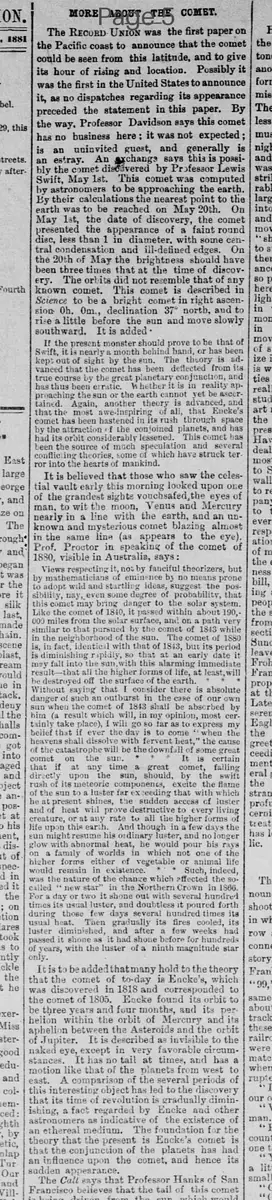
The Record-Union was the first paper on the Pacific coast to announce that the comet could be seen from this latitude, and to give its hour of rising and location. Possibly it was the first in the United States to announce it, as no dispatches regarding its appearance preceded the statement in this paper.
By the way, Professor Davidson says this comet has no business here; it was not expected: is an uninvited guest, and generally is an estray. An exchange says this is possibly the comet discovered by Professor Lewis Swift, May 1st. This comet was computed by astronomers to be approaching the earth. By their calculations the nearest point to the earth was to be reached on May 20th. On May 1st, the date of discovery, the comet presented the appearance of a faint round disc, less than 1° in diameter, with some central condensation and ill-defined edges. On the 20th of May the brightness should have been three times that at the time of discovery. The orbits did not resemble that of any known comet.
This comet is described in Science to be a bright comet in right ascension 0h. 0m., declination 37° north, and to rise a little before the sun and move slowly southward. It is added: If the present monster should prove to be that of Swift, it is nearly a month behind hand, or has been kept out of sight by the sun. The theory is advanced that the comet has been deflected from its true course by the great planetary conjunction, and has thus been erratic. Whether it is in reality approaching the sun or the earth cannot yet be ascertained.
Again, another theory is advanced, and that the most awe-inspiring of all, that Encke's comet has been hastened in its rush through space by the attraction of the conjoined planets, and has had its orbit considerably lessened. This comet has been the source of much speculation and several conflicting theories, some of which have struck terror into the hearts of mankind.
It is believed that those who saw the celestial vault early this morning looked upon one of the grandest sights vouchsafed the eyes of man, to wit the moon, Venus and Mercury nearly in a line with the earth, and an unknown and mysterious comet blazing almost in the same line (as appears to the eye).
Prof. Proctor in speaking of the comet of 1880, visible in Australia, says: Views respecting it, not by fanciful theorizers, but by mathematicians of eminence by no means prone to adopt wild and startling ideas, suggest the possibility, nay, even some degree of probability, that this comet may bring danger to the solar system. Like the comet of 1810, it passed within about 190,000 miles from the solar surface, and on a path very similar to that pursued by the comet of 1843 while in the neighborhood of the sun. The comet of 1880 is, in fact, identical with that of 1843, but its period is diminishing rapidly, so that at an early date it may fall into the sun, with this alarming immediate result—that all the higher forms of life, at least, will be destroyed off the surface of the earth.
Without saying that I consider there is absolute danger of such an outburst in the case of our own sun when the comet of 1843 shall be absorbed by him (a result which will, in my opinion, most certainly take place), I will go so far as to express my belief that if ever the day is to come when the heavens shall dissolve with fervent heat," the cause of the catastrophe will be the downfall of some great comet on the sun. It is certain that if at any time a great comet, falling directly upon the sun, should, by the swift rush of its meteoric components, excite the flame of the sun to a luster far exceeding that with which he at present shines, the sudden access of luster and of heat will prove destructive to every living creature, or at any rate to all the higher forms of life upon this earth. And though in a few days the sun might resume his ordinary luster, and no longer glow with abnormal heat, he would pour his rays on a family of worlds in which not one of the higher forms either of vegetable or animal life would remain in existence.
Such, indeed, was the nature of the change which affected the so-called "new star" in the Northern Crown in 1866. For a day or two it shone out with several hundred times its usual luster, and doubtless it poured forth during those few days several hundred times its usual heat. Then gradually its fires cooled, its luster diminished, and after a few weeks had passed it shone as it had shone before for hundreds of years, with the luster of a ninth magnitude star only.
It is to be added that many hold to the theory that the comet of to-day is Encke's, which was discovered in 1818 and corresponded to the comet of 1805. Encke found its orbit to be three years and four months, and its perihelion within the orbit of Mercury and its aphelion between the Asteroids and the orbit of Jupiter. It is described as invisible to the naked eye, except in very favorable circumstances. It has no tail at times, and has a motion like that of the planets from west to east. A comparison of the several periods of this interesting object has led to the discovery that its time of revolution is gradually diminishing, a fact regarded by Encke and other astronomers as indicative of the existence of an ethereal medium.
The foundation for the theory that the present is Encke's comet is that the conjunction of the planets has had an influence upon the comet, and hence its sudden appearance. The Call says that Professor Hanks of San Francisco believes that the tail of this comet is being driven from the sun, which would seem to point to the fact that the comet had made its nearest approach to the sun, and was now speeding away. This, however, is but a rough conjecture, unassisted by accurate observation.
By the way, Professor Davidson says this comet has no business here; it was not expected: is an uninvited guest, and generally is an estray. An exchange says this is possibly the comet discovered by Professor Lewis Swift, May 1st. This comet was computed by astronomers to be approaching the earth. By their calculations the nearest point to the earth was to be reached on May 20th. On May 1st, the date of discovery, the comet presented the appearance of a faint round disc, less than 1° in diameter, with some central condensation and ill-defined edges. On the 20th of May the brightness should have been three times that at the time of discovery. The orbits did not resemble that of any known comet.
This comet is described in Science to be a bright comet in right ascension 0h. 0m., declination 37° north, and to rise a little before the sun and move slowly southward. It is added: If the present monster should prove to be that of Swift, it is nearly a month behind hand, or has been kept out of sight by the sun. The theory is advanced that the comet has been deflected from its true course by the great planetary conjunction, and has thus been erratic. Whether it is in reality approaching the sun or the earth cannot yet be ascertained.
Again, another theory is advanced, and that the most awe-inspiring of all, that Encke's comet has been hastened in its rush through space by the attraction of the conjoined planets, and has had its orbit considerably lessened. This comet has been the source of much speculation and several conflicting theories, some of which have struck terror into the hearts of mankind.
It is believed that those who saw the celestial vault early this morning looked upon one of the grandest sights vouchsafed the eyes of man, to wit the moon, Venus and Mercury nearly in a line with the earth, and an unknown and mysterious comet blazing almost in the same line (as appears to the eye).
Prof. Proctor in speaking of the comet of 1880, visible in Australia, says: Views respecting it, not by fanciful theorizers, but by mathematicians of eminence by no means prone to adopt wild and startling ideas, suggest the possibility, nay, even some degree of probability, that this comet may bring danger to the solar system. Like the comet of 1810, it passed within about 190,000 miles from the solar surface, and on a path very similar to that pursued by the comet of 1843 while in the neighborhood of the sun. The comet of 1880 is, in fact, identical with that of 1843, but its period is diminishing rapidly, so that at an early date it may fall into the sun, with this alarming immediate result—that all the higher forms of life, at least, will be destroyed off the surface of the earth.
Without saying that I consider there is absolute danger of such an outburst in the case of our own sun when the comet of 1843 shall be absorbed by him (a result which will, in my opinion, most certainly take place), I will go so far as to express my belief that if ever the day is to come when the heavens shall dissolve with fervent heat," the cause of the catastrophe will be the downfall of some great comet on the sun. It is certain that if at any time a great comet, falling directly upon the sun, should, by the swift rush of its meteoric components, excite the flame of the sun to a luster far exceeding that with which he at present shines, the sudden access of luster and of heat will prove destructive to every living creature, or at any rate to all the higher forms of life upon this earth. And though in a few days the sun might resume his ordinary luster, and no longer glow with abnormal heat, he would pour his rays on a family of worlds in which not one of the higher forms either of vegetable or animal life would remain in existence.
Such, indeed, was the nature of the change which affected the so-called "new star" in the Northern Crown in 1866. For a day or two it shone out with several hundred times its usual luster, and doubtless it poured forth during those few days several hundred times its usual heat. Then gradually its fires cooled, its luster diminished, and after a few weeks had passed it shone as it had shone before for hundreds of years, with the luster of a ninth magnitude star only.
It is to be added that many hold to the theory that the comet of to-day is Encke's, which was discovered in 1818 and corresponded to the comet of 1805. Encke found its orbit to be three years and four months, and its perihelion within the orbit of Mercury and its aphelion between the Asteroids and the orbit of Jupiter. It is described as invisible to the naked eye, except in very favorable circumstances. It has no tail at times, and has a motion like that of the planets from west to east. A comparison of the several periods of this interesting object has led to the discovery that its time of revolution is gradually diminishing, a fact regarded by Encke and other astronomers as indicative of the existence of an ethereal medium.
The foundation for the theory that the present is Encke's comet is that the conjunction of the planets has had an influence upon the comet, and hence its sudden appearance. The Call says that Professor Hanks of San Francisco believes that the tail of this comet is being driven from the sun, which would seem to point to the fact that the comet had made its nearest approach to the sun, and was now speeding away. This, however, is but a rough conjecture, unassisted by accurate observation.
What sub-type of article is it?
Curiosity
Extraordinary Event
What themes does it cover?
Catastrophe
Fate Providence
What keywords are associated?
Comet Sighting
Astronomical Theories
Planetary Conjunction
Swift's Comet
Encke's Comet
Solar Catastrophe
What entities or persons were involved?
Professor Davidson
Professor Lewis Swift
Prof. Proctor
Encke
Professor Hanks
Where did it happen?
Pacific Coast
Story Details
Key Persons
Professor Davidson
Professor Lewis Swift
Prof. Proctor
Encke
Professor Hanks
Location
Pacific Coast
Event Date
May 1st
Story Details
Unexpected comet sighted from Pacific coast, announced first by Record-Union; possibly Swift's discovered May 1 or Encke's; theories of deflection by planetary conjunction or hastened orbit; potential dangers to Earth from comet-sun collision speculated.