Thank you for visiting SNEWPapers!
Sign up free
Story
August 24, 1801
The National Intelligencer And Washington Advertiser
Washington, District Of Columbia
What is this article about?
Account of Judge Addison's misconduct in Pennsylvania courts, preventing associate Judge Lucas from charging the grand jury, leading to calls for his impeachment. Covers 1801 Supreme Court review and a June incident in Allegheny County.
Clipping
OCR Quality
95%
Excellent
Full Text
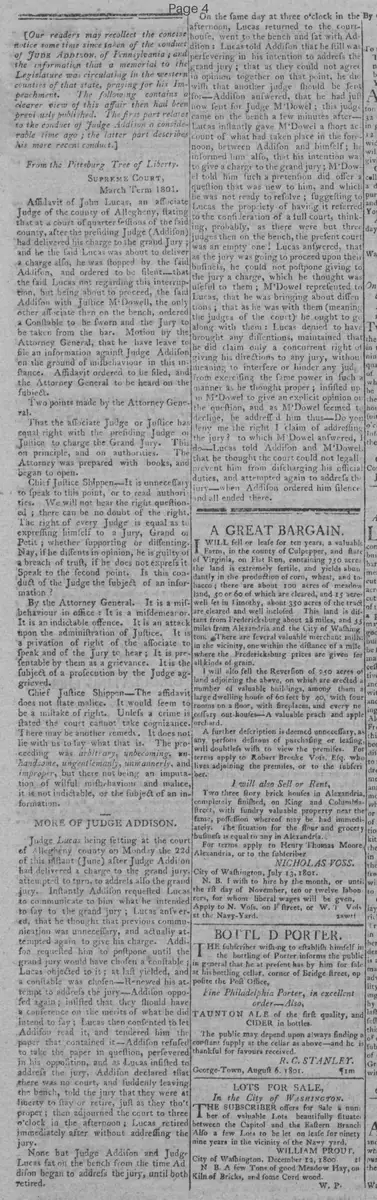
Our readers may recollect the concise notice some time since taken of the conduct of Judge Addison, of Pennsylvania; and the information that a memorial to the Legislature was circulating in the western counties of that state, praying for his Impeachment. The following contains a clearer view of this affair than had been previously published. The first part relates to the conduct of Judge Addison a considerable time ago: the latter part describes his more recent conduct.
From the Pittsburg Tree of Liberty.
SUPREME COURT,
March Term 1801.
Affidavit of John Lucas, an associate Judge of the county of Allegheny, stating that at a court of quarter sessions of the said County, after the presiding Judge (Addison) had delivered his charge to the grand Jury; and he the said Lucas was about to deliver a charge also, he was stopped by the said Addison, and ordered to be silent. That the said Lucas not regarding this interruption, but being about to proceed, the said Addison with Justice M'Dowell, the only other associate then on the bench, ordered a Constable to be sworn and the Jury to be taken from the bar. Motion by the Attorney General, that he have leave to file an information against Judge Addison on the ground of misbehaviour in this instance. Affidavit ordered to be filed, and the Attorney General to be heard on the subject.
Two points made by the Attorney General.
That the associate judge or Justice has equal right with the presiding Judge or Justice to charge the Grand Jury. This on principle, and on authorities. The Attorney was prepared with books, and began to open.
Chief Justice Shippen—It is unnecessary to speak to this point, or to read authorities. We will not hear the right questioned; there can be no doubt of the right. The right of every Judge is equal as to expressing himself to a Jury, Grand or Petit; whether supporting or dissenting. Nay, if he dissents in opinion, he is guilty of a breach of trust, if he does not express it.
'Speak to the second point. Is this conduct of the Judge the subject of an information?'
By the Attorney General. It is a misbehaviour in office: It is a misdemeanor. It is an indictable offence. It is an attack upon the administration of Justice. It is a privation of right of the associate to speak and of the Jury to hear; It is presentable by them as a grievance. It is the subject of a prosecution by the Judge aggrieved.
Chief Justice Shippen—The affidavit does not state malice. It would seem to be a mistake of right. Unless a crime is stated the court cannot take cognizance. There may be another remedy. It does not lie with us to say what that is. The proceeding was arbitrary, unbecoming, and handsome, ungentlemanly, unmannerly, and improper, but there not being an imputation of wilful misbehaviour and malice, it is not indictable, or the subject of an information.
MORE OF JUDGE ADDISON.
Judge Lucas being sitting at the court of Allegheny county on Monday the 22d of this instant (June) after Judge Addison had delivered a charge to the grand jury, attempted to turn, to address also the grand jury. Instantly Addison requested Lucas to communicate to him what he intended to say to the grand jury; Lucas answered, that he thought that previous communication was unnecessary, and actually attempted again to give his charge. Addison requested him to postpone until the grand jury would have chosen a constable; Lucas objected to it; at last yielded, and a constable was chosen—Renewed his attempt to address the jury—Addison opposed again; insisted that they should have a conference on the merits of what he did intend to say: Lucas then consented to let Addison read it, and tendered him the paper that contained it—Addison refused to take the paper in question, persevered in his opposition, and as Lucas insisted to address the jury, Addison declared that there was no court, and suddenly leaving the bench, told the jury that they were at liberty to stay or retire, just as they thought proper; then adjourned the court to three o'clock in the afternoon: Lucas retired immediately after without addressing the jury.
None but Judge Addison and Judge Lucas at on the bench from the time Addison began to address the jury, until both retired.
On the same day at three o'clock in the afternoon, Lucas returned to the court-house, went to the bench and sat with Addison: Lucas told Addison that he still was persevering in his intention to address the grand jury; that as they could not agree in opinion together on that point, he wished that another judge should be sent for—Addison answered, that he had just now sent for Judge M'Dowell; this judge came on the bench a few minutes after— Lucas instantly gave M'Dowell a short account of what had taken place in the forenoon, between Addison and himself: he informed him also, that his intention was to give a charge to the grand jury; M'Dowell told him such a pretension did offer a question that was new to him, and which he was not ready to resolve; suggesting to Lucas the propriety of having it referred to the consideration of a full court, thinking, probably, as there were but three judges then on the bench, the present court was an empty one! Lucas answered, that as the jury was going to proceed upon their business, he could not postpone giving to the jury a charge, which he thought was useful to them: M'Dowell represented to Lucas, that he was bringing about dissensions; that as he was with them (meaning the judges of the court) he ought to go along with them: Lucas denied to have brought any dissensions, maintained that he did claim only a concurrent right of giving his directions to any jury, without meaning to interfere or hinder any judge, from exercising the same power in such a manner as he thought proper; insisted upon M'Dowell to give an explicit opinion on the question, and as M'Dowell seemed to decline, he addressed him thus—Do you deny me the right I claim of addressing the jury? to which M'Dowell answered, I do. Lucas told Addison and M'Dowell, that he thought the court could not legally prevent him from discharging his official duties, and attempted again to address the jury—when Addison ordered him silence and all ended there.
From the Pittsburg Tree of Liberty.
SUPREME COURT,
March Term 1801.
Affidavit of John Lucas, an associate Judge of the county of Allegheny, stating that at a court of quarter sessions of the said County, after the presiding Judge (Addison) had delivered his charge to the grand Jury; and he the said Lucas was about to deliver a charge also, he was stopped by the said Addison, and ordered to be silent. That the said Lucas not regarding this interruption, but being about to proceed, the said Addison with Justice M'Dowell, the only other associate then on the bench, ordered a Constable to be sworn and the Jury to be taken from the bar. Motion by the Attorney General, that he have leave to file an information against Judge Addison on the ground of misbehaviour in this instance. Affidavit ordered to be filed, and the Attorney General to be heard on the subject.
Two points made by the Attorney General.
That the associate judge or Justice has equal right with the presiding Judge or Justice to charge the Grand Jury. This on principle, and on authorities. The Attorney was prepared with books, and began to open.
Chief Justice Shippen—It is unnecessary to speak to this point, or to read authorities. We will not hear the right questioned; there can be no doubt of the right. The right of every Judge is equal as to expressing himself to a Jury, Grand or Petit; whether supporting or dissenting. Nay, if he dissents in opinion, he is guilty of a breach of trust, if he does not express it.
'Speak to the second point. Is this conduct of the Judge the subject of an information?'
By the Attorney General. It is a misbehaviour in office: It is a misdemeanor. It is an indictable offence. It is an attack upon the administration of Justice. It is a privation of right of the associate to speak and of the Jury to hear; It is presentable by them as a grievance. It is the subject of a prosecution by the Judge aggrieved.
Chief Justice Shippen—The affidavit does not state malice. It would seem to be a mistake of right. Unless a crime is stated the court cannot take cognizance. There may be another remedy. It does not lie with us to say what that is. The proceeding was arbitrary, unbecoming, and handsome, ungentlemanly, unmannerly, and improper, but there not being an imputation of wilful misbehaviour and malice, it is not indictable, or the subject of an information.
MORE OF JUDGE ADDISON.
Judge Lucas being sitting at the court of Allegheny county on Monday the 22d of this instant (June) after Judge Addison had delivered a charge to the grand jury, attempted to turn, to address also the grand jury. Instantly Addison requested Lucas to communicate to him what he intended to say to the grand jury; Lucas answered, that he thought that previous communication was unnecessary, and actually attempted again to give his charge. Addison requested him to postpone until the grand jury would have chosen a constable; Lucas objected to it; at last yielded, and a constable was chosen—Renewed his attempt to address the jury—Addison opposed again; insisted that they should have a conference on the merits of what he did intend to say: Lucas then consented to let Addison read it, and tendered him the paper that contained it—Addison refused to take the paper in question, persevered in his opposition, and as Lucas insisted to address the jury, Addison declared that there was no court, and suddenly leaving the bench, told the jury that they were at liberty to stay or retire, just as they thought proper; then adjourned the court to three o'clock in the afternoon: Lucas retired immediately after without addressing the jury.
None but Judge Addison and Judge Lucas at on the bench from the time Addison began to address the jury, until both retired.
On the same day at three o'clock in the afternoon, Lucas returned to the court-house, went to the bench and sat with Addison: Lucas told Addison that he still was persevering in his intention to address the grand jury; that as they could not agree in opinion together on that point, he wished that another judge should be sent for—Addison answered, that he had just now sent for Judge M'Dowell; this judge came on the bench a few minutes after— Lucas instantly gave M'Dowell a short account of what had taken place in the forenoon, between Addison and himself: he informed him also, that his intention was to give a charge to the grand jury; M'Dowell told him such a pretension did offer a question that was new to him, and which he was not ready to resolve; suggesting to Lucas the propriety of having it referred to the consideration of a full court, thinking, probably, as there were but three judges then on the bench, the present court was an empty one! Lucas answered, that as the jury was going to proceed upon their business, he could not postpone giving to the jury a charge, which he thought was useful to them: M'Dowell represented to Lucas, that he was bringing about dissensions; that as he was with them (meaning the judges of the court) he ought to go along with them: Lucas denied to have brought any dissensions, maintained that he did claim only a concurrent right of giving his directions to any jury, without meaning to interfere or hinder any judge, from exercising the same power in such a manner as he thought proper; insisted upon M'Dowell to give an explicit opinion on the question, and as M'Dowell seemed to decline, he addressed him thus—Do you deny me the right I claim of addressing the jury? to which M'Dowell answered, I do. Lucas told Addison and M'Dowell, that he thought the court could not legally prevent him from discharging his official duties, and attempted again to address the jury—when Addison ordered him silence and all ended there.
What sub-type of article is it?
Historical Event
Biography
Crime Story
What themes does it cover?
Justice
Crime Punishment
Misfortune
What keywords are associated?
Judge Misconduct
Grand Jury Charge
Impeachment Memorial
Court Dispute
Legal Rights
What entities or persons were involved?
Judge Addison
Judge Lucas
Chief Justice Shippen
Justice M'dowell
Attorney General
Where did it happen?
Allegheny County, Pennsylvania
Story Details
Key Persons
Judge Addison
Judge Lucas
Chief Justice Shippen
Justice M'dowell
Attorney General
Location
Allegheny County, Pennsylvania
Event Date
March Term 1801; June 22 (Instant)
Story Details
Judge Addison prevents associate Judge Lucas from addressing the grand jury in Allegheny County courts, leading to Supreme Court review in 1801 where the act is deemed improper but not indictable; a similar incident occurs in June, escalating calls for Addison's impeachment.