Thank you for visiting SNEWPapers!
Sign up free
Editorial
July 28, 1944
The Butler County Press
Hamilton, Butler County, Ohio
What is this article about?
Editorial highlights wartime production feats by William L. Batt, noting half the population makes war goods while the other half exceeds prewar civilian output. Urges postwar planning for higher buying power to match productivity and prevent depression like Hoover era.
Clipping
OCR Quality
98%
Excellent
Full Text
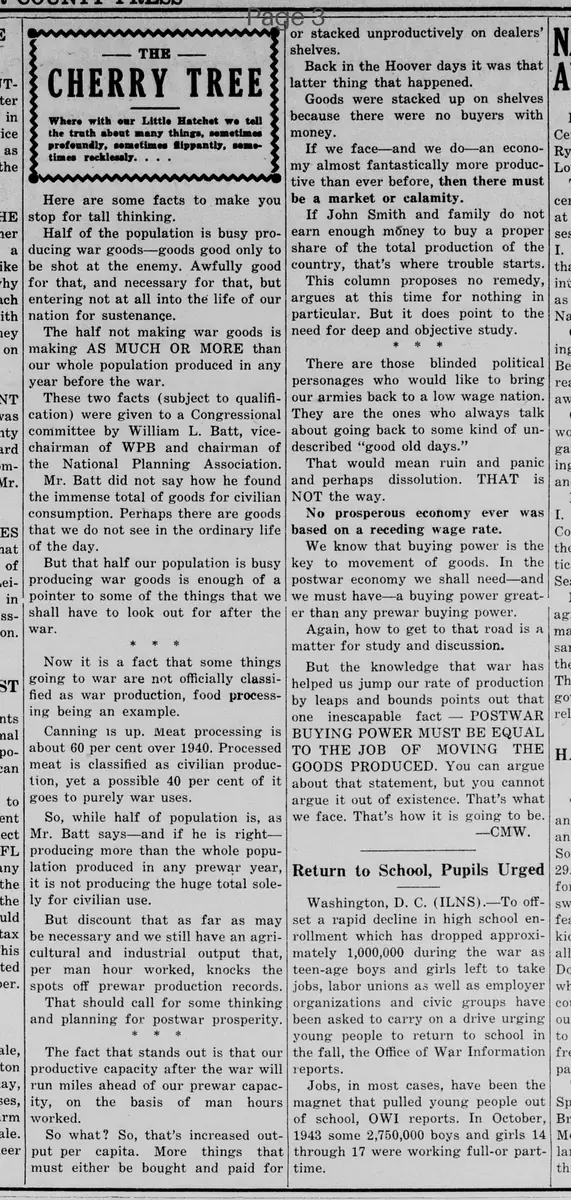
THE CHERRY TREE
Where with our Little Hatchet we tell the truth about many things, sometimes profoundly, sometimes lippantly, sometimes recklessly. . .
Here are some facts to make you stop for tall thinking.
Half of the population is busy producing war goods-goods good only to be shot at the enemy. Awfully good for that, and necessary for that, but entering not at all into the life of our nation for sustenance.
The half not making war goods is making AS MUCH OR MORE than our whole population produced in any year before the war.
These two facts (subject to qualification) were given to a Congressional committee by William L. Batt, vice-chairman of WPB and chairman of the National Planning Association.
Mr. Batt did not say how he found the immense total of goods for civilian consumption. Perhaps there are goods that we do not see in the ordinary life of the day.
But that half our population is busy producing war goods is enough of a pointer to some of the things that we shall have to look out for after the war.
Now it is a fact that some things going to war are not officially classified as war production, food processing being an example.
Canning is up. Meat processing is about 60 per cent over 1940. Processed meat is classified as civilian production, yet a possible 40 per cent of it goes to purely war uses.
So, while half of population is, as Mr. Batt says-and if he is right-producing more than the whole population produced in any prewar year, it is not producing the huge total solely for civilian use.
But discount that as far as may be necessary and we still have an agricultural and industrial output that, per man hour worked, knocks the spots off prewar production records.
That should call for some thinking and planning for postwar prosperity.
The fact that stands out is that our productive capacity after the war will run miles ahead of our prewar capacity, on the basis of man hours worked.
So what? So, that's increased output per capita. More things that must either be bought and paid for or stacked unproductively on dealers' shelves.
Back in the Hoover days it was that latter thing that happened.
Goods were stacked up on shelves because there were no buyers with money.
If we face-and we do-an economy almost fantastically more productive than ever before, then there must be a market or calamity.
If John Smith and family do not earn enough money to buy a proper share of the total production of the country, that's where trouble starts.
This column proposes no remedy, argues at this time for nothing in particular. But it does point to the need for deep and objective study.
There are those blinded political personages who would like to bring our armies back to a low wage nation.
They are the ones who always talk about going back to some kind of undefined "good old days."
That would mean ruin and panic and perhaps dissolution. THAT is NOT the way.
No prosperous economy ever was based on a receding wage rate.
We know that buying power is the key to movement of goods. In the postwar economy we shall need-and we must have-a buying power greater than any prewar buying power.
Again, how to get to that road is a matter for study and discussion.
But the knowledge that war has helped us jump our rate of production by leaps and bounds points out that one inescapable fact - POSTWAR BUYING POWER MUST BE EQUAL TO THE JOB OF MOVING THE GOODS PRODUCED. You can argue about that statement, but you cannot argue it out of existence. That's what we face. That's how it is going to be.
-CMW.
Where with our Little Hatchet we tell the truth about many things, sometimes profoundly, sometimes lippantly, sometimes recklessly. . .
Here are some facts to make you stop for tall thinking.
Half of the population is busy producing war goods-goods good only to be shot at the enemy. Awfully good for that, and necessary for that, but entering not at all into the life of our nation for sustenance.
The half not making war goods is making AS MUCH OR MORE than our whole population produced in any year before the war.
These two facts (subject to qualification) were given to a Congressional committee by William L. Batt, vice-chairman of WPB and chairman of the National Planning Association.
Mr. Batt did not say how he found the immense total of goods for civilian consumption. Perhaps there are goods that we do not see in the ordinary life of the day.
But that half our population is busy producing war goods is enough of a pointer to some of the things that we shall have to look out for after the war.
Now it is a fact that some things going to war are not officially classified as war production, food processing being an example.
Canning is up. Meat processing is about 60 per cent over 1940. Processed meat is classified as civilian production, yet a possible 40 per cent of it goes to purely war uses.
So, while half of population is, as Mr. Batt says-and if he is right-producing more than the whole population produced in any prewar year, it is not producing the huge total solely for civilian use.
But discount that as far as may be necessary and we still have an agricultural and industrial output that, per man hour worked, knocks the spots off prewar production records.
That should call for some thinking and planning for postwar prosperity.
The fact that stands out is that our productive capacity after the war will run miles ahead of our prewar capacity, on the basis of man hours worked.
So what? So, that's increased output per capita. More things that must either be bought and paid for or stacked unproductively on dealers' shelves.
Back in the Hoover days it was that latter thing that happened.
Goods were stacked up on shelves because there were no buyers with money.
If we face-and we do-an economy almost fantastically more productive than ever before, then there must be a market or calamity.
If John Smith and family do not earn enough money to buy a proper share of the total production of the country, that's where trouble starts.
This column proposes no remedy, argues at this time for nothing in particular. But it does point to the need for deep and objective study.
There are those blinded political personages who would like to bring our armies back to a low wage nation.
They are the ones who always talk about going back to some kind of undefined "good old days."
That would mean ruin and panic and perhaps dissolution. THAT is NOT the way.
No prosperous economy ever was based on a receding wage rate.
We know that buying power is the key to movement of goods. In the postwar economy we shall need-and we must have-a buying power greater than any prewar buying power.
Again, how to get to that road is a matter for study and discussion.
But the knowledge that war has helped us jump our rate of production by leaps and bounds points out that one inescapable fact - POSTWAR BUYING POWER MUST BE EQUAL TO THE JOB OF MOVING THE GOODS PRODUCED. You can argue about that statement, but you cannot argue it out of existence. That's what we face. That's how it is going to be.
-CMW.
What sub-type of article is it?
Economic Policy
What keywords are associated?
Postwar Economy
Buying Power
War Production
Productivity
Wages
Economic Planning
What entities or persons were involved?
William L. Batt
Wpb
National Planning Association
Congressional Committee
Editorial Details
Primary Topic
Postwar Economic Planning And Buying Power
Stance / Tone
Calls For Deep Study And Planning To Ensure Postwar Buying Power Matches Increased Productivity
Key Figures
William L. Batt
Wpb
National Planning Association
Congressional Committee
Key Arguments
Half Of The Population Is Producing War Goods
The Other Half Is Producing As Much Or More Than The Whole Population Did Prewar
Processed Foods Like Meat Contribute To War Uses Despite Civilian Classification
Postwar Productive Capacity Will Exceed Prewar Based On Man Hours
Increased Output Requires Markets And Buying Power To Avoid Calamity
Opposes Returning To Low Wages Or Undefined Good Old Days
Prosperous Economy Needs Greater Postwar Buying Power Than Prewar
War Has Boosted Production Rates Significantly