Thank you for visiting SNEWPapers!
Sign up free
Literary
October 12, 1803
The National Intelligencer And Washington Advertiser
Washington, District Of Columbia
What is this article about?
In Letter Eighth of 'A Defence of Republican Governments,' Madison critiques Montesquieu's views on virtue and patriotism in republics, arguing that modern republics thrive on rational love of country tied to personal happiness, not ancient enthusiasm. He contrasts republican affection with coercive monarchies, emphasizing unity and respect abroad.
Clipping
OCR Quality
95%
Excellent
Full Text
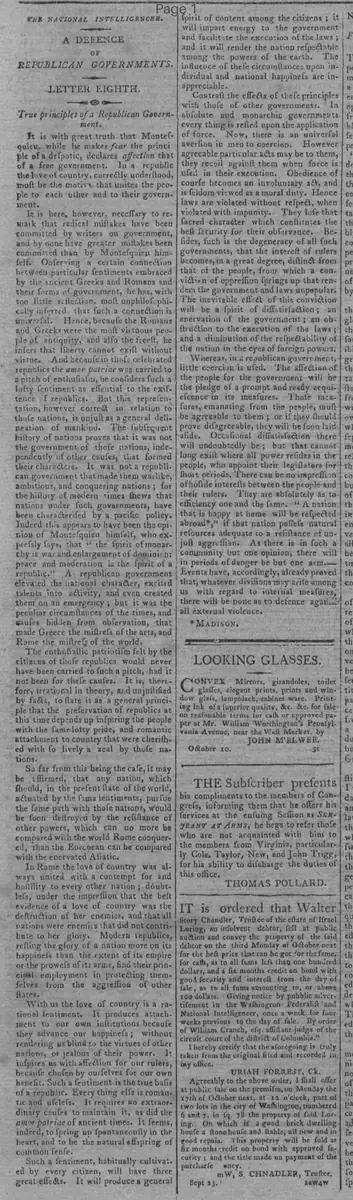
A DEFENCE
OF
REPUBLICAN GOVERNMENTS.
LETTER EIGHTH.
True principles of a Republican Government.
It is with great truth that Montesquieu, while he makes fear the principle of a despotic, declares affection that of a free government. In a republic the love of country, correctly understood, must be the motive that unites the people to each other and to their government.
It is here, however, necessary to remark that radical mistakes have been committed by writers on government, and by none have greater mistakes been committed than by Montesquieu himself. Observing a certain connection between particular sentiments embraced by the ancient Greeks and Romans and their forms of government, he has, with too little reflection, most unphilosophically inferred, that such a connection is universal. Hence, because the Romans and Greeks were the most virtuous people of antiquity, and also the freest, he infers that liberty cannot exist without virtue. And because in those celebrated republics the amor patriae was carried to a pitch of enthusiasm, he considers such a lofty sentiment as essential to the existence of republics. But this representation, however correct in relation to those nations, is unjust as a general delineation of mankind. The subsequent history of nations proves that it was not the government of those nations, independently of other causes, that formed their characters. It was not a republican government that made them warlike, ambitious, and conquering nations; for the history of modern times shows that nations under such governments, have been characterized by a pacific policy.
Indeed this appears to have been the opinion of Montesquieu himself, who expressly says, that "the spirit of monarchy is war and enlargement of dominion: peace and moderation is the spirit of a republic." A republican government elevated the national character, excited talents into activity, and even created them on an emergency; but it was the peculiar circumstances of the times, and causes hidden from observation, that made Greece the mistress of the arts, and Rome the mistress of the world.
The enthusiastic patriotism felt by the citizens of those republics would never have been carried to such a pitch, had it not been for these causes. It is, therefore, irrational in theory, and unjustified by facts, to state it as a general principle that the preservation of republics at this time depends upon inspiring the people with the same lofty pride, and romantic attachment to country that were cherished with so lively a zeal by those nations.
So far from this being the case, it may be affirmed, that any nation, which should, in the present state of the world, actuated by the same sentiments, pursue the same path with those nations, would be soon destroyed by the resistance of other powers, which can no more be compared with the world Rome conquered, than the European can be compared with the enervated Asiatic.
In Rome the love of country was always united with a contempt for and hostility to every other nation: doubtless, under the impression that the best evidence of a love of country was the destruction of her enemies, and that all nations were enemies that did not contribute to her glory. Modern republics, resting the glory of a nation more on its happiness than the extent of its empire or the prowess of its arms, find their principal employment in protecting themselves from the aggression of other states.
With us the love of country is a rational sentiment. It produces attachment to our own institutions because they advance our happiness; without rendering us blind to the virtues of other nations, or jealous of their power. It inspires us with affection for our rulers, because chosen by ourselves for our own benefit. Such a sentiment is the true basis of a republic. Every thing else is romantic and useless. It requires no extraordinary causes to maintain it, as did the amor patriae of ancient times. It seems, indeed, to spring up spontaneously in the heart, and to be the natural offspring of common sense.
Such a sentiment, habitually cultivated by every citizen, will have three great effects. It will produce a general spirit of content among the citizens; it will impart energy to the government and facilitate the execution of the laws; and it will render the nation respectable among the powers of the earth. The influence of these circumstances upon individual and national happiness are inappreciable.
Contrast the effects of these principles with those of other governments. In absolute and monarchic governments every thing is relied upon the application of force. Now, there is a universal aversion in men to coercion. However agreeable particular acts may be to them, they recoil against them when force is used in their execution. Obedience of course becomes an involuntary act, and is seldom viewed as a moral duty. Hence laws are violated without respect, when violated with impunity. They lose that sacred character which constitutes the best security for their observance. Besides, such is the degeneracy of all such governments, that the interest of rulers becomes, in a great degree, distinct from that of the people, from which a conviction of oppression springs up that renders the government and laws unpopular.
The inevitable effect of this conviction will be a spirit of dissatisfaction; an enervation of the government; an obstruction to the execution of the laws; and a diminution of the respectability of the nation in the eyes of foreign powers.
Whereas, in a republican government, little coercion is used. The affection of the people for the government will be the pledge of a prompt and ready acquiescence in its measures. Those measures, emanating from the people, must be agreeable to them; or if they should prove disagreeable, they will be soon laid aside. Occasional dissatisfaction there will undoubtedly be; but that cannot long exist where all power resides in the people, who appoint their legislators for short periods. There can be no impression of hostile interests between the people and their rulers. They are absolutely as to efficiency one and the same. "A nation that is happy at home will be respected abroad," if that nation possesses natural resources adequate to a resistance of unjust aggression. As there is in such a community but one opinion, there will in periods of danger be but one arm.
Events have, accordingly, already proved that, whatever divisions may arise among us with regard to internal measures, there will be none as to defence against all external violence.
*MADISON.
OF
REPUBLICAN GOVERNMENTS.
LETTER EIGHTH.
True principles of a Republican Government.
It is with great truth that Montesquieu, while he makes fear the principle of a despotic, declares affection that of a free government. In a republic the love of country, correctly understood, must be the motive that unites the people to each other and to their government.
It is here, however, necessary to remark that radical mistakes have been committed by writers on government, and by none have greater mistakes been committed than by Montesquieu himself. Observing a certain connection between particular sentiments embraced by the ancient Greeks and Romans and their forms of government, he has, with too little reflection, most unphilosophically inferred, that such a connection is universal. Hence, because the Romans and Greeks were the most virtuous people of antiquity, and also the freest, he infers that liberty cannot exist without virtue. And because in those celebrated republics the amor patriae was carried to a pitch of enthusiasm, he considers such a lofty sentiment as essential to the existence of republics. But this representation, however correct in relation to those nations, is unjust as a general delineation of mankind. The subsequent history of nations proves that it was not the government of those nations, independently of other causes, that formed their characters. It was not a republican government that made them warlike, ambitious, and conquering nations; for the history of modern times shows that nations under such governments, have been characterized by a pacific policy.
Indeed this appears to have been the opinion of Montesquieu himself, who expressly says, that "the spirit of monarchy is war and enlargement of dominion: peace and moderation is the spirit of a republic." A republican government elevated the national character, excited talents into activity, and even created them on an emergency; but it was the peculiar circumstances of the times, and causes hidden from observation, that made Greece the mistress of the arts, and Rome the mistress of the world.
The enthusiastic patriotism felt by the citizens of those republics would never have been carried to such a pitch, had it not been for these causes. It is, therefore, irrational in theory, and unjustified by facts, to state it as a general principle that the preservation of republics at this time depends upon inspiring the people with the same lofty pride, and romantic attachment to country that were cherished with so lively a zeal by those nations.
So far from this being the case, it may be affirmed, that any nation, which should, in the present state of the world, actuated by the same sentiments, pursue the same path with those nations, would be soon destroyed by the resistance of other powers, which can no more be compared with the world Rome conquered, than the European can be compared with the enervated Asiatic.
In Rome the love of country was always united with a contempt for and hostility to every other nation: doubtless, under the impression that the best evidence of a love of country was the destruction of her enemies, and that all nations were enemies that did not contribute to her glory. Modern republics, resting the glory of a nation more on its happiness than the extent of its empire or the prowess of its arms, find their principal employment in protecting themselves from the aggression of other states.
With us the love of country is a rational sentiment. It produces attachment to our own institutions because they advance our happiness; without rendering us blind to the virtues of other nations, or jealous of their power. It inspires us with affection for our rulers, because chosen by ourselves for our own benefit. Such a sentiment is the true basis of a republic. Every thing else is romantic and useless. It requires no extraordinary causes to maintain it, as did the amor patriae of ancient times. It seems, indeed, to spring up spontaneously in the heart, and to be the natural offspring of common sense.
Such a sentiment, habitually cultivated by every citizen, will have three great effects. It will produce a general spirit of content among the citizens; it will impart energy to the government and facilitate the execution of the laws; and it will render the nation respectable among the powers of the earth. The influence of these circumstances upon individual and national happiness are inappreciable.
Contrast the effects of these principles with those of other governments. In absolute and monarchic governments every thing is relied upon the application of force. Now, there is a universal aversion in men to coercion. However agreeable particular acts may be to them, they recoil against them when force is used in their execution. Obedience of course becomes an involuntary act, and is seldom viewed as a moral duty. Hence laws are violated without respect, when violated with impunity. They lose that sacred character which constitutes the best security for their observance. Besides, such is the degeneracy of all such governments, that the interest of rulers becomes, in a great degree, distinct from that of the people, from which a conviction of oppression springs up that renders the government and laws unpopular.
The inevitable effect of this conviction will be a spirit of dissatisfaction; an enervation of the government; an obstruction to the execution of the laws; and a diminution of the respectability of the nation in the eyes of foreign powers.
Whereas, in a republican government, little coercion is used. The affection of the people for the government will be the pledge of a prompt and ready acquiescence in its measures. Those measures, emanating from the people, must be agreeable to them; or if they should prove disagreeable, they will be soon laid aside. Occasional dissatisfaction there will undoubtedly be; but that cannot long exist where all power resides in the people, who appoint their legislators for short periods. There can be no impression of hostile interests between the people and their rulers. They are absolutely as to efficiency one and the same. "A nation that is happy at home will be respected abroad," if that nation possesses natural resources adequate to a resistance of unjust aggression. As there is in such a community but one opinion, there will in periods of danger be but one arm.
Events have, accordingly, already proved that, whatever divisions may arise among us with regard to internal measures, there will be none as to defence against all external violence.
*MADISON.
What sub-type of article is it?
Essay
What themes does it cover?
Political
Liberty Freedom
Patriotism
What keywords are associated?
Republican Government
Love Of Country
Montesquieu
Ancient Republics
Modern Republics
Political Liberty
Patriotism
National Happiness
What entities or persons were involved?
Madison
Literary Details
Title
A Defence Of Republican Governments. Letter Eighth.
Author
Madison
Subject
True Principles Of A Republican Government.
Key Lines
It Is With Great Truth That Montesquieu, While He Makes Fear The Principle Of A Despotic, Declares Affection That Of A Free Government.
In A Republic The Love Of Country, Correctly Understood, Must Be The Motive That Unites The People To Each Other And To Their Government.
The Spirit Of Monarchy Is War And Enlargement Of Dominion: Peace And Moderation Is The Spirit Of A Republic.
With Us The Love Of Country Is A Rational Sentiment.
"A Nation That Is Happy At Home Will Be Respected Abroad,"