Thank you for visiting SNEWPapers!
Sign up free
Litchfield Enquirer
Litchfield, Litchfield County, Connecticut
What is this article about?
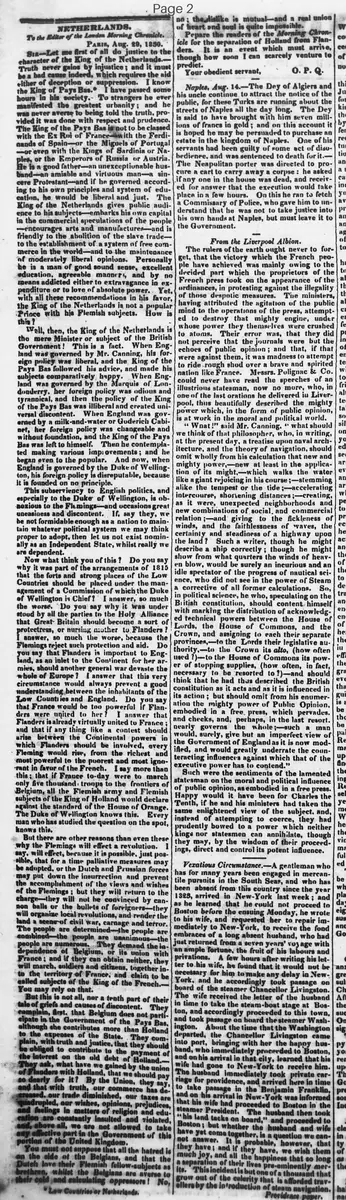
A letter from Paris dated August 29, 1830, defends the character of the King of the Netherlands but highlights Flemish discontent due to subservience to British policy under the Duke of Wellington, predicting a revolution for Belgian independence or union with France, and separation from Holland.
Merged-components note: Continuation of the same article on Netherlands politics across the component boundary.
Clipping
OCR Quality
Full Text
In the Editor of the London Morning Chronicle.
Paris, Aug. 29, 1830.
Sir—Let me first of all do justice to the character of the King of the Netherlands.—
Truth never gains by injustice; and it must be a bad cause indeed, which requires the aid either of deception or suppression. I know the King of Pays Bas. I have passed some hours in his society.— To strangers he ever manifested the greatest urbanity; and he was never averse to being told the truth, provided it was done with respect and prudence.
The King of the Pays Bas is not to be classed with the Ex Roi of France with the Ferdinands of Spain or the Miguels of Portugal —or even with the Kings of Sardinia or Naples, or the Emperors of Russia or Austria.
He is a good father—an unexceptionable husband—amiable and virtuous man—a sincere Protestant—and if he governed according to his own principles and system of education, he would be liberal and just. The King of the Netherlands gives public audience to his subjects—embarks his own capital in the commercial speculations of the people—encourages arts and manufactures—and is friendly to the abolition of the slave trade— to the establishment of a system of free commerce in the world—and to the maintenance of moderately liberal opinions. Personally he is a man of good sound sense, excellent education, agreeable manner, and by no means addicted either to extravagance in expenditure or to love of absolute power. Yet, with all these recommendations in his favor, the King of the Netherlands is not a popular Prince with his Flemish subjects. How is this?
Well, then, the King of the Netherlands is the mere Minister or subject of the British Government! This is a fact. When England was governed by Mr. Canning, his foreign policy was liberal. and the King of the Pays Bas followed his advice. and made his subjects comparatively happy. When England was governed by the Marquis of Londonderry. her foreign policy was odious and tyrannical, and then the policy of the King of the Pays Bas was illiberal and created universal discontent. When England was governed by a milk-and-water or Goderich Cabinet, her foreign policy was changeable and without foundation, and the King of the Pays Bas was left to himself. Then he contemplated making various improvements; and he began even to the popular. And now, when England is governed by the Duke of Wellington, his foreign policy is disreputable, because it is founded on no principle.
This subserviency to English politics, and especially to the Duke of Wellington, is obnoxious to the Flemings—and occasions great uneasiness and discontent. If, say they, we be not formidable enough as a nation to maintain whatever political system we may think proper to adopt, then let us not exist nominally as an Independent State, whilst really we are dependent.
Now what think you of this? Do you say why it was part of the arrangements of 1815 that the forts and strong places of the Low Countries should be placed under the management of a Commission of which the Duke of Wellington is Chief?' I answer, so much the worse. 'Do you say why it was understood by all the parties to the Holy Alliance that Great-Britain should become a sort of protectress, or nursing mother to Flanders?' I answer, so much the worse, because the Flemings reject such protection and aid. Do you say that Flanders is important to England. as an inlet to the Continent for her armies. should another general war devastate the whole of Europe? I answer that this very circumstance would always prevent a good understanding between the inhabitants of the Low Countries and England. Do you say that France would be too powerful if Flanders were united to her? I answer that Flanders is already virtually united to France : and that if any thing like a contest should arise between the Continental powers in which Flanders should be involved, every Fleming would rise. from the richest and most powerful to the poorest and most ignorant in favor of the French. I say more than this: that if France to-day were to march only five thousand troops to the frontiers of Belgium, all the Flemish army and Flemish subjects of the King of Holland would declare against the standard of the House of Orange.
The Duke of Wellington knows this. Every man who has studied the question on the spot, knows this.
But there are other reasons than even these why the Flemings will effect a revolution. I say, will effect, because it is possible, just possible, that for a time palliative measures may be adopted, or the Dutch and Prussian forces may put down the insurrection and prevent the accomplishment of the views and wishes of the Flemings ; but they will return to the charge—they will not be convinced by cannon balls or the bullets of foreigners—they will organize local revolutions, and render the land a scene of civil war, carnage and terror.
The people are determined—the people are combined—the people are unanimous—the people are numerous. They demand the independence of Belgium, or its union with France; and if they can obtain neither, they will march, soldiers and citizens, together into the territory of France, and claim to be called subjects of the King of the French.—
You may rely on that.
But this is not all, nor a tenth part of their tale of griefs and causes of discontent. They complain, first, that Belgium does not participate in the Government of the Pays Bas, although she contributes more than Holland to the expenses of the State. They complain, with truth and justice, that they should be obliged to contribute to the payment of the interest on the old debt of Holland.—
They ask, what have we gained by the union of Flanders with Holland, that we should pay so dearly for it? By the Union, they say, and that with truth, our commerce has decreased. our trade diminished, our taxes are quadrupled, our wishes, opinions, prejudices, and feelings in matters of religion and education are constantly insulted—and violated. and, above all, we are not allowed to take any effective part in the Government of this portion of the United Kingdom.
You must not suppose that all the hatred is on the side of the Belgians, and that the Dutch love their Flemish fellow-subjects as brethren, whilst the Belgians are averse to their cold and calculating oppressors! No,
no : the dislike is mutual—and a real union of heart and soul is quite impossible.
Prepare the readers of the Morning Chronicle for the separation of Holland from Flanders.
It is an event which must arrive, though how soon I can scarcely venture to predict.
Your obedient servant,
O. P. Q.
What sub-type of article is it?
What keywords are associated?
What entities or persons were involved?
Where did it happen?
Foreign News Details
Primary Location
Flanders
Event Date
Aug. 29, 1830
Key Persons
Outcome
predicted revolution, civil war, separation of holland from flanders, potential union with france or independence of belgium
Event Details
Letter defends the King's character but attributes Flemish unpopularity to subservience to British policy, especially under Wellington; details grievances over government participation, taxes, debt, commerce decline, religious insults; predicts inevitable revolution and separation despite possible temporary suppression.