Thank you for visiting SNEWPapers!
Sign up free
Editorial
June 15, 1869
Nashville Union And American
Nashville, Davidson County, Tennessee
What is this article about?
Editorial warns of dangers in partisan politicians' war rhetoric on the Alabama question to gain votes, especially the Irish vote, risking peace with Britain despite support from Grant and business for peaceful resolution.
Clipping
OCR Quality
98%
Excellent
Full Text
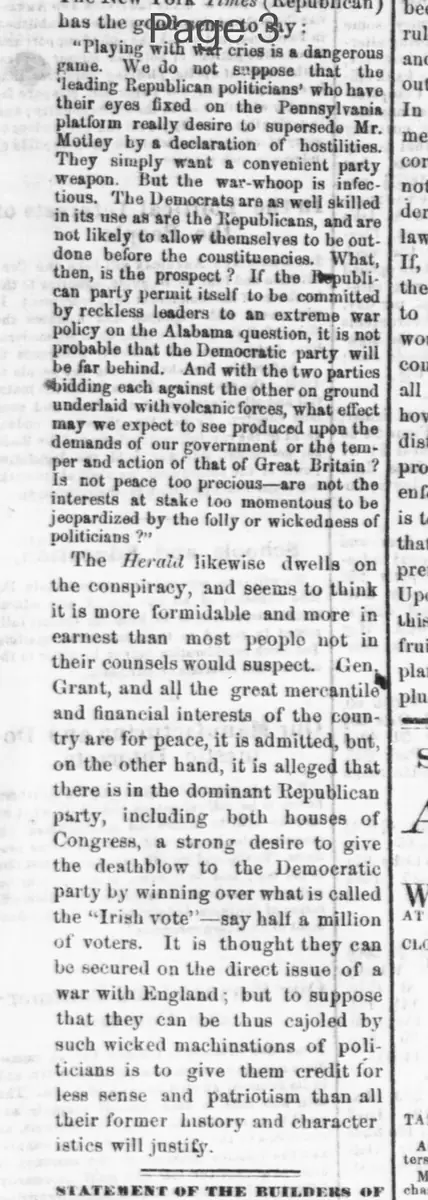
"Playing with war cries is a dangerous
game. We do not suppose that the
'leading Republican politicians' who have
their eyes fixed on the Pennsylvania
platform really desire to supersede Mr.
Motley by a declaration of hostilities.
They simply want a convenient party
weapon. But the war-whoop is infectious.
The Democrats are as well skilled
in its use as are the Republicans, and are
not likely to allow themselves to be out-
done before the constituencies. What,
then, is the prospect? If the Republican
party permit itself to be committed
by reckless leaders to an extreme war
policy on the Alabama question, it is not
probable that the Democratic party will
be far behind. And with the two parties
outbidding each against the other on ground
underlaid with volcanic forces, what effect
may we expect to see produced upon the
demands of our government or the temper
and action of that of Great Britain?
Is not peace too precious—are not the
interests at stake too momentous to be
jeopardized by the folly or wickedness of
politicians?"
The Herald likewise dwells on
the conspiracy, and seems to think
it is more formidable and more in
earnest than most people not in
their counsels would suspect. Gen.
Grant, and all the great mercantile
and financial interests of the country
are for peace, it is admitted, but,
on the other hand, it is alleged that
there is in the dominant Republican
party, including both houses of
Congress, a strong desire to give
the deathblow to the Democratic
party by winning over what is called
the "Irish vote"—say half a million
of voters. It is thought they can
be secured on the direct issue of a
war with England; but to suppose
that they can be thus cajoled by
such wicked machinations of politicians
is to give them credit for
less sense and patriotism than all
their former history and character
istics will justify.
game. We do not suppose that the
'leading Republican politicians' who have
their eyes fixed on the Pennsylvania
platform really desire to supersede Mr.
Motley by a declaration of hostilities.
They simply want a convenient party
weapon. But the war-whoop is infectious.
The Democrats are as well skilled
in its use as are the Republicans, and are
not likely to allow themselves to be out-
done before the constituencies. What,
then, is the prospect? If the Republican
party permit itself to be committed
by reckless leaders to an extreme war
policy on the Alabama question, it is not
probable that the Democratic party will
be far behind. And with the two parties
outbidding each against the other on ground
underlaid with volcanic forces, what effect
may we expect to see produced upon the
demands of our government or the temper
and action of that of Great Britain?
Is not peace too precious—are not the
interests at stake too momentous to be
jeopardized by the folly or wickedness of
politicians?"
The Herald likewise dwells on
the conspiracy, and seems to think
it is more formidable and more in
earnest than most people not in
their counsels would suspect. Gen.
Grant, and all the great mercantile
and financial interests of the country
are for peace, it is admitted, but,
on the other hand, it is alleged that
there is in the dominant Republican
party, including both houses of
Congress, a strong desire to give
the deathblow to the Democratic
party by winning over what is called
the "Irish vote"—say half a million
of voters. It is thought they can
be secured on the direct issue of a
war with England; but to suppose
that they can be thus cajoled by
such wicked machinations of politicians
is to give them credit for
less sense and patriotism than all
their former history and character
istics will justify.
What sub-type of article is it?
Foreign Affairs
Partisan Politics
War Or Peace
What keywords are associated?
Alabama Question
War Cries
Partisan Politics
Irish Vote
Peace With Britain
Republican Conspiracy
What entities or persons were involved?
Republican Politicians
Democrats
Mr. Motley
Gen. Grant
Irish Vote
Great Britain
The Herald
Editorial Details
Primary Topic
Dangers Of Partisan War Rhetoric On Alabama Question
Stance / Tone
Warning Against Political Escalation Risking War With Britain
Key Figures
Republican Politicians
Democrats
Mr. Motley
Gen. Grant
Irish Vote
Great Britain
The Herald
Key Arguments
Playing With War Cries Is Dangerous
Politicians Use Alabama Issue As Party Weapon
War Whoop Is Infectious Between Parties
Parties May Outbid Each Other Leading To Extreme War Policy
Peace Is Too Precious To Jeopardize For Political Folly
Republican Desire To Win Irish Vote Via War Issue
Irish Voters Have Sense And Patriotism Not To Be Cajoled