Thank you for visiting SNEWPapers!
Sign up free
Editorial
August 23, 1805
Norfolk Gazette And Publick Ledger
Norfolk, Virginia
What is this article about?
Editorial criticizes Spain's bad faith towards the US, including intrigues by Marquis Yrujo and failure of a treaty for restoring captured American merchandise due to Spanish stratagems. Includes legal opinions on whether the US can seek indemnity from Spain after relinquishing claims against France for vessels captured and sold in Spanish ports.
Clipping
OCR Quality
98%
Excellent
Full Text
FROM THE AMERICAN CITIZEN.
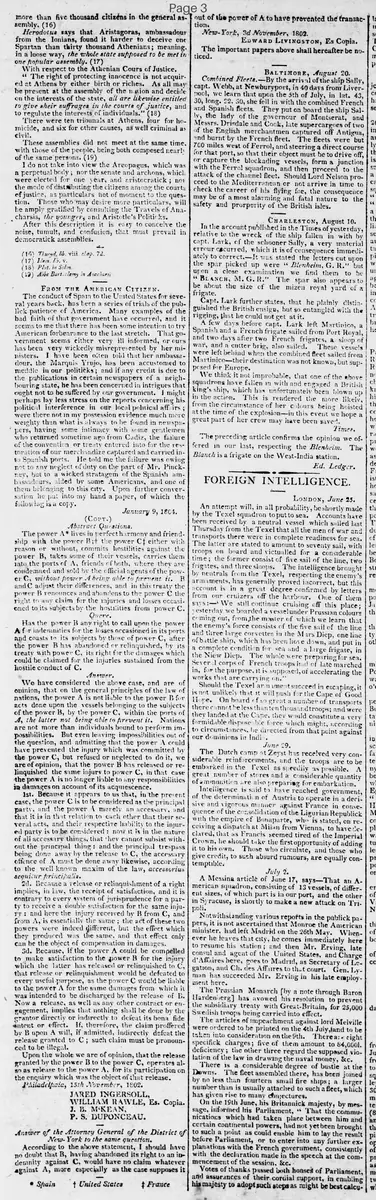
The conduct of Spain to the United States for several years back, has been a series of trials of the public patience of America. Many examples of the bad faith of that government have occurred, and it seems to me that there has been some intention to try American forbearance to the last stretch. That government seems either very ill informed, or ours has been very wickedly misrepresented by her ministers. I have been often told that her ambassador, the Marquis Yrujo, has been accustomed to meddle in our politics; and if any credit is due to the publications in certain newspapers of a neighbouring state, he has been concerned in intrigues that ought not to be suffered by our government. I might perhaps lay less stress on the reports concerning his political interference in our local political affairs; were there not in my possession evidence much more weighty than what is always to be found in newspapers, having some intimacy with some gentlemen who returned sometime ago from Cadiz, the failure of the convention or treaty entered into for the restoration of our merchandize captured and carried into Spanish ports. He told me the failure was owing not to any neglect of duty on the part of Mr. Pinckney, but to a wicked stratagem of the Spanish ambassadors, aided by some Americans, and one of them belonging to this city. Upon further conversation he put into my hand a paper, of which the following is a copy.
January 9, 1804.
(Corr.)
Abstract Questions.
The power A lives in perfect harmony and friendship with the power B; the power C, either with reason or without, commits hostilities against the power B, takes some of their vessels, carries them into the ports of A, friends of both, where they are condemned and sold by the official agents of the power C, without power A being able to prevent it. B and C adjust their differences, and in this treaty the power B renounces and abandons to the power C the right to any claim for the injuries and losses occasioned to its subjects by the hostilities from power C.
Quære.
Has the power B any right to call upon the power A for indemnities for the losses occasioned in its ports and coasts to its subjects by those of power C, after the power B has abandoned or relinquished, by its treaty with power C, its right for the damages which could be claimed for the injuries sustained from the hostile conduct of C.
Answer.
We have considered the above case, and are of opinion, that on the general principles of the law of nations, the power A is not liable to the power B for acts done upon the vessels belonging to the subjects of the power B, by the power C, within the ports of A, the latter not being able to prevent it. Nations are not more than individuals bound to perform impossibilities. But even leaving impossibilities out of the question, and admitting that the power A could have prevented the injury which was committed by the power C, but refused or neglected to do it, we are of opinion, that the power B has released or relinquished the same injury to power C, in that case the power A is no longer liable to any responsibilities in damages on account of its acquiescence.
1st. Because it appears to us that, in the present case, the power C is to be considered as the principal party, and the power A merely an accessory, and that it is in that relation to each other that their several acts, and their respective liability to the injured party is to be considered: now it is in the nature of all accessory things, that they cannot subsist without the principal thing: and the principal trespass being done away by the release to C, the accessory offence of A must be done away likewise, according to the well known maxim of the law, accessorius sequitur principalis.
2d. Because a release or relinquishment of a right implies, in law, the receipt of satisfaction, and it is contrary to every system of jurisprudence for a party to receive a double satisfaction for the same injury: and here the injury received by B from C, and from A, is essentially the same; the act of these two powers were indeed different, but the effect which they produced was the same, and that effect only can be the object of compensation in damages.
3d. Because, if the power A could be compelled to make satisfaction to the power B for the injury which the latter has released or relinquished to C, that release or relinquishment would be defeated to every useful purpose, as the power C would be liable to the power A for the same damages from which it was intended to be discharged by the release of B. Now a release, as well as any other contract or engagement, implies that nothing shall be done by the grantor directly or indirectly to defeat its bona fide intent or effect. If, therefore, the claim proffered by B upon A will, if admitted, indirectly defeat the release granted to C; such claim must be pronounced to be illegal.
Upon the whole we are of opinion, that the release granted by the power B to the power C, operates also as release to the power A, for its participation on the enquiry which was the object of that release.
Philadelphia, 15th November, 1802.
JARED INGERSOLL,
WILLIAM RAWLE, Esq. Copia.
J. B. MCKEAN.
P. S. DUPONCEAU.
Answer of the Attorney General of the District of New-York to the same question.
According to the above statement, I should have no doubt that B, having abandoned its right to an indemnity against C, would have no claim whatever against A, more especially as the case supposes it out of the power of A to have prevented the transaction.
New-York, 3d November, 1802.
Edward Livingston, Esq. Copia.
The important papers above shall hereafter be noticed.
Spain United States France
The conduct of Spain to the United States for several years back, has been a series of trials of the public patience of America. Many examples of the bad faith of that government have occurred, and it seems to me that there has been some intention to try American forbearance to the last stretch. That government seems either very ill informed, or ours has been very wickedly misrepresented by her ministers. I have been often told that her ambassador, the Marquis Yrujo, has been accustomed to meddle in our politics; and if any credit is due to the publications in certain newspapers of a neighbouring state, he has been concerned in intrigues that ought not to be suffered by our government. I might perhaps lay less stress on the reports concerning his political interference in our local political affairs; were there not in my possession evidence much more weighty than what is always to be found in newspapers, having some intimacy with some gentlemen who returned sometime ago from Cadiz, the failure of the convention or treaty entered into for the restoration of our merchandize captured and carried into Spanish ports. He told me the failure was owing not to any neglect of duty on the part of Mr. Pinckney, but to a wicked stratagem of the Spanish ambassadors, aided by some Americans, and one of them belonging to this city. Upon further conversation he put into my hand a paper, of which the following is a copy.
January 9, 1804.
(Corr.)
Abstract Questions.
The power A lives in perfect harmony and friendship with the power B; the power C, either with reason or without, commits hostilities against the power B, takes some of their vessels, carries them into the ports of A, friends of both, where they are condemned and sold by the official agents of the power C, without power A being able to prevent it. B and C adjust their differences, and in this treaty the power B renounces and abandons to the power C the right to any claim for the injuries and losses occasioned to its subjects by the hostilities from power C.
Quære.
Has the power B any right to call upon the power A for indemnities for the losses occasioned in its ports and coasts to its subjects by those of power C, after the power B has abandoned or relinquished, by its treaty with power C, its right for the damages which could be claimed for the injuries sustained from the hostile conduct of C.
Answer.
We have considered the above case, and are of opinion, that on the general principles of the law of nations, the power A is not liable to the power B for acts done upon the vessels belonging to the subjects of the power B, by the power C, within the ports of A, the latter not being able to prevent it. Nations are not more than individuals bound to perform impossibilities. But even leaving impossibilities out of the question, and admitting that the power A could have prevented the injury which was committed by the power C, but refused or neglected to do it, we are of opinion, that the power B has released or relinquished the same injury to power C, in that case the power A is no longer liable to any responsibilities in damages on account of its acquiescence.
1st. Because it appears to us that, in the present case, the power C is to be considered as the principal party, and the power A merely an accessory, and that it is in that relation to each other that their several acts, and their respective liability to the injured party is to be considered: now it is in the nature of all accessory things, that they cannot subsist without the principal thing: and the principal trespass being done away by the release to C, the accessory offence of A must be done away likewise, according to the well known maxim of the law, accessorius sequitur principalis.
2d. Because a release or relinquishment of a right implies, in law, the receipt of satisfaction, and it is contrary to every system of jurisprudence for a party to receive a double satisfaction for the same injury: and here the injury received by B from C, and from A, is essentially the same; the act of these two powers were indeed different, but the effect which they produced was the same, and that effect only can be the object of compensation in damages.
3d. Because, if the power A could be compelled to make satisfaction to the power B for the injury which the latter has released or relinquished to C, that release or relinquishment would be defeated to every useful purpose, as the power C would be liable to the power A for the same damages from which it was intended to be discharged by the release of B. Now a release, as well as any other contract or engagement, implies that nothing shall be done by the grantor directly or indirectly to defeat its bona fide intent or effect. If, therefore, the claim proffered by B upon A will, if admitted, indirectly defeat the release granted to C; such claim must be pronounced to be illegal.
Upon the whole we are of opinion, that the release granted by the power B to the power C, operates also as release to the power A, for its participation on the enquiry which was the object of that release.
Philadelphia, 15th November, 1802.
JARED INGERSOLL,
WILLIAM RAWLE, Esq. Copia.
J. B. MCKEAN.
P. S. DUPONCEAU.
Answer of the Attorney General of the District of New-York to the same question.
According to the above statement, I should have no doubt that B, having abandoned its right to an indemnity against C, would have no claim whatever against A, more especially as the case supposes it out of the power of A to have prevented the transaction.
New-York, 3d November, 1802.
Edward Livingston, Esq. Copia.
The important papers above shall hereafter be noticed.
Spain United States France
What sub-type of article is it?
Foreign Affairs
Legal Reform
What keywords are associated?
Spain Us Relations
Bad Faith
Marquis Yrujo
Treaty Failure
Captured Vessels
Law Of Nations
Indemnity
France Spain Us
What entities or persons were involved?
Spain
United States
Marquis Yrujo
Mr. Pinckney
Jared Ingersoll
William Rawle
J. B. Mckean
P. S. Du Ponceau
Edward Livingston
Editorial Details
Primary Topic
Spain's Bad Faith In Us Treaty Negotiations Over Captured Vessels
Stance / Tone
Critical Of Spain's Conduct And Intrigues
Key Figures
Spain
United States
Marquis Yrujo
Mr. Pinckney
Jared Ingersoll
William Rawle
J. B. Mckean
P. S. Du Ponceau
Edward Livingston
Key Arguments
Spain's Conduct Has Tested American Patience Through Bad Faith
Marquis Yrujo Involved In Political Intrigues In Us
Failure Of Treaty For Restoring Captured Merchandise Due To Spanish Stratagem Aided By Americans
Under Law Of Nations, Us (B) Cannot Claim Indemnity From Spain (A) After Releasing France (C)
Release To Principal (C) Extinguishes Accessory Liability Of A
Double Satisfaction For Same Injury Is Contrary To Jurisprudence
Claim Against A Would Defeat Intent Of Release To C