Thank you for visiting SNEWPapers!
Sign up free
Letter to Editor
March 8, 1826
The Massachusetts Spy, And Worcester County Advertiser
Worcester, Worcester County, Massachusetts
What is this article about?
A philosophical essay reflecting on the nature of virtue and honesty, arguing that true moral character is only proven through adversity and temptation, not in easy circumstances. It critiques superficial claims of integrity and praises virtue tested by trial.
Clipping
OCR Quality
95%
Excellent
Full Text
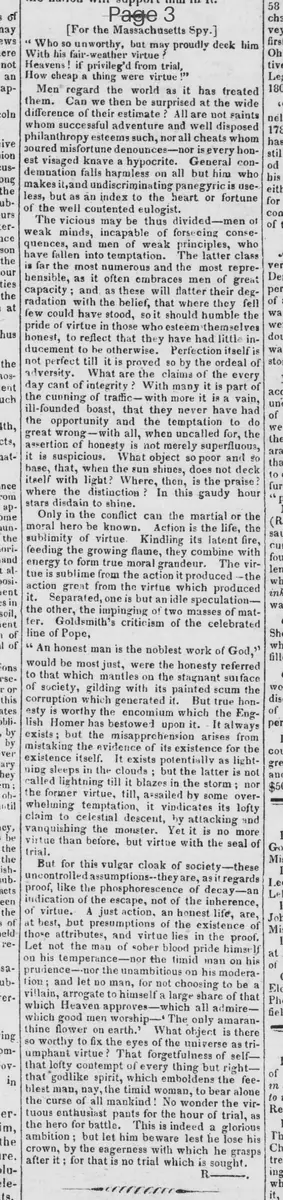
[For the Massachusetts Spy.]
" Who so unworthy, but may proudly deck him With his fair-weather virtue? Heavens! if privileg'd from trial. How cheap a thing were virtue!"
Men regard the world as it has treated them. Can we then be surprised at the wide difference of their estimate ? All are not saints whom successful adventure and well disposed philanthropy esteems such, nor all cheats whom soured misfortune denounces—nor is every honest visaged knave a hypocrite. General condemnation falls harmless on all but him who makes it, and undiscriminating panegyric is useless, but as an index to the heart or fortune of the well contented eulogist.
The vicious may be thus divided—men of weak minds, incapable of foreseeing consequences, and men of weak principles, who have fallen into temptation. The latter class is far the most numerous and the most reprehensible, as it often embraces men of great capacity; and as these will flatter their degradation with the belief, that where they fell few could have stood, it should humble the pride of virtue in those who esteem themselves honest, to reflect that they have had little inducement to be otherwise. Perfection itself is not perfect till it is proved so by the ordeal of adversity. What are the claims of the every day cant of integrity ? With many it is part of the cunning of traffic—with more it is a vain, ill-founded boast, that they never have had the opportunity and the temptation to do great wrong—with all, when uncalled for, the assertion of honesty is not merely superfluous, it is suspicious. What object so poor and so base, that, when the sun shines, does not deck itself with light? Where, then, is the praise? where the distinction ? In this gaudy hour stars disdain to shine.
Only in the conflict can the martial or the moral hero be known. Action is the life, the sublimity of virtue. Kindling its latent fire, feeding the growing flame, they combine with energy to form true moral grandeur. The virtue is sublime from the action it produced—the action great from the virtue which produced it. Separated, one is but an idle speculation—the other, the impinging of two masses of matter. Goldsmith's criticism of the celebrated line of Pope,
"An honest man is the noblest work of God,"
would be most just, were the honesty referred to that which mantles on the stagnant surface of society, gilding with its painted scum the corruption which generated it. But true honesty is worthy the encomium which the English Homer has bestowed upon it. It always exists; but the misapprehension arises from mistaking the evidence of its existence for the existence itself. It exists potentially as lightning sleeps in the clouds; but the latter is not called lightning till it blazes in the storm; nor the former virtue, till, assailed by some overwhelming temptation it vindicates its lofty claim to celestial descent, by attacking and vanquishing the monster. Yet it is no more virtue than before, but virtue with the seal of trial.
But for this vulgar cloak of society—these uncontrolled assumptions—they are, as it regards proof, like the phosphorescence of decay—an indication of the escape, not of the inherence, of virtue. A just action, an honest life, are, at best, but presumptions of the existence of those attributes, and virtue lies in the proof.
Let not the man of sober blood pride himself on his temperance—nor the timid man on his prudence—nor the unambitious on his moderation; and let no man, for not choosing to be a villain, arrogate to himself a large share of that which Heaven approves—which all admire—which good men worship—' The only amaranthine flower on earth.'" What object is there so worthy to fix the eyes of the universe as triumphant virtue? That forgetfulness of self that lofty contempt of every thing but right—that godlike spirit, which emboldens the feeblest man, nay, the timid woman, to bear alone the curse of all mankind! No wonder the virtuous enthusiast pants for the hour of trial, as the hero for battle. This is indeed a glorious ambition: but let him beware lest he lose his crown, by the eagerness with which he grasps after it: for that is no trial which is sought.
R
" Who so unworthy, but may proudly deck him With his fair-weather virtue? Heavens! if privileg'd from trial. How cheap a thing were virtue!"
Men regard the world as it has treated them. Can we then be surprised at the wide difference of their estimate ? All are not saints whom successful adventure and well disposed philanthropy esteems such, nor all cheats whom soured misfortune denounces—nor is every honest visaged knave a hypocrite. General condemnation falls harmless on all but him who makes it, and undiscriminating panegyric is useless, but as an index to the heart or fortune of the well contented eulogist.
The vicious may be thus divided—men of weak minds, incapable of foreseeing consequences, and men of weak principles, who have fallen into temptation. The latter class is far the most numerous and the most reprehensible, as it often embraces men of great capacity; and as these will flatter their degradation with the belief, that where they fell few could have stood, it should humble the pride of virtue in those who esteem themselves honest, to reflect that they have had little inducement to be otherwise. Perfection itself is not perfect till it is proved so by the ordeal of adversity. What are the claims of the every day cant of integrity ? With many it is part of the cunning of traffic—with more it is a vain, ill-founded boast, that they never have had the opportunity and the temptation to do great wrong—with all, when uncalled for, the assertion of honesty is not merely superfluous, it is suspicious. What object so poor and so base, that, when the sun shines, does not deck itself with light? Where, then, is the praise? where the distinction ? In this gaudy hour stars disdain to shine.
Only in the conflict can the martial or the moral hero be known. Action is the life, the sublimity of virtue. Kindling its latent fire, feeding the growing flame, they combine with energy to form true moral grandeur. The virtue is sublime from the action it produced—the action great from the virtue which produced it. Separated, one is but an idle speculation—the other, the impinging of two masses of matter. Goldsmith's criticism of the celebrated line of Pope,
"An honest man is the noblest work of God,"
would be most just, were the honesty referred to that which mantles on the stagnant surface of society, gilding with its painted scum the corruption which generated it. But true honesty is worthy the encomium which the English Homer has bestowed upon it. It always exists; but the misapprehension arises from mistaking the evidence of its existence for the existence itself. It exists potentially as lightning sleeps in the clouds; but the latter is not called lightning till it blazes in the storm; nor the former virtue, till, assailed by some overwhelming temptation it vindicates its lofty claim to celestial descent, by attacking and vanquishing the monster. Yet it is no more virtue than before, but virtue with the seal of trial.
But for this vulgar cloak of society—these uncontrolled assumptions—they are, as it regards proof, like the phosphorescence of decay—an indication of the escape, not of the inherence, of virtue. A just action, an honest life, are, at best, but presumptions of the existence of those attributes, and virtue lies in the proof.
Let not the man of sober blood pride himself on his temperance—nor the timid man on his prudence—nor the unambitious on his moderation; and let no man, for not choosing to be a villain, arrogate to himself a large share of that which Heaven approves—which all admire—which good men worship—' The only amaranthine flower on earth.'" What object is there so worthy to fix the eyes of the universe as triumphant virtue? That forgetfulness of self that lofty contempt of every thing but right—that godlike spirit, which emboldens the feeblest man, nay, the timid woman, to bear alone the curse of all mankind! No wonder the virtuous enthusiast pants for the hour of trial, as the hero for battle. This is indeed a glorious ambition: but let him beware lest he lose his crown, by the eagerness with which he grasps after it: for that is no trial which is sought.
R
What sub-type of article is it?
Philosophical
Reflective
Ethical Moral
What themes does it cover?
Morality
What keywords are associated?
Virtue
Honesty
Adversity
Trial
Temptation
Moral Hero
Integrity
What entities or persons were involved?
R
Massachusetts Spy
Letter to Editor Details
Author
R
Recipient
Massachusetts Spy
Main Argument
true virtue and honesty are only proven through trials and temptations in adversity, not in prosperous or untested circumstances; superficial claims of integrity are suspicious and unproven.
Notable Details
Opening Quote On Fair Weather Virtue
References Goldsmith's Criticism Of Pope's Line 'An Honest Man Is The Noblest Work Of God'
Analogy Of Virtue To Lightning In Clouds
Quote On 'The Only Amaranthine Flower On Earth'