Thank you for visiting SNEWPapers!
Sign up free
Editorial
October 4, 1833
Richmond Enquirer
Richmond, Richmond County, Virginia
What is this article about?
This editorial, part I, doubts President Jackson's authority over public deposits, highlights the Treasury Department's independence from executive control, quotes historical acts establishing departments, and critiques the removal of Secretary Taney over Bank of the United States abuses, while urging action against the bank.
Clipping
OCR Quality
95%
Excellent
Full Text
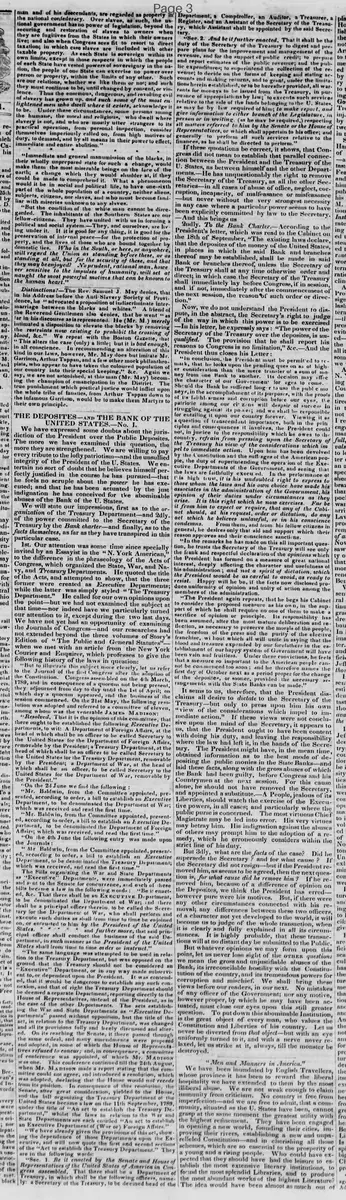
THE DEPOSITES-AND THE BANK OF THE UNITED STATES.-No. I.
We have expressed some doubts about the jurisdiction of the President over the Public Deposites. The more we have examined this question, the more they are strengthened. We are willing to pay every tribute to the lofty patriotism--and the unsullied integrity of the President of the U. States. We entertain no sort of doubt that he believes himself perfectly justified in the course he has pursued-that he feels no scruple about the power he has executed; and that he has been actuated by the just indignation he has conceived for the abominable abuses of the Bank of the U. States.
We will state our impressions, first as to the organization of the Treasury Department-and 2dly. of the power committed to the Secretary of the Treasury by the Bank charter-and finally; as to the facts themselves, as far as they have transpired in this particular case.
1st. Our attention was some time since specially invited by an Essayist in the "N. York American," to the difference in the phraseology of the Acts of Congress, which organized the State, War, and Navy, and Treasury Departments. He quoted the title of the Acts, and attempted to show, that the three former were created as Executive Departments; while the latter was simply styled "The Treasury Department." He called for our own opinions upon the point-but we had not examined the subject at that time-nor indeed have we particularly turned our attention to it, except during the two last days. We have not yet had an opportunity of examining the Journals of Congress-and our researches had not extended beyond the three volumes of Story's Edition of "The Public and General Statutes"- when we met with an article from the New York Courier and Enquirer, which professes to give the following history of the laws in question:
"But to illustrate this subject more clearly, let us refer to the Journal of the first Congress after the adoption of the Constitution. Congress assembled on the 4th March, 1789, and in consequence of a quorum not being present, they adjourned from day to day until the 1st of April; on which day a quorum appeared, and the business of the session commenced. On the 21st May, the following resolution was adopted and referred to a committee of eleven, among whom was the venerable James Madison:
"Resolved, That it is the opinion of this committee, that there ought to be established the following Executive Departments, to wit: A Department of Foreign Affairs, at the head of which shall be an officer to be called Secretary to the United States for the Department of Foreign Affairs, removable by the President; a Treasury Department, at the head of which shall be an officer to be called Secretary to the United States for the Treasury Department, removable by the President; a Department of War, at the head of which shall be an officer, to be called Secretary to the United States for the Department of War, removable by the President."
"On the 21st June we find the following:
"Mr. Baldwin, from the Committee appointed, presented, according to order, a bill to establish an Executive Department, to be denominated the Department of War; which was received and read the first time."
"Mr. Baldwin, from the Committee appointed, presented, according to order, a bill to establish an Executive Department, to be denominated the Department of Foreign Affairs: which was received, and read the first time."
"On the 4th June the following entry was made upon the Journals:
"Mr Baldwin, from the Committee appointed, presented, according to order, a bill to establish an Executive Department, to be denominated the Treasury Department; which was received, and read the first time."
The Bills organizing the War and State Departments as "Executive" Departments, were immediately passed and sent to the Senate for concurrence, and each of these bills became a law in the following words: "Be it enacted, &c. That there shall be an Executive Department, to be denominated the Department of War; and there shall be a principal officer therein, to be called the Secretary for the Department of War, who shall perform and execute such duties as shall from time to time be enjoined on, or entrusted to him by the President of the United States.
and furthermore, that said principal officer shall conduct the business of the said Department, in such manner as the President of the United States shall from time to time order or instruct."
"The same language was attempted to be used in relation to the Treasury Department, but was opposed on the ground that the Treasury should not be considered an "Executive" Department, or in any way made subservient to, or dependent upon the President. It was contended, that it would be dangerous to establish any such connexion, and that of right the Treasury Department should be deemed a separate Department, reporting directly to the House of Representatives, instead of the President, as in the case of the other Departments. The acts establishing the War and State Departments as "Executive Departments" passed without opposition, but the title of the act, in relation to the Treasury Department, was changed and all its provisions fully and freely discussed and altered. On its reaching the Senate, it there passed through the same ordeal, and many amendments were proposed and adopted, in some of which the House of Representatives refused to concur; and, in consequence, a committee of conference was appointed, of which Mr. Madison was one. This conference continued till the 24th August, when Mr. Madison made a report stating that the committee could not agree, and introduced a resolution, which was adopted, declaring that the House would not recede from its position. In consequence of this resolution, the Senate, after great consideration, yielded to the House, and the bill organizing the Treasury Department of the United States became a law on the 2d September, 1789, under the title of "An act to establish the Treasury Department," whilst the laws in relation to the War and State Departments are each entitled "An act to establish an Executive Department of (War or) Foreign Affairs."
"We have already given the provisions of this act, showing the dependence of those Departments upon the Executive, and will now quote the first and second sections of the "Act to establish the Treasury Department." They are in the following words:
"Sec. 1. Be it enacted by the Senate and House of Representatives of the United States of America in Congress assembled, That there shall be a Department of Treasury, in which shall be the following officers, namely: a Secretary of the Treasury, to be deemed head of the Department; a Comptroller, an Auditor, a Treasurer, a Register, and an Assistant of the Secretary of the Treasury, which Assistant shall be appointed by the said Secretary.
"Sec.2. And be it further enacted. That it shall be the duty of the Secretary of the Treasury to digest and prepare plans for the improvement and management of the revenue, and for the support of public credit; to prepare and report estimates of the public revenue; and the public expenditures; to superintend the collection of the revenue; to decide on the forms of keeping and stating accounts and making returns, and to grant, under the limitations herein established, or to be hereafter provided, all warrants for moneys to be issued from the Treasury, in pursuance of appropriations by law; "to execute such services relative to the sale of the lands belonging to the U. States, as may be by law required of him; to make report, and give information to either branch of the Legislature, in person or in writing. (as he may be required,) respecting all matters referred to him by the Senate or the House of Representatives, or which shall appertain to his office; and generally to perform all such services relative to the finances, as he shall be directed to perform."
If these quotations be correct, it shows, that Congress did not mean to establish that parallel connexion between the President and the Treasury of the U. States, as between himself and the other Departments.-He has unquestionably the right to remove the Secretary of the Treasury, as all the other Secretaries-in all cases of abuse of office, neglect, corruption, incapacity, of malfeasance or misfeasance -but never without the very strongest necessity in any case where a particular power seems to have been explicitly committed by law to the Secretary.
—And this brings us 2dly. To the Bank Charter.-According to the President's letter, which was read to the Cabinet on the 18th of September, "The existing laws declare, that the deposites of the money of the United States, in places in which the said Bank and branches thereof may be established, shall be made in said Bank or branches thereof, unless the Secretary of the Treasury shall at any time otherwise order and direct; in which case the Secretary of the Treasury shall immediately lay before Congress, if in session, and if not, immediately after the commencement of the next session, the reason of such order or direction."
Now, we do not understand the President to dispute, in the abstract, the Secretary's right to judge of the way in which this power is to be exercised —In his letter, he expressly says : "The power of the Secretary of the Treasury over the deposites, is unqualified. The provision that he shall report his reasons to Congress is no limitation," &c.-And the President thus closes his Letter:
"In conclusion, the President must be permitted to remark, that he looks upon the pending question as of higher consideration than the mere transfer of a sum of money from one Bank to another. Its decision may affect the character of our Government for ages to come. Should the Bank be suffered longer to use the public moneys, in the accomplishment of its purposes, with the proofs of its faithlessness and corruption before our eyes, the patriotic among our citizens will despair of success in struggling against its power; and we shall be responsible for entailing it upon our country forever. Viewing it as a question of transcendent importance, both in the principles and consequences it involves, the President could not, in justice to the responsibility which he owes to the country, refrain from pressing upon the Secretary of the Treasury his view of the considerations which impel to immediate action. Upon him has been devolved by the Constitution and the suffrages of the American people, the duty of superintending the operation of the Executive Departments of the Government, and seeing that the laws are faithfully executed. In the performance of this high trust, it is his undoubted right to express to those whom the laws and his own choice have made his associates in the administration of the Government, his opinion of their duties under circumstances as they arise. It is this right which he now exercises. Far be it from him to expect or require, that any of the Cabinet should, at his request, order or dictation, do any act which he believes unlawful, or in his conscience condemns.
From them, and from his fellow citizens in general, he desires only that aid and support which their reason approves and their conscience sanctions.
"In the remarks he has made on this all important question, he trusts the Secretary of the Treasury will see only the frank and respectful declaration of the opinions which the President has formed on a measure of great national interest, deeply affecting the character and usefulness of his administration; and not a spirit of dictation, which the President would be as careful to avoid, as ready to resist. Happy will he be, if the facts now disclosed produce uniformity of opinion and unity of action among the members of the administration.
"The President again repeats, that he begs his Cabinet to consider the proposed measure as his own, in the support of which he shall require no one of them to make a sacrifice of opinion or principle. Its responsibility has been assumed, after the most mature deliberation and reflection, as necessary to preserve the morals of the people, the freedom of the press and the purity of the elective franchise, without which all will unite in saying that the blood and treasure expended by our forefathers in the establishment of our happy system of Government will have been vain and fruitless. Under these convictions, he feels that a measure so important to the American people cannot be commenced too soon: and he therefore names the first day of October next as a period proper for the change of the deposites, or sooner, provided the necessary arrangements with the State Banks can be made."
It seems to us, therefore, that the President disclaims all desire to dictate to the Secretary of the Treasury-but only to press upon him his own "view of the considerations which impel to immediate action." If these views were not conclusive upon the mind of the Secretary, it appears to us, that the President ought to have been content with doing his duty, and leaving the responsibility where the law had left it, in the hands of the Secretary. The President might have, in the mean time, obtained information as to the best mode of depositing the public monies in the State Banks-and laid these facts, along with the gross abuses of which the Bank had been guilty, before Congress and his Countrymen at the next session. For this cause alone, he should not have removed the Secretary. and appointed a substitute.-A People, jealous of its Liberties, should watch the exercise of the Executive powers, in all cases; and particularly where the public purse is concerned. The most virtuous Chief Magistrate may be led into error. His very virtues may betray him. His indignation against the abuses of others may prompt him to the adoption of a remedy, which he erroneously considers within the strict line of his duty.
But 3dly, what are the facts of the case? Did he supersede the Secretary? and for what cause? If the Secretary did not resign--but if the President removed him, as seems to be agreed, then the next question is, for what cause did he remove him? If he removed him, because of a difference of opinion on the Deposites, we think the President has erred— however pure were his motives. But, if there were any other circumstances connected with his removal; any differences between these two officers. of a character not yet developed to the world, it will become us to judge of the whole transaction, when it is clearly and fully explained in all its circumstances. It is highly probable, that these transactions will at no distant day be submitted to the Public.
But whatever opinions we may form upon this point, let us never lose sight of the other question: we mean the gross and unjustifiable abuses of the Bank, its irreconcilable hostility with the Constitution of the country, and its tremendous powers for corruption and mischief. We shall bring these views before our readers, in our next. No mistakes of any officer of the Government; nor any motive, however proper, by which he may have been actuated, must close our eyes upon this still greater question. To put down this abominable Institution, is the great object of every man, who values the Constitution and Liberties of his country. Let us never be diverted from that object—but with an eye uniformly turned to it, and with a nerve never relaxed, let us strike at it, always, till the monster be destroyed.
We have expressed some doubts about the jurisdiction of the President over the Public Deposites. The more we have examined this question, the more they are strengthened. We are willing to pay every tribute to the lofty patriotism--and the unsullied integrity of the President of the U. States. We entertain no sort of doubt that he believes himself perfectly justified in the course he has pursued-that he feels no scruple about the power he has executed; and that he has been actuated by the just indignation he has conceived for the abominable abuses of the Bank of the U. States.
We will state our impressions, first as to the organization of the Treasury Department-and 2dly. of the power committed to the Secretary of the Treasury by the Bank charter-and finally; as to the facts themselves, as far as they have transpired in this particular case.
1st. Our attention was some time since specially invited by an Essayist in the "N. York American," to the difference in the phraseology of the Acts of Congress, which organized the State, War, and Navy, and Treasury Departments. He quoted the title of the Acts, and attempted to show, that the three former were created as Executive Departments; while the latter was simply styled "The Treasury Department." He called for our own opinions upon the point-but we had not examined the subject at that time-nor indeed have we particularly turned our attention to it, except during the two last days. We have not yet had an opportunity of examining the Journals of Congress-and our researches had not extended beyond the three volumes of Story's Edition of "The Public and General Statutes"- when we met with an article from the New York Courier and Enquirer, which professes to give the following history of the laws in question:
"But to illustrate this subject more clearly, let us refer to the Journal of the first Congress after the adoption of the Constitution. Congress assembled on the 4th March, 1789, and in consequence of a quorum not being present, they adjourned from day to day until the 1st of April; on which day a quorum appeared, and the business of the session commenced. On the 21st May, the following resolution was adopted and referred to a committee of eleven, among whom was the venerable James Madison:
"Resolved, That it is the opinion of this committee, that there ought to be established the following Executive Departments, to wit: A Department of Foreign Affairs, at the head of which shall be an officer to be called Secretary to the United States for the Department of Foreign Affairs, removable by the President; a Treasury Department, at the head of which shall be an officer to be called Secretary to the United States for the Treasury Department, removable by the President; a Department of War, at the head of which shall be an officer, to be called Secretary to the United States for the Department of War, removable by the President."
"On the 21st June we find the following:
"Mr. Baldwin, from the Committee appointed, presented, according to order, a bill to establish an Executive Department, to be denominated the Department of War; which was received and read the first time."
"Mr. Baldwin, from the Committee appointed, presented, according to order, a bill to establish an Executive Department, to be denominated the Department of Foreign Affairs: which was received, and read the first time."
"On the 4th June the following entry was made upon the Journals:
"Mr Baldwin, from the Committee appointed, presented, according to order, a bill to establish an Executive Department, to be denominated the Treasury Department; which was received, and read the first time."
The Bills organizing the War and State Departments as "Executive" Departments, were immediately passed and sent to the Senate for concurrence, and each of these bills became a law in the following words: "Be it enacted, &c. That there shall be an Executive Department, to be denominated the Department of War; and there shall be a principal officer therein, to be called the Secretary for the Department of War, who shall perform and execute such duties as shall from time to time be enjoined on, or entrusted to him by the President of the United States.
and furthermore, that said principal officer shall conduct the business of the said Department, in such manner as the President of the United States shall from time to time order or instruct."
"The same language was attempted to be used in relation to the Treasury Department, but was opposed on the ground that the Treasury should not be considered an "Executive" Department, or in any way made subservient to, or dependent upon the President. It was contended, that it would be dangerous to establish any such connexion, and that of right the Treasury Department should be deemed a separate Department, reporting directly to the House of Representatives, instead of the President, as in the case of the other Departments. The acts establishing the War and State Departments as "Executive Departments" passed without opposition, but the title of the act, in relation to the Treasury Department, was changed and all its provisions fully and freely discussed and altered. On its reaching the Senate, it there passed through the same ordeal, and many amendments were proposed and adopted, in some of which the House of Representatives refused to concur; and, in consequence, a committee of conference was appointed, of which Mr. Madison was one. This conference continued till the 24th August, when Mr. Madison made a report stating that the committee could not agree, and introduced a resolution, which was adopted, declaring that the House would not recede from its position. In consequence of this resolution, the Senate, after great consideration, yielded to the House, and the bill organizing the Treasury Department of the United States became a law on the 2d September, 1789, under the title of "An act to establish the Treasury Department," whilst the laws in relation to the War and State Departments are each entitled "An act to establish an Executive Department of (War or) Foreign Affairs."
"We have already given the provisions of this act, showing the dependence of those Departments upon the Executive, and will now quote the first and second sections of the "Act to establish the Treasury Department." They are in the following words:
"Sec. 1. Be it enacted by the Senate and House of Representatives of the United States of America in Congress assembled, That there shall be a Department of Treasury, in which shall be the following officers, namely: a Secretary of the Treasury, to be deemed head of the Department; a Comptroller, an Auditor, a Treasurer, a Register, and an Assistant of the Secretary of the Treasury, which Assistant shall be appointed by the said Secretary.
"Sec.2. And be it further enacted. That it shall be the duty of the Secretary of the Treasury to digest and prepare plans for the improvement and management of the revenue, and for the support of public credit; to prepare and report estimates of the public revenue; and the public expenditures; to superintend the collection of the revenue; to decide on the forms of keeping and stating accounts and making returns, and to grant, under the limitations herein established, or to be hereafter provided, all warrants for moneys to be issued from the Treasury, in pursuance of appropriations by law; "to execute such services relative to the sale of the lands belonging to the U. States, as may be by law required of him; to make report, and give information to either branch of the Legislature, in person or in writing. (as he may be required,) respecting all matters referred to him by the Senate or the House of Representatives, or which shall appertain to his office; and generally to perform all such services relative to the finances, as he shall be directed to perform."
If these quotations be correct, it shows, that Congress did not mean to establish that parallel connexion between the President and the Treasury of the U. States, as between himself and the other Departments.-He has unquestionably the right to remove the Secretary of the Treasury, as all the other Secretaries-in all cases of abuse of office, neglect, corruption, incapacity, of malfeasance or misfeasance -but never without the very strongest necessity in any case where a particular power seems to have been explicitly committed by law to the Secretary.
—And this brings us 2dly. To the Bank Charter.-According to the President's letter, which was read to the Cabinet on the 18th of September, "The existing laws declare, that the deposites of the money of the United States, in places in which the said Bank and branches thereof may be established, shall be made in said Bank or branches thereof, unless the Secretary of the Treasury shall at any time otherwise order and direct; in which case the Secretary of the Treasury shall immediately lay before Congress, if in session, and if not, immediately after the commencement of the next session, the reason of such order or direction."
Now, we do not understand the President to dispute, in the abstract, the Secretary's right to judge of the way in which this power is to be exercised —In his letter, he expressly says : "The power of the Secretary of the Treasury over the deposites, is unqualified. The provision that he shall report his reasons to Congress is no limitation," &c.-And the President thus closes his Letter:
"In conclusion, the President must be permitted to remark, that he looks upon the pending question as of higher consideration than the mere transfer of a sum of money from one Bank to another. Its decision may affect the character of our Government for ages to come. Should the Bank be suffered longer to use the public moneys, in the accomplishment of its purposes, with the proofs of its faithlessness and corruption before our eyes, the patriotic among our citizens will despair of success in struggling against its power; and we shall be responsible for entailing it upon our country forever. Viewing it as a question of transcendent importance, both in the principles and consequences it involves, the President could not, in justice to the responsibility which he owes to the country, refrain from pressing upon the Secretary of the Treasury his view of the considerations which impel to immediate action. Upon him has been devolved by the Constitution and the suffrages of the American people, the duty of superintending the operation of the Executive Departments of the Government, and seeing that the laws are faithfully executed. In the performance of this high trust, it is his undoubted right to express to those whom the laws and his own choice have made his associates in the administration of the Government, his opinion of their duties under circumstances as they arise. It is this right which he now exercises. Far be it from him to expect or require, that any of the Cabinet should, at his request, order or dictation, do any act which he believes unlawful, or in his conscience condemns.
From them, and from his fellow citizens in general, he desires only that aid and support which their reason approves and their conscience sanctions.
"In the remarks he has made on this all important question, he trusts the Secretary of the Treasury will see only the frank and respectful declaration of the opinions which the President has formed on a measure of great national interest, deeply affecting the character and usefulness of his administration; and not a spirit of dictation, which the President would be as careful to avoid, as ready to resist. Happy will he be, if the facts now disclosed produce uniformity of opinion and unity of action among the members of the administration.
"The President again repeats, that he begs his Cabinet to consider the proposed measure as his own, in the support of which he shall require no one of them to make a sacrifice of opinion or principle. Its responsibility has been assumed, after the most mature deliberation and reflection, as necessary to preserve the morals of the people, the freedom of the press and the purity of the elective franchise, without which all will unite in saying that the blood and treasure expended by our forefathers in the establishment of our happy system of Government will have been vain and fruitless. Under these convictions, he feels that a measure so important to the American people cannot be commenced too soon: and he therefore names the first day of October next as a period proper for the change of the deposites, or sooner, provided the necessary arrangements with the State Banks can be made."
It seems to us, therefore, that the President disclaims all desire to dictate to the Secretary of the Treasury-but only to press upon him his own "view of the considerations which impel to immediate action." If these views were not conclusive upon the mind of the Secretary, it appears to us, that the President ought to have been content with doing his duty, and leaving the responsibility where the law had left it, in the hands of the Secretary. The President might have, in the mean time, obtained information as to the best mode of depositing the public monies in the State Banks-and laid these facts, along with the gross abuses of which the Bank had been guilty, before Congress and his Countrymen at the next session. For this cause alone, he should not have removed the Secretary. and appointed a substitute.-A People, jealous of its Liberties, should watch the exercise of the Executive powers, in all cases; and particularly where the public purse is concerned. The most virtuous Chief Magistrate may be led into error. His very virtues may betray him. His indignation against the abuses of others may prompt him to the adoption of a remedy, which he erroneously considers within the strict line of his duty.
But 3dly, what are the facts of the case? Did he supersede the Secretary? and for what cause? If the Secretary did not resign--but if the President removed him, as seems to be agreed, then the next question is, for what cause did he remove him? If he removed him, because of a difference of opinion on the Deposites, we think the President has erred— however pure were his motives. But, if there were any other circumstances connected with his removal; any differences between these two officers. of a character not yet developed to the world, it will become us to judge of the whole transaction, when it is clearly and fully explained in all its circumstances. It is highly probable, that these transactions will at no distant day be submitted to the Public.
But whatever opinions we may form upon this point, let us never lose sight of the other question: we mean the gross and unjustifiable abuses of the Bank, its irreconcilable hostility with the Constitution of the country, and its tremendous powers for corruption and mischief. We shall bring these views before our readers, in our next. No mistakes of any officer of the Government; nor any motive, however proper, by which he may have been actuated, must close our eyes upon this still greater question. To put down this abominable Institution, is the great object of every man, who values the Constitution and Liberties of his country. Let us never be diverted from that object—but with an eye uniformly turned to it, and with a nerve never relaxed, let us strike at it, always, till the monster be destroyed.
What sub-type of article is it?
Economic Policy
Constitutional
Partisan Politics
What keywords are associated?
Public Deposits
Bank Of The United States
Treasury Department
Presidential Power
Secretary Removal
Bank Abuses
Constitutional Limits
What entities or persons were involved?
President Of The United States
Secretary Of The Treasury
Bank Of The United States
James Madison
Congress
Editorial Details
Primary Topic
Presidential Jurisdiction Over Public Deposits And Removal Of Treasury Secretary
Stance / Tone
Critical Of Presidential Overreach But Supportive Of Anti Bank Measures
Key Figures
President Of The United States
Secretary Of The Treasury
Bank Of The United States
James Madison
Congress
Key Arguments
Treasury Department Was Intentionally Not Made An Executive Department To Limit Presidential Control
Secretary Of The Treasury Has Unqualified Power Over Deposits Per Bank Charter
President Erred In Removing Secretary Over Policy Disagreement On Deposits
Bank Of The United States Guilty Of Abuses, Corruption, And Constitutional Hostility
Public Must Focus On Destroying The Bank Despite Executive Errors