Thank you for visiting SNEWPapers!
Sign up free
Literary
February 25, 1888
The Irish Standard
Minneapolis, Saint Paul, Hennepin County, Ramsey County, Minnesota
What is this article about?
An Irish girl, Rose M'Donnel, emigrates to America seeking work to support her struggling family. Alone in New York, she finds shelter with a kind gentleman and his wife, who turns out to be her long-lost sister, now married and prosperous, leading to family reconciliation and aid.
Clipping
OCR Quality
95%
Excellent
Full Text
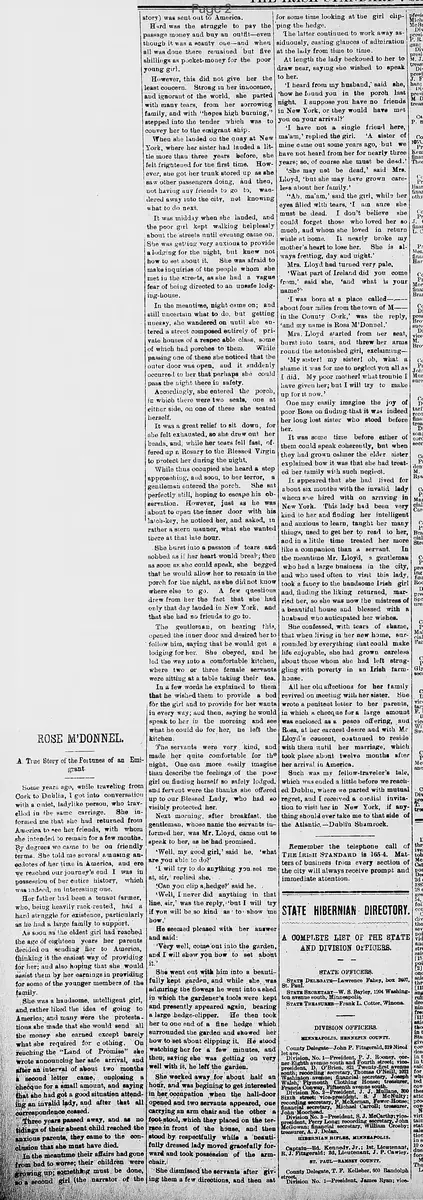
ROSE M'DONNEL,
A True Story of the Fortunes of an Emigrant.
Some years ago, while traveling from Cork to Dublin, I got into conversation with a quiet, ladylike person, who traveled in the same carriage. She informed me that she had returned from America to see her friends, with whom she intended to remain for a few months. By degrees we came to be on friendly terms. She told me several amusing anecdotes of her time in America, and ere we reached our journey's end I was in possession of her entire history, which was indeed an interesting one.
Her father had been a tenant farmer, who, being heavily rack-rented, had a hard struggle for existence, particularly as he had a large family to support. As soon as the eldest girl had reached the age of eighteen years her parents decided on sending her to America, thinking it the easiest way of providing for her; and also hoping that she would assist them by her earnings in providing for some of the younger members of the family.
She was a handsome, intelligent girl, and rather liked the idea of going to America; and many were the protestations she made that she would send all the money she earned except barely what she required for clothing. On reaching the "Land of Promise" she wrote announcing her safe arrival, and after an interval of about two months second letter came, enclosing cheque for a small amount, and saying that she had got a good situation attending an invalid lady, and after that all correspondence ceased.
Three years passed away, and as no tidings of their absent child reached the anxious parents, they came to the conclusion that she must have died. In the meantime their affairs had gone from bad to worse; their children were growing up; something must be done, so second girl (the narrator of the story) was sent out to America.
Hard was the struggle to pay the passage money and buy an outfit—even though it was a scanty one—and when all was done there remained but five shillings as pocket-money for the poor young girl. However, this did not give her the least concern. Strong in her innocence, and ignorant of the world, she parted with many tears, from her sorrowing family, and with "hopes high burning," stepped into the tender which was to convey her to the emigrant ship.
When she landed on the quay at New York, where her sister had landed a little more than three years before, she felt frightened for the first time. However, she got her trunk stored up as she saw other passengers doing, and then, not having any friends to go to, wandered away into the city, not knowing what to do next.
It was midday when she landed, and the poor girl kept walking helplessly about the streets until evening came on. She was getting very anxious to provide a lodging for the night, but knew not how to set about it. She was afraid to make inquiries of the people whom she met in the streets, as she had a vague fear of being directed to an unsafe lodging-house.
In the meantime, night came on; and still uncertain what to do, but getting nervous, she wandered on until she entered a street composed entirely of private houses of a respectable class, some of which had porches to them. While passing one of these she noticed that the outer door was open, and it suddenly occurred to her that perhaps she could pass the night there in safety.
Accordingly, she entered the porch, in which there were two seats, one at either side, on one of these she seated herself. It was a great relief to sit down, for she felt exhausted, so she drew out her beads, and, while her tears fell fast, offered up a Rosary to the Blessed Virgin to protect her during the night.
While thus occupied she heard a step approaching, and soon, to her terror, a gentleman entered the porch. She sat perfectly still, hoping to escape his observation. However, just as he was about to open the inner door with his latch-key, he noticed her, and asked, in rather a stern manner, what she wanted there at that late hour.
She burst into a passion of tears, and sobbed as if her heart would break; then as soon as she could speak, she begged that he would allow her to remain in the porch for the night, as she did not know where else to go. A few questions drew from her the fact that she had only that day landed in New York, and that she had no friends to go to.
The gentleman, on hearing this, opened the inner door and desired her to follow him, saying that he would get a lodging for her. She obeyed, and he led the way into a comfortable kitchen, where two or three female servants were sitting at a table taking their tea. In a few words he explained to them that he wished them to provide a bed for the girl and to provide for her wants in every way; and then, saying he would speak to her in the morning and see what he could do for her, he left the kitchen.
The servants were very kind, and made her quite comfortable for the night. One can more easily imagine than describe the feelings of the poor girl on finding herself so safely lodged, and fervent were the thanks she offered up to our Blessed Lady, who had so visibly protected her.
Next morning, after breakfast, the gentleman, whose name the servants informed her was Mr. Lloyd, came out to speak to her, as he had promised.
'Well, my good girl,' said he, 'what are you able to do?'
'I will try to do anything you set me at, sir,' replied she.
'Can you clip a hedge?' said he.
'Well, I never did anything in that line, sir,' was the reply, 'but I will try if you will be so kind as to show me how.'
He seemed pleased with her answer and said:
'Very well, come out into the garden, and I will show you how to set about it.'
She went out with him into a beautifully kept garden, and while she was admiring the flowers he went into a shed in which the gardener's tools were kept and presently appeared again, bearing a large hedge-clipper.
He then took her to one end of a fine hedge which surrounded the garden and showed her how to set about clipping it. He stood watching her for a few minutes, and then, saying she was getting on very well with it, he left the garden.
She worked away for about half an hour, and was beginning to get interested in her occupation when the hall-door opened and two servants appeared, one carrying an arm chair and the other a foot-stool, which they placed on the terrace in front of the house, and then stood by, respectfully while a beautifully dressed lady moved gracefully forward and took possession of the arm-chair.
She dismissed the servants after giving them a few directions, and then sat for some time looking at the girl clipping the hedge. The latter continued to work away assiduously, casting glances of admiration at the lady from time to time.
At length the lady beckoned to her to draw near, saying she wished to speak to her.
'I heard from my husband,' said she, 'how he found you in the porch last night. I suppose you have no friends in New York, or they would have met you on your arrival?'
'I have not a single friend here, ma'am,' replied the girl. 'A sister of mine came out some years ago, but we have not heard from her for nearly three years; so, of course she must be dead.'
'She may not be dead,' said Mrs. Lloyd, 'but she may have grown careless about her family.'
'Ah, ma'am,' said the girl, while her eyes filled with tears, 'I am sure she must be dead. I don't believe she could forget those who loved her so much, and whom she loved in return while at home. It nearly broke my mother's heart to lose her. She is always fretting, day and night.'
Mrs. Lloyd had turned very pale.
'What part of Ireland did you come from,' said she, 'and what is your name?'
'I was born at a place called--- about four miles from the town of M--- in the County Cork,' was the reply, 'and my name is Rose M'Donnel.'
Mrs. Lloyd started from her seat, burst into tears, and threw her arms round the astonished girl, exclaiming:
'My sister! my sister! oh, what a shame it was for me to neglect you all as I did. My poor mother! what trouble I have given her; but I will try to make up for it now.'
One may easily imagine the joy of poor Rose on finding that it was indeed her long lost sister who stood before her.
It was some time before either of them could speak coherently, but when they had grown calmer the elder sister explained how it was that she had treated her family with such neglect.
It appeared that she had lived for about six months with the invalid lady whom she hired with on arriving in New York. This lady had been very kind to her and finding her intelligent and anxious to learn, taught her many things, used to get her to read to her, and in a little time treated her more like a companion than a servant. In the meantime Mr. Lloyd, a gentleman who had a large business in the city, and who used often to visit this lady, took a fancy to the handsome Irish girl and, finding the liking returned, married her, so she was now the mistress of a beautiful house and blessed with a husband who anticipated her wishes.
She confessed, with tears of shame, that when living in her new home, surrounded by everything that could make life enjoyable, she had grown careless about those whom she had left struggling with poverty in an Irish farm-house.
All her old affections for her family revived on meeting with her sister. She wrote a penitent letter to her parents, in which a cheque for a large amount was enclosed as a peace offering, and Rose, at her earnest desire and with Mr. Lloyd's consent, continued to reside with them until her marriage, which took place about twelve months after her arrival in America.
Such was my fellow-traveler's tale, which was ended a little before we reached Dublin, where we parted with mutual regret, and I received a cordial invitation to visit her in New York, if anything should ever take me to that side of the Atlantic. -Dublin Shamrock.
A True Story of the Fortunes of an Emigrant.
Some years ago, while traveling from Cork to Dublin, I got into conversation with a quiet, ladylike person, who traveled in the same carriage. She informed me that she had returned from America to see her friends, with whom she intended to remain for a few months. By degrees we came to be on friendly terms. She told me several amusing anecdotes of her time in America, and ere we reached our journey's end I was in possession of her entire history, which was indeed an interesting one.
Her father had been a tenant farmer, who, being heavily rack-rented, had a hard struggle for existence, particularly as he had a large family to support. As soon as the eldest girl had reached the age of eighteen years her parents decided on sending her to America, thinking it the easiest way of providing for her; and also hoping that she would assist them by her earnings in providing for some of the younger members of the family.
She was a handsome, intelligent girl, and rather liked the idea of going to America; and many were the protestations she made that she would send all the money she earned except barely what she required for clothing. On reaching the "Land of Promise" she wrote announcing her safe arrival, and after an interval of about two months second letter came, enclosing cheque for a small amount, and saying that she had got a good situation attending an invalid lady, and after that all correspondence ceased.
Three years passed away, and as no tidings of their absent child reached the anxious parents, they came to the conclusion that she must have died. In the meantime their affairs had gone from bad to worse; their children were growing up; something must be done, so second girl (the narrator of the story) was sent out to America.
Hard was the struggle to pay the passage money and buy an outfit—even though it was a scanty one—and when all was done there remained but five shillings as pocket-money for the poor young girl. However, this did not give her the least concern. Strong in her innocence, and ignorant of the world, she parted with many tears, from her sorrowing family, and with "hopes high burning," stepped into the tender which was to convey her to the emigrant ship.
When she landed on the quay at New York, where her sister had landed a little more than three years before, she felt frightened for the first time. However, she got her trunk stored up as she saw other passengers doing, and then, not having any friends to go to, wandered away into the city, not knowing what to do next.
It was midday when she landed, and the poor girl kept walking helplessly about the streets until evening came on. She was getting very anxious to provide a lodging for the night, but knew not how to set about it. She was afraid to make inquiries of the people whom she met in the streets, as she had a vague fear of being directed to an unsafe lodging-house.
In the meantime, night came on; and still uncertain what to do, but getting nervous, she wandered on until she entered a street composed entirely of private houses of a respectable class, some of which had porches to them. While passing one of these she noticed that the outer door was open, and it suddenly occurred to her that perhaps she could pass the night there in safety.
Accordingly, she entered the porch, in which there were two seats, one at either side, on one of these she seated herself. It was a great relief to sit down, for she felt exhausted, so she drew out her beads, and, while her tears fell fast, offered up a Rosary to the Blessed Virgin to protect her during the night.
While thus occupied she heard a step approaching, and soon, to her terror, a gentleman entered the porch. She sat perfectly still, hoping to escape his observation. However, just as he was about to open the inner door with his latch-key, he noticed her, and asked, in rather a stern manner, what she wanted there at that late hour.
She burst into a passion of tears, and sobbed as if her heart would break; then as soon as she could speak, she begged that he would allow her to remain in the porch for the night, as she did not know where else to go. A few questions drew from her the fact that she had only that day landed in New York, and that she had no friends to go to.
The gentleman, on hearing this, opened the inner door and desired her to follow him, saying that he would get a lodging for her. She obeyed, and he led the way into a comfortable kitchen, where two or three female servants were sitting at a table taking their tea. In a few words he explained to them that he wished them to provide a bed for the girl and to provide for her wants in every way; and then, saying he would speak to her in the morning and see what he could do for her, he left the kitchen.
The servants were very kind, and made her quite comfortable for the night. One can more easily imagine than describe the feelings of the poor girl on finding herself so safely lodged, and fervent were the thanks she offered up to our Blessed Lady, who had so visibly protected her.
Next morning, after breakfast, the gentleman, whose name the servants informed her was Mr. Lloyd, came out to speak to her, as he had promised.
'Well, my good girl,' said he, 'what are you able to do?'
'I will try to do anything you set me at, sir,' replied she.
'Can you clip a hedge?' said he.
'Well, I never did anything in that line, sir,' was the reply, 'but I will try if you will be so kind as to show me how.'
He seemed pleased with her answer and said:
'Very well, come out into the garden, and I will show you how to set about it.'
She went out with him into a beautifully kept garden, and while she was admiring the flowers he went into a shed in which the gardener's tools were kept and presently appeared again, bearing a large hedge-clipper.
He then took her to one end of a fine hedge which surrounded the garden and showed her how to set about clipping it. He stood watching her for a few minutes, and then, saying she was getting on very well with it, he left the garden.
She worked away for about half an hour, and was beginning to get interested in her occupation when the hall-door opened and two servants appeared, one carrying an arm chair and the other a foot-stool, which they placed on the terrace in front of the house, and then stood by, respectfully while a beautifully dressed lady moved gracefully forward and took possession of the arm-chair.
She dismissed the servants after giving them a few directions, and then sat for some time looking at the girl clipping the hedge. The latter continued to work away assiduously, casting glances of admiration at the lady from time to time.
At length the lady beckoned to her to draw near, saying she wished to speak to her.
'I heard from my husband,' said she, 'how he found you in the porch last night. I suppose you have no friends in New York, or they would have met you on your arrival?'
'I have not a single friend here, ma'am,' replied the girl. 'A sister of mine came out some years ago, but we have not heard from her for nearly three years; so, of course she must be dead.'
'She may not be dead,' said Mrs. Lloyd, 'but she may have grown careless about her family.'
'Ah, ma'am,' said the girl, while her eyes filled with tears, 'I am sure she must be dead. I don't believe she could forget those who loved her so much, and whom she loved in return while at home. It nearly broke my mother's heart to lose her. She is always fretting, day and night.'
Mrs. Lloyd had turned very pale.
'What part of Ireland did you come from,' said she, 'and what is your name?'
'I was born at a place called--- about four miles from the town of M--- in the County Cork,' was the reply, 'and my name is Rose M'Donnel.'
Mrs. Lloyd started from her seat, burst into tears, and threw her arms round the astonished girl, exclaiming:
'My sister! my sister! oh, what a shame it was for me to neglect you all as I did. My poor mother! what trouble I have given her; but I will try to make up for it now.'
One may easily imagine the joy of poor Rose on finding that it was indeed her long lost sister who stood before her.
It was some time before either of them could speak coherently, but when they had grown calmer the elder sister explained how it was that she had treated her family with such neglect.
It appeared that she had lived for about six months with the invalid lady whom she hired with on arriving in New York. This lady had been very kind to her and finding her intelligent and anxious to learn, taught her many things, used to get her to read to her, and in a little time treated her more like a companion than a servant. In the meantime Mr. Lloyd, a gentleman who had a large business in the city, and who used often to visit this lady, took a fancy to the handsome Irish girl and, finding the liking returned, married her, so she was now the mistress of a beautiful house and blessed with a husband who anticipated her wishes.
She confessed, with tears of shame, that when living in her new home, surrounded by everything that could make life enjoyable, she had grown careless about those whom she had left struggling with poverty in an Irish farm-house.
All her old affections for her family revived on meeting with her sister. She wrote a penitent letter to her parents, in which a cheque for a large amount was enclosed as a peace offering, and Rose, at her earnest desire and with Mr. Lloyd's consent, continued to reside with them until her marriage, which took place about twelve months after her arrival in America.
Such was my fellow-traveler's tale, which was ended a little before we reached Dublin, where we parted with mutual regret, and I received a cordial invitation to visit her in New York, if anything should ever take me to that side of the Atlantic. -Dublin Shamrock.
What sub-type of article is it?
Prose Fiction
What themes does it cover?
Moral Virtue
Political
What keywords are associated?
Irish Emigration
Sister Reunion
Family Neglect
Rack Renting
American Dream
What entities or persons were involved?
Dublin Shamrock
Literary Details
Title
Rose M'donnel, A True Story Of The Fortunes Of An Emigrant.
Author
Dublin Shamrock
Subject
Fortunes Of An Irish Emigrant Girl Reuniting With Her Neglected Sister In America
Key Lines
She Burst Into A Passion Of Tears, And Sobbed As If Her Heart Would Break; Then As Soon As She Could Speak, She Begged That He Would Allow Her To Remain In The Porch For The Night, As She Did Not Know Where Else To Go.
Mrs. Lloyd Started From Her Seat, Burst Into Tears, And Threw Her Arms Round The Astonished Girl, Exclaiming: 'My Sister! My Sister! Oh, What A Shame It Was For Me To Neglect You All As I Did.'
She Confessed, With Tears Of Shame, That When Living In Her New Home, Surrounded By Everything That Could Make Life Enjoyable, She Had Grown Careless About Those Whom She Had Left Struggling With Poverty In An Irish Farm House.