Thank you for visiting SNEWPapers!
Sign up free
Story
November 6, 1931
The Weekly Gazette
East Hartford, Hartford County, Connecticut
What is this article about?
The first recording of a real human heartbeat in a motion picture occurs in an animated educational film produced by Audio-Cinema studios for Western Electric Company, depicting a family of telephone instruments including the electrical stethoscope. An employee's irregular pulse is amplified and recorded directly for a hospital scene.
Clipping
OCR Quality
95%
Excellent
Full Text
First Real Heart Throb Is Put Into Film;
"Pump-Pump" Is Recorded Like Speech
Though press agents have claimed it since motion pictures began, the first real heart throb has just been put into a film. This is no aortic flip-flop induced in the audience by the girl, the mortgage and the old homestead, but the actual beat of the heart in performing its routine duties.
The action which calls for this sound occurs in an animated cartoon. The picture, an educational film produced at the Audio-Cinema studios, depicts a re-union in the family of telephone instruments manufactured by the Western Electric Company.
Shows Telephone Family
The chief character is the telephone itself. The others in the cast are its offspring-the radio microphone, the loud-speaker, the public address system, talking pictures, and the electrical stethoscope.
To illustrate the latter instrument, the story includes a scene in a hospital. A doctor is seen applying the stethoscope to a patient and the sound of a heart beating is heard considerably amplified.
Beat is Irregular
As the action is portrayed entirely by cartooned figures, the part of the film which carries the sound effects was made separately. An employee in the studio, chosen because of his irregular pulse, supplied the heart beat.
Ordinarily, physicians or students listen in on the electrical stethoscope by means of earphones. In this case the instrument was plugged into the amplifier of the Western Electric sound-recording system used in making the film. By means of special adjustments engineers were able to work the two systems directly without first having the sound emitted into the air.
Records Made
Phonograph records of heart beats have been made from the electrical stethoscope for use in medical schools. Oscillographic records have also been transmitted from one physician to another by telephoto and consultations held over long distance telephone. But the sound of the human heart beating has heretofore never been produced in a motion picture film.
The successful recording may lead to the production of motion picture lectures. Specialists can illustrate their diagnoses by reproducing beats which are typical of various forms of heart trouble.
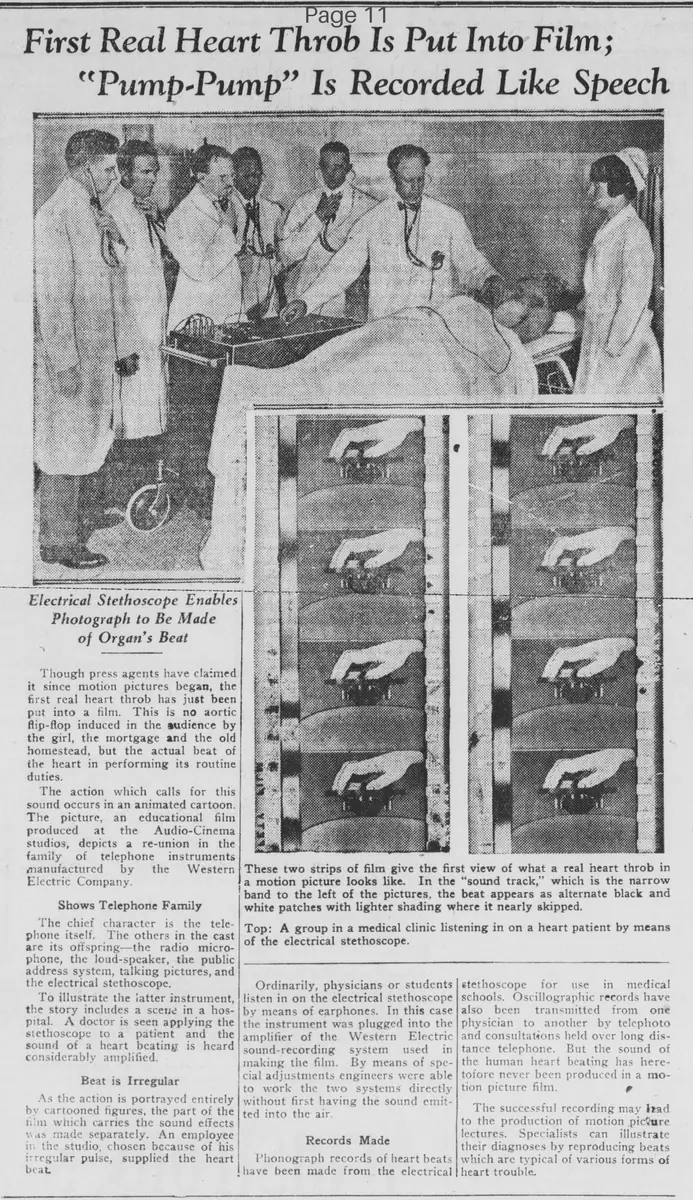
These two strips of film give the first view of what a real heart throb in a motion picture looks like. In the "sound track," which is the narrow band to the left of the pictures, the beat appears as alternate black and white patches with lighter shading where it nearly skipped.
Top: A group in a medical clinic listening in on a heart patient by means of the electrical stethoscope.
"Pump-Pump" Is Recorded Like Speech
Though press agents have claimed it since motion pictures began, the first real heart throb has just been put into a film. This is no aortic flip-flop induced in the audience by the girl, the mortgage and the old homestead, but the actual beat of the heart in performing its routine duties.
The action which calls for this sound occurs in an animated cartoon. The picture, an educational film produced at the Audio-Cinema studios, depicts a re-union in the family of telephone instruments manufactured by the Western Electric Company.
Shows Telephone Family
The chief character is the telephone itself. The others in the cast are its offspring-the radio microphone, the loud-speaker, the public address system, talking pictures, and the electrical stethoscope.
To illustrate the latter instrument, the story includes a scene in a hospital. A doctor is seen applying the stethoscope to a patient and the sound of a heart beating is heard considerably amplified.
Beat is Irregular
As the action is portrayed entirely by cartooned figures, the part of the film which carries the sound effects was made separately. An employee in the studio, chosen because of his irregular pulse, supplied the heart beat.
Ordinarily, physicians or students listen in on the electrical stethoscope by means of earphones. In this case the instrument was plugged into the amplifier of the Western Electric sound-recording system used in making the film. By means of special adjustments engineers were able to work the two systems directly without first having the sound emitted into the air.
Records Made
Phonograph records of heart beats have been made from the electrical stethoscope for use in medical schools. Oscillographic records have also been transmitted from one physician to another by telephoto and consultations held over long distance telephone. But the sound of the human heart beating has heretofore never been produced in a motion picture film.
The successful recording may lead to the production of motion picture lectures. Specialists can illustrate their diagnoses by reproducing beats which are typical of various forms of heart trouble.
These two strips of film give the first view of what a real heart throb in a motion picture looks like. In the "sound track," which is the narrow band to the left of the pictures, the beat appears as alternate black and white patches with lighter shading where it nearly skipped.
Top: A group in a medical clinic listening in on a heart patient by means of the electrical stethoscope.
What sub-type of article is it?
Curiosity
Medical Curiosity
Extraordinary Event
What themes does it cover?
Triumph
Recovery
What keywords are associated?
Heart Recording
Motion Picture
Electrical Stethoscope
Animated Cartoon
Western Electric
Audio Cinema Studios
Where did it happen?
Audio Cinema Studios
Story Details
Location
Audio Cinema Studios
Story Details
An animated educational film about Western Electric's telephone family includes the first motion picture recording of a human heartbeat using an electrical stethoscope on an employee's irregular pulse, amplified directly into the film's sound system for a hospital scene.