Thank you for visiting SNEWPapers!
Sign up free
Daily Davenport Gazette
Davenport, Scott County, Iowa
What is this article about?
British forces at Sebastopol decimated by winter cold and mismanagement; effective troops reduced from 56,000 to 10-11,000, with thousands dead or hospitalized. Reports detail frozen deaths, including Major McDonald, and blame on neglect by various departments under Lord Raglan.
Clipping
OCR Quality
Full Text
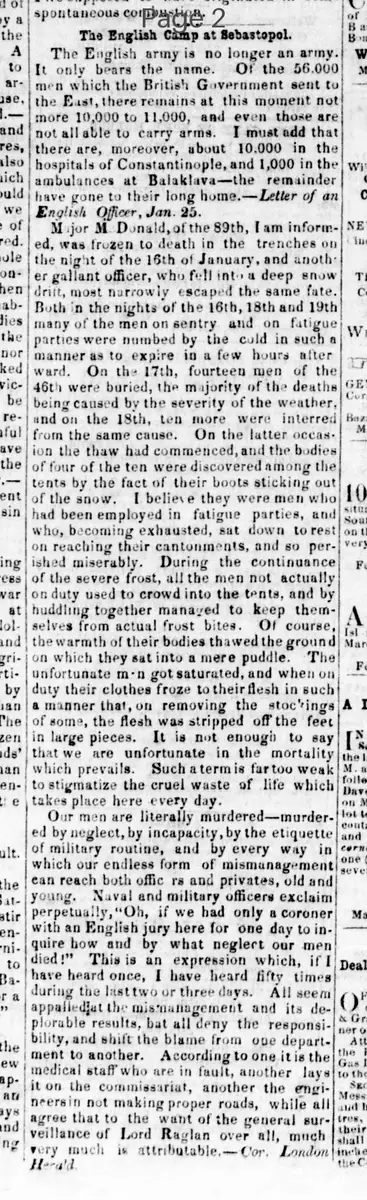
The English army is no longer an army. It only bears the name. Of the 56,000 men which the British Government sent to the East, there remains at this moment not more than 10,000 to 11,000, and even those are not all able to carry arms. I must add that there are, moreover, about 10,000 in the hospitals of Constantinople, and 1,000 in the ambulances at Balaklava—the remainder have gone to their long home.—Letter of an English Officer, Jan. 25.
Major McDonald, of the 89th, I am informed, was frozen to death in the trenches on the night of the 16th of January, and another gallant officer, who fell into a deep snow drift, most narrowly escaped the same fate. Both in the nights of the 16th, 18th and 19th many of the men on sentry and on fatigue parties were numbed by the cold in such a manner as to expire in a few hours afterward. On the 17th, fourteen men of the 46th were buried, the majority of the deaths being caused by the severity of the weather and on the 18th, ten more were interred from the same cause. On the latter occasion the thaw had commenced, and the bodies of four of the ten were discovered among the tents by the fact of their boots sticking out of the snow. I believe they were men who had been employed in fatigue parties, and who, becoming exhausted, sat down to rest on reaching their cantonments, and so perished miserably. During the continuance of the severe frost, all the men not actually on duty used to crowd into the tents, and by huddling together managed to keep themselves from actual frost bites. Of course the warmth of their bodies thawed the ground on which they sat into a mere puddle. The unfortunate men got saturated, and when on duty their clothes froze to their flesh in such a manner that, on removing the stockings of some, the flesh was stripped off the feet in large pieces. It is not enough to say that we are unfortunate in the mortality which prevails. Such a term is far too weak to stigmatize the cruel waste of life which takes place here every day.
Our men are literally murdered—murdered by neglect, by incapacity, by the etiquette of military routine, and by every way in which our endless form of mismanagement can reach both officers and privates, old and young. Naval and military officers exclaim perpetually, "Oh, if we had only a coroner with an English jury here for one day to inquire how and by what neglect our men died!" This is an expression which, if I have heard once, I have heard fifty times during the last two or three days. All seem appalled at the mismanagement and its deplorable results, but all deny the responsibility, and shift the blame from one department to another. According to one it is the medical staff who are in fault, another lays it on the commissariat, another the engineers in not making proper roads, while all agree that to the want of the general surveillance of Lord Raglan over all, much very much is attributable.—Cor. London Herald.
What sub-type of article is it?
What keywords are associated?
What entities or persons were involved?
Where did it happen?
Foreign News Details
Primary Location
Sebastopol
Event Date
January 16 25, 1855
Key Persons
Outcome
effective troops reduced from 56,000 to 10,000-11,000; 10,000 in constantinople hospitals; 1,000 in balaklava ambulances; remainder dead. major mcdonald frozen to death; 14 men of 46th buried on january 17; 10 more on january 18, mostly from cold.
Event Details
British army at Sebastopol suffers severe losses from extreme cold and mismanagement. Men die from frostbite in trenches and camps; bodies found after thaw. Troops huddle in tents, leading to wet and frozen clothing causing further injury. Blame shifted among medical staff, commissariat, engineers, and Lord Raglan's oversight.