Thank you for visiting SNEWPapers!
Sign up free
The New Hampshire Gazette And Historical Chronicle
Portsmouth, Greenland, Rockingham County, New Hampshire
What is this article about?
Rev. Mr. Dawes recounts the plague in Aleppo starting summer 1761, lasting to September 1762, preceded by severe winter 1756-57 destroying olive trees and causing deaths, famine in 1757-58 with cannibalism and sales of family, prior plague killing 60,000 in 1758, troubles and earthquakes in 1759-60. Peak burials 200-300 daily in June-July 1761; unusual cases noted, including in Cyprus 1760.
Clipping
OCR Quality
Full Text
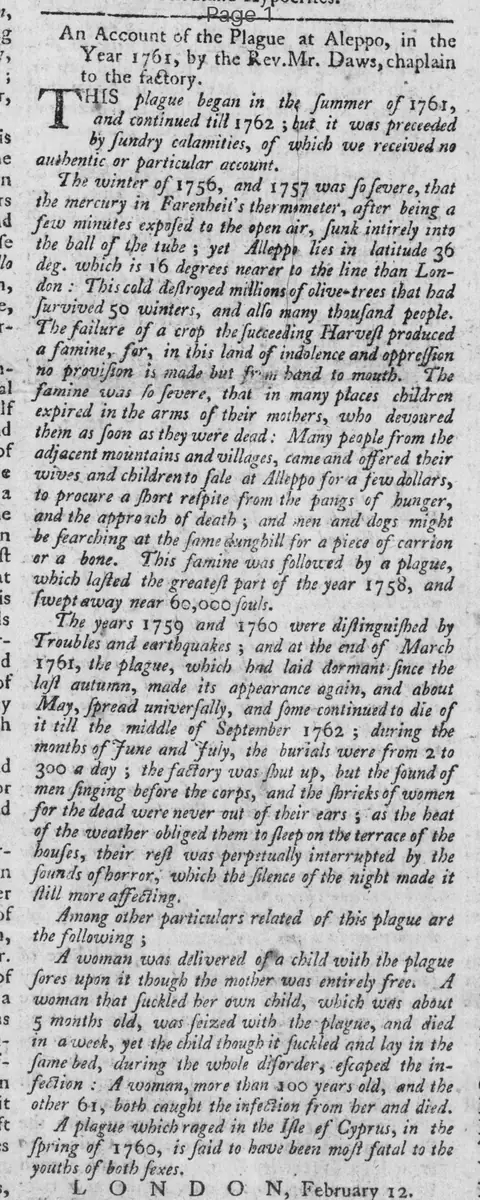
THIS plague began in the summer of 1761, and continued till 1762; but it was preceded by sundry calamities, of which we received no authentic or particular account.
The winter of 1756, and 1757 was so severe, that the mercury in Fahrenheit's thermometer, after being a few minutes exposed to the open air, sunk entirely into the ball of the tube; yet Aleppo lies in latitude 36 deg. which is 16 degrees nearer to the line than London: This cold destroyed millions of olive-trees that had survived 50 winters, and also many thousand people.
The failure of a crop the succeeding harvest produced a famine, for, in this land of indolence and oppression no provision is made but from hand to mouth. The famine was so severe, that in many places children expired in the arms of their mothers, who devoured them as soon as they were dead: Many people from the adjacent mountains and villages, came and offered their wives and children to sale at Aleppo for a few dollars, to procure a short respite from the pangs of hunger, and the approach of death; and men and dogs might be searching at the same dunghill for a piece of carrion or a bone. This famine was followed by a plague, which lasted the greatest part of the year 1758, and swept away near 60,000 souls.
The years 1759 and 1760 were distinguished by Troubles and earthquakes: and at the end of March 1761, the plague, which had laid dormant since the last autumn, made its appearance again, and about May, spread universally, and some continued to die of it till the middle of September 1762; during the months of June and July, the burials were from 200 to 300 a day; the factory was shut up, but the sound of men singing before the corpses, and the shrieks of women for the dead were never out of their ears; as the heat of the weather obliged them to sleep on the terrace of the houses, their rest was perpetually interrupted by the sounds of horror, which the silence of the night made it still more affecting.
Among other particulars related of this plague are the following;
A woman was delivered of a child with the plague sores upon it though the mother was entirely free. A woman that suckled her own child, which was about 5 months old, was seized with the plague, and died in a week, yet the child though it suckled and lay in the same bed, during the whole disorder, escaped the infection: A woman, more than 100 years old, and the other 61, both caught the infection from her and died.
A plague which raged in the Isle of Cyprus, in the spring of 1760, is said to have been most fatal to the youths of both sexes.
What sub-type of article is it?
What keywords are associated?
What entities or persons were involved?
Where did it happen?
Foreign News Details
Primary Location
Aleppo
Event Date
Summer Of 1761 To Middle Of September 1762
Key Persons
Outcome
burials from 200 to 300 a day in june and july 1761; previous plague in 1758 swept away near 60,000 souls; many thousand people died in severe winter 1756-1757; famine in 1757-1758 led to deaths including cannibalism
Event Details
The plague began in summer 1761 after dormant period, spread universally by May, continued till September 1762; preceded by severe winter destroying olive trees and killing thousands, famine causing extreme hunger and sales of family members, prior plague in 1758, troubles and earthquakes in 1759-1760; factory shut up amid daily burials and sounds of mourning; unusual cases of infection in newborns and escapes in infants; separate plague in Cyprus 1760 fatal to youths.