Thank you for visiting SNEWPapers!
Sign up free
Delaware Patriot & American Watchman
Wilmington, New Castle County, Delaware
What is this article about?
Committee report on Tennessee militiamen's six-month service under Gov. Blount during War of 1812, court martial at Mobile on Dec. 5, 1814, for mutiny and desertion at Fort Jackson, resulting in six executions approved by Gen. Jackson.
Clipping
OCR Quality
Full Text
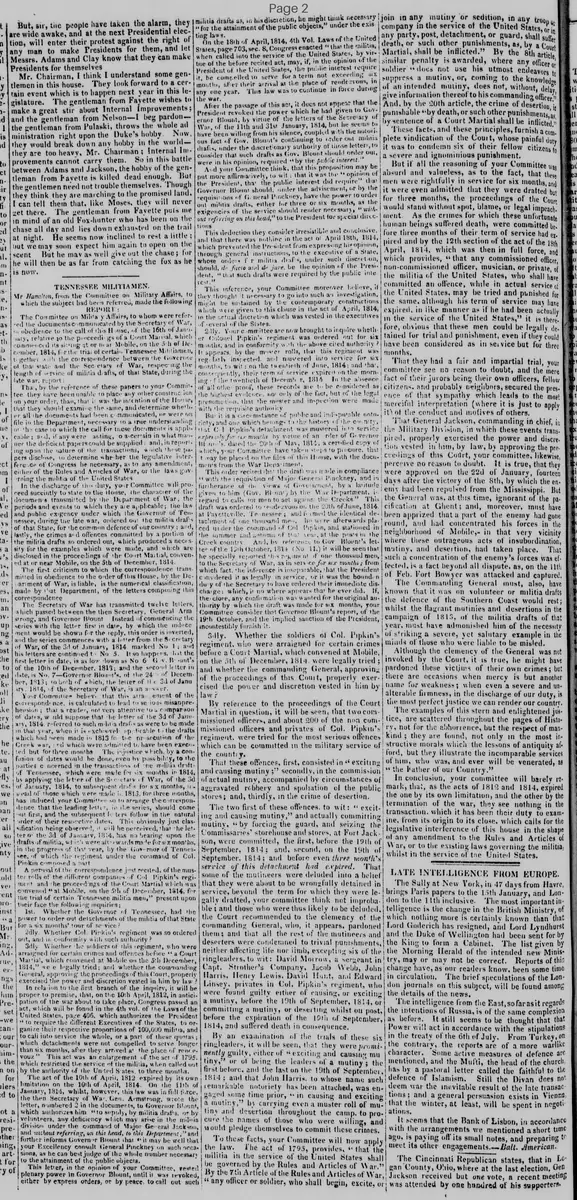
Mr. Hamilton, from the Committee on Military Affairs, to which the subject had been referred, made the following REPORT:
The Committee on Military Affairs, to whom were referred the documents communicated by the Secretary of War, to obedience to the call of this House, of the 16th of January, necessary, relative to the proceedings of a Court Martial, which commenced its sitting at or near Mobile, on the 5th of December, 1814, for the trial of certain Tennessee Militiamen, together with the correspondence between the Governor of that state and the Secretary of War, respecting the length of service of militia drafts, of that State, during the late war, report.
That, by the reference of these papers to your Committee they have been unable to place any other construction on your order, than, that it was the intention of the House, that they should examine the same, and determine whether all the documents had been communicated, or were on file in the Department, necessary to a true understanding of the case to which the call for these documents is applicable; and, if any were wanting, to ascertain in what manner the deficient papers could be supplied: and, in reporting upon the nature of the transactions, which these papers disclose, to determine whether the legislative interference of Congress be necessary, as to any amendment, either of the Rules and Articles of War, or the laws governing the militia of the United States.
In the discharge of this duty, your Committee will proceed succinctly to state to the House, the character of the documents transmitted by the Department of War, the periods and events to which they are applicable; the law and public exigency under which the Governor of Tennessee, during the late war, ordered out the militia drafts of that State, for the common defence of our country; and, lastly, the crimes and offences committed by a portion of the militia drafts so ordered out, which produced a necessity for the examples which were made, and which are disclosed in the proceedings of the Court Martial, convened at or near Mobile, on the 5th of December, 1814.
The first criticism to which the correspondence transmitted in obedience to the order of this House, by the Department of War, is liable, is the numerical classification, made by that Department, of the letters composing this correspondence.
The Secretary of War has transmitted twelve letters, which passed between the then Secretary, General Armstrong, and Governor Blount. Instead of commencing the series with the letter first in date, by which the inducement would be shown for the reply, this order is inverted, and the series commences with a letter from the Secretary of War, of the 3d of January, 1814 marked No 1: and his letters are continued to No 5. It so happens, that the first letter in date, is as low down as No 6 Governor Blount's of the 10th of December, 1813: and the second letter in date, is No. 7—Governor Blount's, of the 24th of December, 1813; to both of which, the letter of the 3d of January, 1814, of the Secretary of War, is an answer.
Your Committee believe that this arrangement of the correspondence, is calculated to lead to serious misapprehension; that a reader, not very attentive to a comparison of dates, would suppose that the letter of the 3d of January, 1814, referred to such militia drafts as were to be made in that year, when it is exclusively applicable to the drafts which had been made in 1813 for the prosecution of the Creek war, and which were admitted to, have been executed but for three months. The injustice which, by a confusion of dates would be done, even by possibility, to the parties concerned in the transactions of the militia drafts of Tennessee, which were made for six months in 1814, by applying the letter of the Secretary of War, of the 3d of January, 1814, to subsequent drafts for six months, instead of those which were made in 1813, for three months, has induced your Committee so to arrange the correspondence, that the leading letter, in the series, should come out first, and the subsequent letters follow in the natural order of their respective dates. This obviously just classification being observed, it will be perceived, that the letter of the 3d of January, 1814, has no bearing upon the drafts of militia, which were afterwards made for six months, in the progress of that year, by the Governor of Tennessee, of which the regiment under the command of Col. Pinkin composed a part.
A perusal of the correspondence just recited, of the muster rolls of the different companies of Col Pipkin's regiment, and the proceedings of the Court Martial which was convened "at Mobile, on the 5th of December, 1814, for the trial of certain Tennessee militia men," present upon their face the following inquiries;
1st. Whether the Governor of Tennessee, had the power to order out detachments of the militia of that State for a six months' tour of service?
2dly. Whether Col. Pinkin's regiment was so ordered out, and in conformity with such authority?
3dly Whether the soldiers of this regiment, who were arraigned for certain crimes and offences before "a Court Martial, which convened at Mobile on the 5th December, 1814," were legally tried: and whether the commanding General, approving the proceedings of this Court, properly exercised the power and discretion vested in him by law?
In relation to the first branch of the inquiry, it will be proper to premise, that, on the 10th April, 1812, in anticipation of the war about to take place, Congress passed an act, which will be found in the 4th vol. of the Laws of the United States, page 406, which authorizes the President "to require the different Executives of the States, to organize their respective proportions of 100,000 militia, and to call into service the whole, or a part of these quotas; which detachments were not compelled to serve longer than six months, after they arrived at the place of rendezvous.
This act was an enlargement of the act of 1795, which restricted the service of the militia, when called out by the authority of the United States, to three months.
The act of the 10th of April, 1812 expired by its own limitation on the 10th of April, 1814. On the 11th of January, 1814, whilst, however, this law was in full force, the then Secretary of War, Gen. Armstrong, wrote the letter, numbered 2 in the documents, to Governor Blount, which authorizes him "to supply, by militia drafts, or by volunteers, any deficiency which may arise in the militia division under the command of Major General Jackson, and without referring, on this head, to this Department;" and further informs Governor Blount that "it may be well that your Excellency consult General Pinckney on such occasions, as he can best judge of the whole number necessary to the attainment of the public objects."
This letter, in the opinion of your Committee, vested plenary power in Governor Blount, until it was revoked, either by express orders, or by peace, to call out such militia drafts as, in his discretion, he might think necessary "for the attainment of the public objects," under the existing laws.
On the 18th of April, 1814, 4th Vol. Laws of the United States, page 703, sec. 8, Congress enacted "that the militia, when called into the service of the United States, by virtue of the before recited act, may, if, in the opinion of the President of the United States, the public interest require it, be compelled to serve for a term not exceeding six months, after their arrival at the place of rendezvous, in any one year. This law was to continue in force during the war."
After the passage of this act, it does not appear that the President revoked the power which he had given to Governor Blount, by virtue of the letters of the Secretary of War, of the 11th and 31st January, 1814, but he seems to have been willing from his silence, coupled with the notorious fact of Gov. Blount's continuing to order out militia drafts, under the discretionary authority of those letters, to consider that such drafts as Gov. Blount should order out, were in his opinion, required "by the public interest."
And your Committee think, that this proposition may be put more affirmatively, to wit: that it was the "opinion of the President, that the public interest did require" that Governor Blount should, under the advisement, or by the requisitions of General Pinckney, have the power to order out militia drafts, either for three or six months, as the exigencies of the service should render necessary, "without referring on this head," to the President for special directions.
This deduction they consider irresistible and conclusive, and that there was nothing in the act of April 18th, 1814, which prevented the President from expressing his opinion, through general instructions, to the executive of a State, whose orders for militia drafts, under such discretion should, de facto and de jure, be the opinion of the President, "that such drafts were required by the public interest."
This Inference, your Committee moreover believe, if they thought it necessary to go into such an investigation, might be sustained by the contemporary constructions which were given to this clause in the act of April, 1814, in the actual discretion which was vested in the executives of several of the States.
2dly. Your committee are now brought to inquire whether Colonel Pipkin's regiment was ordered out for six months, and in conformity with the above cited authority?
It appears, by the muster rolls, that this regiment was regularly inspected, and mustered into service for six months, to wit: on the twentieth of June, 1814: and consequently, their term of service expired on the morning of the twentieth of December, 1814. In the absence of all other proof, these records are to be considered as the highest evidence, not only of the fact, but of the legal presumption, that the muster and inspection were made with the requisite authority.
But it is a circumstance of public and indisputable notoriety, and one which belongs to the history of the country, that Col. Pipkin's detachment was mustered into service expressly for six months by virtue of an order of Governor Blount's, dated the 20th of May, 1814; a certified copy of which, your Committee have taken steps to procure, that it may be placed on the files of this House, with the documents from the War Department.
This order recited that the draft was made in compliance "with the requisition of Major General Pinckney, and in furtherance of the views of Government, by a latitude given to him (Gov. Blount) by the War Department, in regard to calls for men to act against the Creeks." This draft was ordered to rendezvous on the 20th of June, 1814, at Fayetteville, Tennessee: and formed the identical detachment of one thousand men, who were afterwards placed under the command of Col Pipkin, and stationed in the summer and autumn of that year, at the posts in the Creek country. And, by reference to Gov Blount's letter of the 19th October, 1814 (No 1,) it will be seen that he specially reported this regiment of one thousand men, to the Secretary of War, as in service for six months; from which fact, the inference is inseparable, that the President considered it as legally in service, or it was the bounden duty of the Secretary to have ordered their immediate discharge: which, it no where appears that he ever did. If, therefore, any confirmation was wanted for the original authority by which the draft was made for six months, your Committee consider that Governor Blount's report, of the 19th October, and the implied sanction of the President, incontestibly furnish it.
3dly. Whether the soldiers of Col. Pipkin's regiment, who were arraigned for certain crimes before a Court Martial, which convened at Mobile, on the 5th of December, 1814, were legally tried; and whether the commanding General, approving of the proceedings of this Court, properly exercised the power and discretion vested in him by law?
By reference to the proceedings of the Court Martial in question, it will be seen, that two commissioned officers, and about 200 of the non-commissioned officers and privates of Col. Pipkin's regiment, were tried for the most serious offences which can be committed in the military service of the country.
That these offences, first, consisted in "exciting and causing mutiny;" secondly, in the commission of actual mutiny, accompanied by circumstances of aggravated robbery and spoliation of the public stores; and, thirdly, in the crime of desertion.
The two first of these offences, to wit: "exciting and causing mutiny," and actually committing mutiny, "by forcing the guard, and seizing the Commissaries' storehouse and stores, at Fort Jackson, were committed, the first, before the 19th of September, 1814; and, second, on the 19th of September, 1814; and before even three months' service of this detachment had expired. That some of the mutineers were deluded into a belief that they were about to be wrongfully detained in service, beyond the term for which they were legally drafted, your committee think not improbable; and those who were thus likely to be deluded, the Court recommended to the clemency of the commanding General, who, it appears, pardoned them; and that all the rest of the mutineers and deserters were condemned to trivial punishments, neither affecting life nor limb, excepting six of the ringleaders, to wit: David Morrow, a sergeant in Capt. Strother's Company, Jacob Webb, John Harris, Henry Lewis, David Hart, and Edward Linsey, privates in Col. Pipkin's regiment, who were found guilty either of causing, or exciting a mutiny, before the 19th of September, 1814, or committing a mutiny, or deserting whilst on post, before the expiration of the 19th of September, 1814, and suffered death in consequence.
By an examination of the trials of these six ringleaders, it will be seen, that they were prominently guilty, either of "exciting and causing mutiny," or of being the leaders of a mutiny; the first before, and the last on the 19th of September, 1814: and that John Harris, to whose name such remarkable notoriety has been attached, was engaged some time prior, "in causing and exciting a mutiny," by carrying even a muster roll of mutiny and desertion throughout the camp, to procure the names of those who were willing, and would pledge themselves to commit these crimes.
To these facts, your Committee will now apply the legal. The act of 1795, provides, "that the militia in the service of the United States shall be governed by the Rules and Articles of War."
By the 7th Article of the Rules and Articles of War, "any officer or soldier, who shall begin, excite, or join in any mutiny or sedition, in any troop or company in the service of the United States, or in any party, post, detachment, or guard, shall suffer death, or such other punishments, as, by a Court Martial, shall be inflicted." By the 8th article, a similar penalty is awarded where any officer or soldier does not use his utmost endeavors to suppress a mutiny or sedition, coming to the knowledge of an intended mutiny, does not, without delay, give information thereof to his commanding officer." And, by the 20th article, the crime of desertion, is punishable "by death, or such other punishments, as, by sentence of a Court Martial shall be inflicted."
These facts, and these principles, furnish a complete vindication of the Court, whose painful duty it was to condemn six of their fellow citizens to a severe and ignominious punishment.
But if all the reasoning of your Committee was absurd and valueless, as to the fact, that these men were rightfully in service for six months, and it were even admitted that they were drafted but for three months, the proceedings of the Court would stand without spot, blame, or legal impeachment. As the crimes for which these unfortunate human beings suffered death, were committed before three months of their term of service had expired and by the 12th section of the act of the 18th April, 1814, which was then in full force, and which provides, "that any commissioned officer, non-commissioned officer, musician, or private, of the militia of the United States, who shall have committed an offence, while in actual service of the United States, may be tried and punished for the same, although his term of service may have expired, in like manner as if he had been actually in the service of the United States," it is therefore, obvious that these men could be legally detained for trial and punishment, even if they could have been considered as in service but for three months.
That they had a fair and impartial trial, your committee see no reason to doubt, and the mere fact of their jurors being their own officers, fellow citizens, and probably neighbors, secured the presence of that sympathy which leads to the most merciful interpretation (where it is just to apply it) of the conduct and motives of others.
That General Jackson, commanding in chief, in the Military Division, in which these events transpired, properly exercised the power and discretion vested in him, by law, by approving the proceedings of this Court, your committee, likewise, perceive no reason to doubt. it is true, that they were approved on the 22d of January, fourteen days after the victory of the 8th, by which the enemy had been repulsed from the Mississippi. But the General was, at this time, ignorant of the pacification at Ghent; and, moreover, must have been apprized that a part of the enemy had gone round, and had concentrated his forces in the neighborhood of Mobile,—in that very vicinity where these outrageous acts of insubordination, mutiny, and desertion, had taken place. That such a concentration of the enemy's forces was effected, is a fact beyond all dispute, as, on the 11th of Feb. Fort Bowyer was attacked and captured.
The Commanding General must, also, have known that it was on volunteer or militia drafts the defence of the Southern Coast would rest; whilst the flagrant mutinies and desertions in the campaign of 1814, of the militia drafts of that year, must have admonished him of the necessity of striking a severe, yet salutary example in the minds of those who were liable to be misled.
Although the clemency of the General was not invoked by the Court, it is true, he might have pardoned these victims of their own crimes; but there are occasions when mercy is but another name for weakness; when even a severe and unalterable firmness, in the discharge of our duty, is the most perfect justice we can render our country.
The examples of this stern and enlightened justice, are scattered throughout the pages of History, not for the abhorrence, but the respect of mankind; they are found, not only in the most instructive morals which the lessons of antiquity afford, but they illustrate the incomparable services of him, who was, and ever will be venerated, as "the Father of our Country."
In conclusion, your committee will barely remark, that, as the acts of 1812 and 1814, expired the one by its own limitation, and the other by the termination of the war, they see nothing in the transaction, which it has been their duty to examine, from its origin to its close, which calls for the legislative interference of this house in the shape of any amendment to the Rules and Articles of War, or to the existing laws governing the militia whilst in the service of the United States.
What sub-type of article is it?
What keywords are associated?
What entities or persons were involved?
Where did it happen?
Domestic News Details
Primary Location
Mobile
Event Date
5th Of December, 1814
Key Persons
Outcome
six ringleaders executed for mutiny and desertion; others pardoned or received minor punishments.
Event Details
Committee report examines legality of Tennessee militia's six-month service under Governor Blount, court martial proceedings at Mobile for mutiny, robbery, and desertion by Col. Pipkin's regiment at Fort Jackson on September 19, 1814, and General Jackson's approval of sentences.