Thank you for visiting SNEWPapers!
Sign up free
Alexandria Gazette & Daily Advertiser
Alexandria, Virginia
What is this article about?
The US frigate Congress arrives in Norfolk from a cruise along South America, reporting a bloody Patriot victory over Spanish General Morillo at Assumption, Margarita. Morillo retreats after heavy losses; war ravages Venezuela, suspending commerce.
Clipping
OCR Quality
Full Text
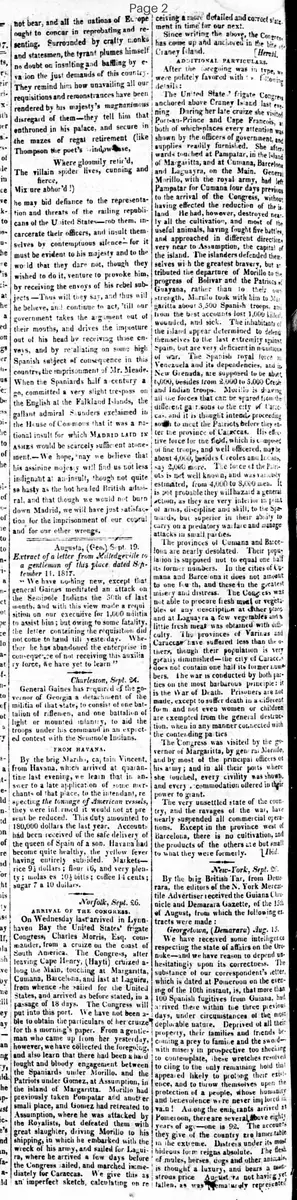
ARRIVAL OF THE CONGRESS.
On Wednesday last arrived in Lynn-haven Bay the United States' frigate Congress, Charles Morris, Esq. commander, from a cruise on the coast of South America. The Congress, after leaving Cape Henry, (Hayti) cruized along the Main, touching at Margarita, Cumana, Barcelona, and last at Laguira, from whence she sailed for the United States, and arrived as before stated, in a passage of 18 days. The Congress will put into this port. We have not been able to obtain the particulars of her cruise for this morning's paper. From a gentleman who came up from her yesterday, however, we have collected the foregoing, and also learn that there had been a hard fought and bloody engagement between the Spaniards under Morillo, and the Patriots under Gomez, at Assumption, in the island of Margarita. Morillo had previously taken Pampatar and another small place, and Gomez had retreated to Assumption, where he was attacked by the Royalists, but defeated them with great slaughter, driving Morillo to his shipping, in which he embarked with the wreck of his army, and sailed for Laguira, where he arrived a few days before the Congress sailed, and marched immediately for Caracas. We give this as an imperfect sketch, calculating on receiving a more detailed and correct statement in time for our next.
Since writing the above, the Congress has come up and anchored in the roads off Craney Island.
[ Herald.
ADDITIONAL PARTICULARS.
After the foregoing was in type, we were politely favored with the following details:
The United States frigate Congress anchored above Craney Island last evening.
During her late cruise she visited Port-au-Prince and Cape Francois, at both of which places every attention was shown by the officers of government, and supplies readily furnished. She afterwards touched at Pampatar, in the island of Margarita, and at Cumana, Barcelona and Laguayra, on the Main. General Morillo, with the royal army, had left Pampatar for Cumana four days previous to the arrival of the Congress, without having effected the reduction of the island. He had, however, destroyed nearly all the cultivation, and most of the useful animals, having fought five battles, and approached in different directions very near to Assumption, the capital of the island. The islanders defended themselves with the greatest bravery, but are attributed the departure of Morillo to the progress of Bolivar and the Patriots of Guayana, rather than to their own strength. Morillo took with him to Margarita about 8,500 Spanish troops, and from the best accounts lost 1,000 killed, wounded, and sick. The inhabitants of the island appear determined to defend themselves to the last extremity against Spain, but are very deficient in munitions of war. The Spanish royal force in Venezuela and its dependencies, and in New Granada, are supposed to be about 6,000, besides from 2,000 to 3,000 creole and Indian troops. Morillo is having all the forces that can be spared from the different garrisons to the city of Caracas, and it is thought intends proceeding south to meet the Patriots before they enter the province of Caracas. His effective force for the field, which is composed of fine troops, and well officered, may be about 4,000, besides creoles and Indians, say 2,000 more. The force of the Patriots not well known, and was variously estimated, from 4,000 to 8,000 men. It is not probable they will hazard a general action, as they are very inferior in point of arms, discipline and skill, to the Spaniards, but superior in their ability to carry on a predatory warfare and manage attacks in small parties.
The provinces of Cumana and Barcelona are nearly desolated. Their population is supposed not to equal one half its former numbers. In the cities of Cumana and Barcelona it does not amount to one fifth, and these in the greatest misery and distress. The Congress was not able to procure fresh meat or vegetables of any description at either place, and at Laguayra a few vegetables and a little fresh meat was obtained with difficulty. The provinces of Varinas and Caraccas have suffered less than the others, though their population is very greatly diminished—the city of Caraccas does not contain one half its former number. The war is conducted by both parties on the most barbarous principle: it is the War of Death. Prisoners are not made, except to suffer death in a different form and not even women or children are exempted from the general destruction, when in any manner connected with the contending parties.
The Congress was visited by the governor of Margarita, by general Morillo, and by most of the principal officers of his army; and in all their ports where she touched, every civility was shown, and every accommodation offered in their power to grant.
The very unsettled state of the country, and the ravages of the war, have nearly suspended all commercial operations. Except in the province west of Barcelona, there is no cultivation, and the products of the others are but small to what they were formerly.
[ Ibid.
What sub-type of article is it?
What keywords are associated?
What entities or persons were involved?
Where did it happen?
Foreign News Details
Primary Location
Island Of Margarita, Venezuela
Event Date
September 26
Key Persons
Outcome
morillo's forces defeated with 1,000 killed, wounded, and sick; retreated to shipping and sailed for laguira; war devastates provinces, suspends commerce
Event Details
US frigate Congress returns from South American cruise, reporting engagement at Assumption where Patriots under Gomez defeated Spaniards under Morillo; Morillo had taken Pampatar, fought five battles, destroyed cultivations; attributed retreat to Bolivar's progress; details on troop strengths, provincial desolation, barbarous war conduct, and hospitable treatment of Congress