Thank you for visiting SNEWPapers!
Sign up free
Letter to Editor
July 7, 1821
Daily National Intelligencer
Washington, District Of Columbia
What is this article about?
A citizen urges completion of the Potomac navigation canal, detailing benefits for Virginia's western settlements via Monongahela and other rivers, reciprocal gains for Maryland, Pennsylvania's fiscal capacity to aid, and national trade advantages, countering emigration and isolation.
Clipping
OCR Quality
98%
Excellent
Full Text
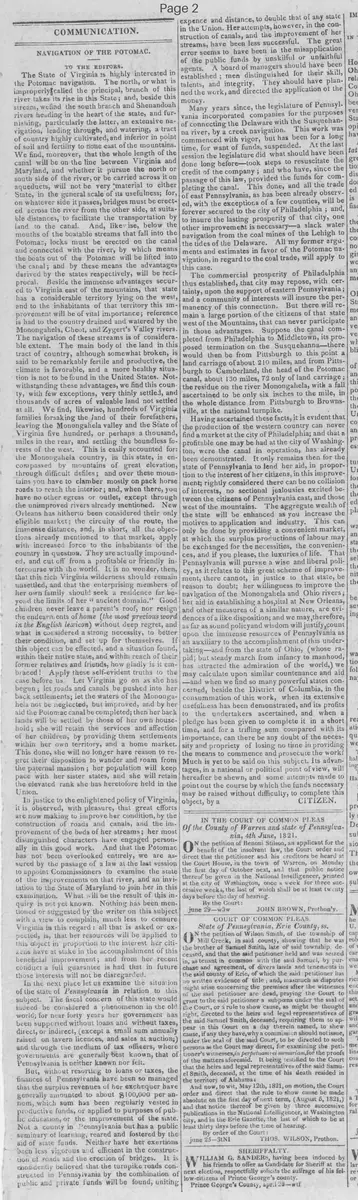
COMMUNICATION.
NAVIGATION OF THE POTOMAC.
TO THE EDITORS.
The State of Virginia is highly interested in the Potomac navigation. The north, or what is improperly called the principal, branch of this river takes its rise in this State; and, beside this stream, we find the south branch and Shenandoah rivers heading in the heart of the state, and furnishing, particularly the latter, an extensive navigation, leading through, and watering, a tract of country highly cultivated, and inferior in point of soil and fertility to none east of the mountains.
We find, moreover, that the whole length of the canal will be on the line between Virginia and Maryland, and whether it pursue the north or south side of the river, or be carried across it on aqueducts, will not be very material to either State, in the general scale of its usefulness; for, on whatever side it passes, bridges must be erected across the river from the other side, at suitable distances, to facilitate the transportation by land to the canal. And, likewise, below the mouths of the boatable streams that fall into the Potomac, locks must be erected on the canal and connected with the river, by which means the boats out of the Potomac will be lifted into the canal; and by these means the advantages derived by the states respectively, will be reciprocal. Beside the immense advantages secured to Virginia east of the mountains, that state has a considerable territory lying on the west, and to the inhabitants of that territory this improvement will be of vital importance; reference is had to the country drained and watered by the Monongahela, Cheat, and Tygart's Valley rivers.
The navigation of these streams is of considerable extent. The main body of the land in this tract of country, although somewhat broken, is said to be remarkably fertile and productive, the climate is favorable, and a more healthy situation is not to be found in the United States. Notwithstanding these advantages, we find this country, with few exceptions, very thinly settled, and thousands of acres of valuable land not settled at all. We find, likewise, hundreds of Virginia families forsaking the land of their forefathers, leaving the Monongahela valley and the State of Virginia five hundred, or perhaps a thousand, miles in the rear, and settling the boundless forests of the west. This is easily accounted for: the Monongahela country, in this state, is encompassed by mountains of great elevation, through difficult defiles; and over these mountains you have to clamber mostly on pack horse roads to reach the interior; and, when there, you have no other egress or outlet, except through the unimproved rivers already mentioned. New Orleans has hitherto been considered their only eligible market; the circuity of the route, the immense distance, and, in short, all the objections already mentioned to that market, apply with increased force to the inhabitants of the country in question. They are actually impounded, and cut off from a profitable or friendly intercourse with the world. It is no wonder, then, that this rich Virginia wilderness should remain unsettled, and that the enterprising members of her own family should seek a residence far beyond the limits of her ancient domain. Good children never leave a parent's roof, nor resign the endearments of home (the most precious word in the English lexicon) without deep regret, and what is considered a strong necessity, to better their condition, and set up for themselves. If this object can be effected, and a situation found, within their native state, and within reach of their former relatives and friends, how gladly is it embraced! Apply these self-evident truths to the case before us. Let Virginia go on as she has begun; let roads and canals be pushed into her back settlements; let the waters of the Monongahela not be neglected, but improved, and by her aid the Potomac canal be completed; then her back lands will be settled by those of her own household; she will retain the services and affection of her children, by providing them settlements within her own territory, and a home market.
This done, she will no longer have reason to regret their disposition to wander and roam from the paternal mansion; her population will keep pace with her sister states, and she will retain the elevated rank she has heretofore held in the Union.
In justice to the enlightened policy of Virginia, it is observed, with pleasure, that great efforts are now making to improve her condition, by the construction of roads and canals, and the improvement of the beds of her streams; her most distinguished characters have engaged personally in this good work. And that the Potomac has not been overlooked entirely, we are assured by the passage of a law at the last session to appoint Commissioners to examine the state of the improvements on that river, and an invitation to the State of Maryland to join her in this examination. What will be the result of this inquiry is not yet known. Nothing has been mentioned or suggested by the writer on this subject with a view to complain, much less to censure Virginia in this regard: all that is asked or expected, is, that her resources will be applied to this object in proportion to the interest her citizens have at stake in the accomplishment of this beneficial improvement; and from her recent conduct a full guarantee is had that in future those interests will not be disregarded.
In the next place let us examine the situation of the state of Pennsylvania in relation to this subject. The fiscal concern of this state would indeed be considered a phenomenon in the old world; for near forty years her government has been supported without loans and without taxes, direct, or indirect, (except a small sum annually raised on tavern licences, and sales at auction;) and through the medium of tax officers, where governments are generally best known, that of Pennsylvania is neither known nor felt.
But, without resorting to loans or taxes, the finances of Pennsylvania have been so managed that the surplus revenues of her exchequer have generally amounted to about $100,000 per annum, which sum has been regularly vested in productive funds, or applied to purposes of public education, or the improvement of the state. Not a county in Pennsylvania but has a public seminary of learning, reared and fostered by the aid of state funds. Neither have her exertions been less vigorous and efficient in the construction of roads and the erection of bridges. It is confidently believed that the turnpike roads constructed in Pennsylvania by the combination of public and private funds will be found, uniting in the Union. Her attempts, however, in the construction of canals, and the improvement of her streams, have been less successful. The great error seems to have been in the misapplication of the public funds by unskilful or unfaithful agents. A board of managers should have been established; men distinguished for their skill, talents, and integrity. They should have planned the work, and directed the application of the money.
Many years since, the legislature of Pennsylvania incorporated companies for the purposes of connecting the Delaware with the Susquehanna river, by a creek navigation. This work was commenced with vigor, but has been for a long time, for want of funds, suspended. At the last session the legislature did what should have been done long before—took steps to resuscitate the enterprise; and who have, since the passage of this law, provided the funds for completing the canal. This done, and all the trade of east Pennsylvania, as has been already observed, with the exceptions of a few counties, will be forever secured to the city of Philadelphia; and, to insure the lasting prosperity of that city, one other improvement is necessary—a slack water navigation from the coal mines of the Lehigh to the tides of the Delaware. All my former arguments and estimates in favor of the Potomac navigation, in regard to the coal trade, will apply to this case.
The commercial prosperity of Philadelphia thus established, that city may repose, with certainty, upon the support of eastern Pennsylvania; and a community of interests will insure the permanency of this connection. But there will remain a large portion of the citizens of that state west of the Mountains, that can never participate in those advantages. Suppose the canal completed from Philadelphia to Middletown, its proposed termination on the Susquehanna—there would then be from Pittsburgh to this point a land carriage of about 210 miles, and from Pittsburgh to Cumberland, the head of the Potomac canal, about 130 miles, 72 only of land carriage; the residue on the river Monongahela, with a fall ascertained to be only six inches to the mile, in the whole distance from Pittsburgh to Brownsville, at the national turnpike.
Having ascertained these facts, it is evident that the production of the western country can never find a market at the city of Philadelphia; and that a profitable one may be had at the city of Washington, were the canal in operation, has already been demonstrated. It only remains then for the state of Pennsylvania to lend her aid, in proportion to the interest of her citizens, in this improvement; rightly considered there can be no collision of interests, no sectional jealousies excited between the citizens of Pennsylvania east, and those west of the mountains. The aggregate wealth of the state will be enhanced as you increase the motives to application and industry. This can only be done by providing a convenient market at which the surplus productions of labour may be exchanged for the necessities, the conveniences, and if you please, the luxuries of life. That Pennsylvania will pursue a wise and liberal policy, as it relates to this great scheme of improvement, there cannot, in justice to that state, be reason to doubt; her willingness to improve the navigation of the Monongahela and Ohio rivers; her aid in establishing a hospital at New Orleans, and other measures of a similar nature, are evidences of a like disposition; and we may, therefore, as far as sound policy and wisdom will justify, count upon the immense resources of Pennsylvania as an auxiliary to the accomplishment of this undertaking—and from the state of Ohio, (whose rapid but steady march from infancy to manhood, has attracted the admiration of the world,) we may calculate upon similar countenance and aid—and when we find so many powerful states concerned, beside the District of Columbia, in the consummation of this work, when its extensive usefulness has been demonstrated, and its profits to the undertakers ascertained, and when a pledge has been given to complete it in a short time, and for a trifling sum compared with its importance, can there be any doubt of the necessity and propriety of losing no time in providing the means to commence and prosecute the work?
Much is yet to be said on this subject. Its advantages, in a national or political point of view, will hereafter be shewn, and some attempts made to point out the course by which the funds necessary may be raised without difficulty, to complete this object, by a
CITIZEN.
NAVIGATION OF THE POTOMAC.
TO THE EDITORS.
The State of Virginia is highly interested in the Potomac navigation. The north, or what is improperly called the principal, branch of this river takes its rise in this State; and, beside this stream, we find the south branch and Shenandoah rivers heading in the heart of the state, and furnishing, particularly the latter, an extensive navigation, leading through, and watering, a tract of country highly cultivated, and inferior in point of soil and fertility to none east of the mountains.
We find, moreover, that the whole length of the canal will be on the line between Virginia and Maryland, and whether it pursue the north or south side of the river, or be carried across it on aqueducts, will not be very material to either State, in the general scale of its usefulness; for, on whatever side it passes, bridges must be erected across the river from the other side, at suitable distances, to facilitate the transportation by land to the canal. And, likewise, below the mouths of the boatable streams that fall into the Potomac, locks must be erected on the canal and connected with the river, by which means the boats out of the Potomac will be lifted into the canal; and by these means the advantages derived by the states respectively, will be reciprocal. Beside the immense advantages secured to Virginia east of the mountains, that state has a considerable territory lying on the west, and to the inhabitants of that territory this improvement will be of vital importance; reference is had to the country drained and watered by the Monongahela, Cheat, and Tygart's Valley rivers.
The navigation of these streams is of considerable extent. The main body of the land in this tract of country, although somewhat broken, is said to be remarkably fertile and productive, the climate is favorable, and a more healthy situation is not to be found in the United States. Notwithstanding these advantages, we find this country, with few exceptions, very thinly settled, and thousands of acres of valuable land not settled at all. We find, likewise, hundreds of Virginia families forsaking the land of their forefathers, leaving the Monongahela valley and the State of Virginia five hundred, or perhaps a thousand, miles in the rear, and settling the boundless forests of the west. This is easily accounted for: the Monongahela country, in this state, is encompassed by mountains of great elevation, through difficult defiles; and over these mountains you have to clamber mostly on pack horse roads to reach the interior; and, when there, you have no other egress or outlet, except through the unimproved rivers already mentioned. New Orleans has hitherto been considered their only eligible market; the circuity of the route, the immense distance, and, in short, all the objections already mentioned to that market, apply with increased force to the inhabitants of the country in question. They are actually impounded, and cut off from a profitable or friendly intercourse with the world. It is no wonder, then, that this rich Virginia wilderness should remain unsettled, and that the enterprising members of her own family should seek a residence far beyond the limits of her ancient domain. Good children never leave a parent's roof, nor resign the endearments of home (the most precious word in the English lexicon) without deep regret, and what is considered a strong necessity, to better their condition, and set up for themselves. If this object can be effected, and a situation found, within their native state, and within reach of their former relatives and friends, how gladly is it embraced! Apply these self-evident truths to the case before us. Let Virginia go on as she has begun; let roads and canals be pushed into her back settlements; let the waters of the Monongahela not be neglected, but improved, and by her aid the Potomac canal be completed; then her back lands will be settled by those of her own household; she will retain the services and affection of her children, by providing them settlements within her own territory, and a home market.
This done, she will no longer have reason to regret their disposition to wander and roam from the paternal mansion; her population will keep pace with her sister states, and she will retain the elevated rank she has heretofore held in the Union.
In justice to the enlightened policy of Virginia, it is observed, with pleasure, that great efforts are now making to improve her condition, by the construction of roads and canals, and the improvement of the beds of her streams; her most distinguished characters have engaged personally in this good work. And that the Potomac has not been overlooked entirely, we are assured by the passage of a law at the last session to appoint Commissioners to examine the state of the improvements on that river, and an invitation to the State of Maryland to join her in this examination. What will be the result of this inquiry is not yet known. Nothing has been mentioned or suggested by the writer on this subject with a view to complain, much less to censure Virginia in this regard: all that is asked or expected, is, that her resources will be applied to this object in proportion to the interest her citizens have at stake in the accomplishment of this beneficial improvement; and from her recent conduct a full guarantee is had that in future those interests will not be disregarded.
In the next place let us examine the situation of the state of Pennsylvania in relation to this subject. The fiscal concern of this state would indeed be considered a phenomenon in the old world; for near forty years her government has been supported without loans and without taxes, direct, or indirect, (except a small sum annually raised on tavern licences, and sales at auction;) and through the medium of tax officers, where governments are generally best known, that of Pennsylvania is neither known nor felt.
But, without resorting to loans or taxes, the finances of Pennsylvania have been so managed that the surplus revenues of her exchequer have generally amounted to about $100,000 per annum, which sum has been regularly vested in productive funds, or applied to purposes of public education, or the improvement of the state. Not a county in Pennsylvania but has a public seminary of learning, reared and fostered by the aid of state funds. Neither have her exertions been less vigorous and efficient in the construction of roads and the erection of bridges. It is confidently believed that the turnpike roads constructed in Pennsylvania by the combination of public and private funds will be found, uniting in the Union. Her attempts, however, in the construction of canals, and the improvement of her streams, have been less successful. The great error seems to have been in the misapplication of the public funds by unskilful or unfaithful agents. A board of managers should have been established; men distinguished for their skill, talents, and integrity. They should have planned the work, and directed the application of the money.
Many years since, the legislature of Pennsylvania incorporated companies for the purposes of connecting the Delaware with the Susquehanna river, by a creek navigation. This work was commenced with vigor, but has been for a long time, for want of funds, suspended. At the last session the legislature did what should have been done long before—took steps to resuscitate the enterprise; and who have, since the passage of this law, provided the funds for completing the canal. This done, and all the trade of east Pennsylvania, as has been already observed, with the exceptions of a few counties, will be forever secured to the city of Philadelphia; and, to insure the lasting prosperity of that city, one other improvement is necessary—a slack water navigation from the coal mines of the Lehigh to the tides of the Delaware. All my former arguments and estimates in favor of the Potomac navigation, in regard to the coal trade, will apply to this case.
The commercial prosperity of Philadelphia thus established, that city may repose, with certainty, upon the support of eastern Pennsylvania; and a community of interests will insure the permanency of this connection. But there will remain a large portion of the citizens of that state west of the Mountains, that can never participate in those advantages. Suppose the canal completed from Philadelphia to Middletown, its proposed termination on the Susquehanna—there would then be from Pittsburgh to this point a land carriage of about 210 miles, and from Pittsburgh to Cumberland, the head of the Potomac canal, about 130 miles, 72 only of land carriage; the residue on the river Monongahela, with a fall ascertained to be only six inches to the mile, in the whole distance from Pittsburgh to Brownsville, at the national turnpike.
Having ascertained these facts, it is evident that the production of the western country can never find a market at the city of Philadelphia; and that a profitable one may be had at the city of Washington, were the canal in operation, has already been demonstrated. It only remains then for the state of Pennsylvania to lend her aid, in proportion to the interest of her citizens, in this improvement; rightly considered there can be no collision of interests, no sectional jealousies excited between the citizens of Pennsylvania east, and those west of the mountains. The aggregate wealth of the state will be enhanced as you increase the motives to application and industry. This can only be done by providing a convenient market at which the surplus productions of labour may be exchanged for the necessities, the conveniences, and if you please, the luxuries of life. That Pennsylvania will pursue a wise and liberal policy, as it relates to this great scheme of improvement, there cannot, in justice to that state, be reason to doubt; her willingness to improve the navigation of the Monongahela and Ohio rivers; her aid in establishing a hospital at New Orleans, and other measures of a similar nature, are evidences of a like disposition; and we may, therefore, as far as sound policy and wisdom will justify, count upon the immense resources of Pennsylvania as an auxiliary to the accomplishment of this undertaking—and from the state of Ohio, (whose rapid but steady march from infancy to manhood, has attracted the admiration of the world,) we may calculate upon similar countenance and aid—and when we find so many powerful states concerned, beside the District of Columbia, in the consummation of this work, when its extensive usefulness has been demonstrated, and its profits to the undertakers ascertained, and when a pledge has been given to complete it in a short time, and for a trifling sum compared with its importance, can there be any doubt of the necessity and propriety of losing no time in providing the means to commence and prosecute the work?
Much is yet to be said on this subject. Its advantages, in a national or political point of view, will hereafter be shewn, and some attempts made to point out the course by which the funds necessary may be raised without difficulty, to complete this object, by a
CITIZEN.
What sub-type of article is it?
Persuasive
Informative
Political
What themes does it cover?
Infrastructure
Economic Policy
Politics
What keywords are associated?
Potomac Navigation
Canal Improvement
Virginia West
Pennsylvania Aid
Monongahela River
Trade Routes
Western Settlements
Infrastructure Policy
What entities or persons were involved?
Citizen.
To The Editors.
Letter to Editor Details
Author
Citizen.
Recipient
To The Editors.
Main Argument
the completion of the potomac navigation canal is essential for virginia's western development, providing markets and retaining population; it offers reciprocal benefits to maryland, and pennsylvania and ohio should contribute proportionally to enhance regional trade and prosperity without sectional conflicts.
Notable Details
References To Monongahela, Cheat, And Tygart's Valley Rivers
Praises Pennsylvania's Tax Free Governance And Surplus Revenues
Compares Land Carriage Distances: 210 Miles To Philadelphia Vs. 72 Miles To Potomac Canal
Analogizes State Development To Parental Care For Children