Thank you for visiting SNEWPapers!
Sign up free
Jenks' Portland Gazette
Portland, Cumberland County, Maine
What is this article about?
Diplomatic exchange between Russia and France: Russia accuses France of territorial violations, interferences, and aggressions across Europe; France counters with charges of Russian breaches, favoritism to England, and threats war if Russia allies with Britain. Reported from London, Oct. 26.
Clipping
OCR Quality
Full Text
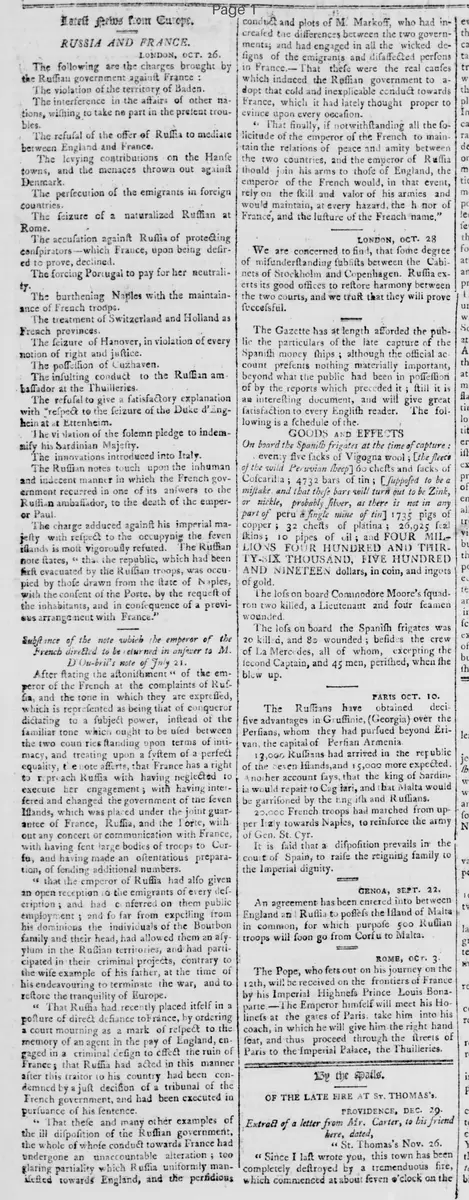
RUSSIA AND FRANCE.
LONDON, OCT. 26.
The following are the charges brought by the Russian government against France:
'The violation of the territory of Baden.
The interference in the affairs of other nations, wishing to take no part in the present troubles.
The refusal of the offer of Russia to mediate between England and France.
The levying contributions on the Hanse towns, and the menaces thrown out against Denmark.
The persecution of the emigrants in foreign countries.
The seizure of a naturalized Russian at Rome.
The accusation against Russia of protecting conspirators—which France, upon being desired to prove, declined.
The forcing Portugal to pay for her neutrality.
The burdening Naples with the maintenance of French troops.
The treatment of Switzerland and Holland as French provinces.
The seizure of Hanover, in violation of every notion of right and justice.
The possession of Cuxhaven.
The insulting conduct to the Russian ambassador at the Tuilleries.
The refusal to give a satisfactory explanation with respect to the seizure of the Duke d'Enghien at Ettenheim.
The violation of the solemn pledge to indemnify his Sardinian Majesty.
The innovations introduced into Italy.
The Russian notes touch upon the inhuman and indecent manner in which the French government recurred in one of its answers to the Russian ambassador, to the death of the emperor Paul.
The charge adduced against his imperial majesty with respect to the occupying the seven islands is most vigorously refuted. The Russian note states, "that the republic, which had been first evacuated by the Russian troops, was occupied by those drawn from the state of Naples, with the consent of the Porte, by the request of the inhabitants, and in consequence of a previous arrangement with France."
Substance of the note which the emperor of the French directed to be returned in answer to M. D'Obril's note of July 21.
After stating the astonishment of the emperor of the French at the complaints of Russia, and the tone in which they are expressed, which is represented as being that of conqueror dictating to a subject power, instead of the familiar tone which ought to be used between the two countries standing upon terms of intimacy, and treating upon a system of perfect equality, the note asserts, that France has a right to reproach Russia with having neglected to execute her engagements; with having interfered and changed the government of the seven islands, which was placed under the joint guarantee of France, Russia, and the Porte, without any concert or communication with France, with having sent large bodies of troops to Corfu, and having made an ostentatious preparation of sending additional numbers.
That the emperor of Russia had also given an open reception to the emigrants of every description; and had conferred on them public employment; and so far from expelling from his dominions the individuals of the Bourbon family and their head, had allowed them an asylum in the Russian territories, and had participated in their criminal projects, contrary to the wise example of his father, at the time of his endeavouring to terminate the war, and to restore the tranquility of Europe.
That Russia had recently placed itself in a posture of direct defiance to France, by ordering a court mourning as a mark of respect to the memory of an agent in the pay of England, engaged in a criminal design to effect the ruin of France; that Russia had acted in this manner after this traitor to his country had been condemned by a just decision of a tribunal of the French government, and had been executed in pursuance of his sentence.
That these and many other examples of the hostile disposition of the Russian government, the whole of whose conduct towards France had undergone an unaccountable alteration; too glaring partiality which Russia uniformly manifested towards England, and the perfidious conduct and plots of M. Markoff, who had increased the differences between the two governments; and had engaged in all the wicked designs of the emigrants and disaffected persons in France.That these were the real causes which induced the Russian government to adopt that cold and inexplicable conduct towards France, which it had lately thought proper to evince upon every occasion.
That finally, if notwithstanding all the solicitude of the emperor of the French to maintain the relations of peace and amity between the two countries. and the emperor of Russia should join his arms to those of England, the emperor of the French would, in that event, rely on the skill and valor of his armies and would maintain, at every hazard, the honor of France, and the lustre of the French name."
What sub-type of article is it?
What keywords are associated?
What entities or persons were involved?
Where did it happen?
Foreign News Details
Primary Location
Europe
Event Date
October 26
Key Persons
Outcome
mutual diplomatic accusations exchanged; france threatens war if russia allies with england.
Event Details
Russia lists charges against France including territorial violations in Baden, Hanover, Cuxhaven; interferences in other nations; mistreatment of emigrants and ambassadors. France responds accusing Russia of breaching engagements on the Seven Islands, harboring emigrants, favoring England, and court mourning for a French traitor; warns of conflict if Russia joins England.