Thank you for visiting SNEWPapers!
Sign up free
Editorial
March 25, 1890
Lancaster Daily Intelligencer
Lancaster, Lancaster County, Pennsylvania
What is this article about?
Editorial criticizes Pennsylvania Supreme Court Chief Justice Paxson's opinion allowing T-style street railroad rails in Easton against city wishes, deeming it poor law-making. Also mocks Paxson's historical inaccuracies in a speech about the Alaska purchase and Russian fleet.
Clipping
OCR Quality
95%
Excellent
Full Text
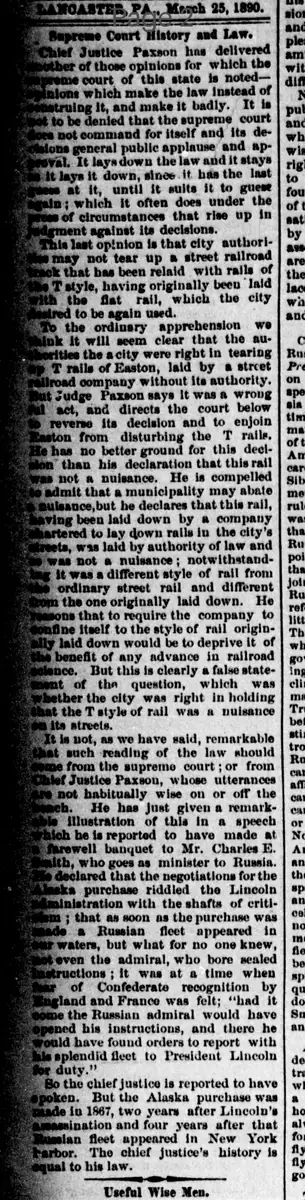
Supreme Court History and Law.
Chief Justice Paxson has delivered another of those opinions for which the supreme court of this state is noted—opinions which make the law instead of construing it, and make it badly. It is not to be denied that the supreme court does not command for itself and its decisions general public applause and approval. It lays down the law and it stays laid down, since it has the last guess at it, until it suits it to guess again; which it often does under the pressure of circumstances that rise up in judgment against its decisions.
This last opinion is that city authorities may not tear up a street railroad track that has been relaid with rails of T style, having originally been laid with the flat rail, which the city required to be again used.
To the ordinary apprehension we think it will seem clear that the authorities of a city were right in tearing up the T rails of Easton, laid by a street railroad company without its authority.
But Judge Paxson says it was a wrong act, and directs the court below to reverse its decision and to enjoin Easton from disturbing the T rails.
He has no better ground for this declaration than his declaration that this rail was not a nuisance. He is compelled to admit that a municipality may abate a nuisance, but he declares that this rail, having been laid down by a company chartered to lay down rails in the city's streets, was laid by authority of law and was not a nuisance; notwithstanding it was a different style of rail from the ordinary street rail and different from the one originally laid down. He reasons that to require the company to confine itself to the style of rail originally laid down would be to deprive it of the benefit of any advance in railroad science. But this is clearly a false statement of the question, which was whether the city was right in holding that the T style of rail was a nuisance on its streets.
It is not, as we have said, remarkable that such reading of the law should come from the supreme court; or from Chief Justice Paxson, whose utterances are not habitually wise on or off the bench. He has just given a remarkable illustration of this in a speech which he is reported to have made at a farewell banquet to Mr. Charles E. Smith, who goes as minister to Russia.
He declared that the negotiations for the Alaska purchase riddled the Lincoln administration with the shafts of criticism; that as soon as the purchase was made a Russian fleet appeared in American waters, but what for no one knew, not even the admiral, who bore sealed instructions; it was at a time when the fear of Confederate recognition by England and France was felt; 'had it come the Russian admiral would have opened his instructions, and there he would have found orders to report with his splendid fleet to President Lincoln for duty.'
So the chief justice is reported to have spoken. But the Alaska purchase was made in 1867, two years after Lincoln's inauguration and four years after that Russian fleet appeared in New York harbor. The chief justice's history is equal to his law.
Chief Justice Paxson has delivered another of those opinions for which the supreme court of this state is noted—opinions which make the law instead of construing it, and make it badly. It is not to be denied that the supreme court does not command for itself and its decisions general public applause and approval. It lays down the law and it stays laid down, since it has the last guess at it, until it suits it to guess again; which it often does under the pressure of circumstances that rise up in judgment against its decisions.
This last opinion is that city authorities may not tear up a street railroad track that has been relaid with rails of T style, having originally been laid with the flat rail, which the city required to be again used.
To the ordinary apprehension we think it will seem clear that the authorities of a city were right in tearing up the T rails of Easton, laid by a street railroad company without its authority.
But Judge Paxson says it was a wrong act, and directs the court below to reverse its decision and to enjoin Easton from disturbing the T rails.
He has no better ground for this declaration than his declaration that this rail was not a nuisance. He is compelled to admit that a municipality may abate a nuisance, but he declares that this rail, having been laid down by a company chartered to lay down rails in the city's streets, was laid by authority of law and was not a nuisance; notwithstanding it was a different style of rail from the ordinary street rail and different from the one originally laid down. He reasons that to require the company to confine itself to the style of rail originally laid down would be to deprive it of the benefit of any advance in railroad science. But this is clearly a false statement of the question, which was whether the city was right in holding that the T style of rail was a nuisance on its streets.
It is not, as we have said, remarkable that such reading of the law should come from the supreme court; or from Chief Justice Paxson, whose utterances are not habitually wise on or off the bench. He has just given a remarkable illustration of this in a speech which he is reported to have made at a farewell banquet to Mr. Charles E. Smith, who goes as minister to Russia.
He declared that the negotiations for the Alaska purchase riddled the Lincoln administration with the shafts of criticism; that as soon as the purchase was made a Russian fleet appeared in American waters, but what for no one knew, not even the admiral, who bore sealed instructions; it was at a time when the fear of Confederate recognition by England and France was felt; 'had it come the Russian admiral would have opened his instructions, and there he would have found orders to report with his splendid fleet to President Lincoln for duty.'
So the chief justice is reported to have spoken. But the Alaska purchase was made in 1867, two years after Lincoln's inauguration and four years after that Russian fleet appeared in New York harbor. The chief justice's history is equal to his law.
What sub-type of article is it?
Legal Reform
What keywords are associated?
Supreme Court Criticism
Chief Justice Paxson
Street Railroad Tracks
Easton T Rails
Alaska Purchase History
What entities or persons were involved?
Chief Justice Paxson
Supreme Court Of Pennsylvania
City Of Easton
Street Railroad Company
Charles E. Smith
Abraham Lincoln
Editorial Details
Primary Topic
Criticism Of Supreme Court Opinion On Easton Street Railroad Tracks
Stance / Tone
Strongly Critical Of Chief Justice Paxson And The Court
Key Figures
Chief Justice Paxson
Supreme Court Of Pennsylvania
City Of Easton
Street Railroad Company
Charles E. Smith
Abraham Lincoln
Key Arguments
Supreme Court Makes Law Badly Instead Of Construing It
City Authorities Right To Remove Unauthorized T Rails
Paxson's Opinion Wrongly Deems T Rails Not A Nuisance
Requiring Original Rail Style Does Not Deprive Company Of Scientific Advances
Paxson's Speech Contains Historical Errors About Alaska Purchase And Russian Fleet