Thank you for visiting SNEWPapers!
Sign up free
Kentucky Gazette And General Advertiser
Lexington, Fayette County, Kentucky
What is this article about?
At Madame Bonaparte's drawing room in Paris, the First Consul confronted Lord Whitworth over potential renewal of war after 15 years of European conflict, amid French colonial armaments and British ultimatum. Reports of preparations at La Hogue and Cherbourg, rumored embargo on British vessels, and a stranded arms ship off Ireland with French-Irish union colors heighten tensions.
Clipping
OCR Quality
Full Text
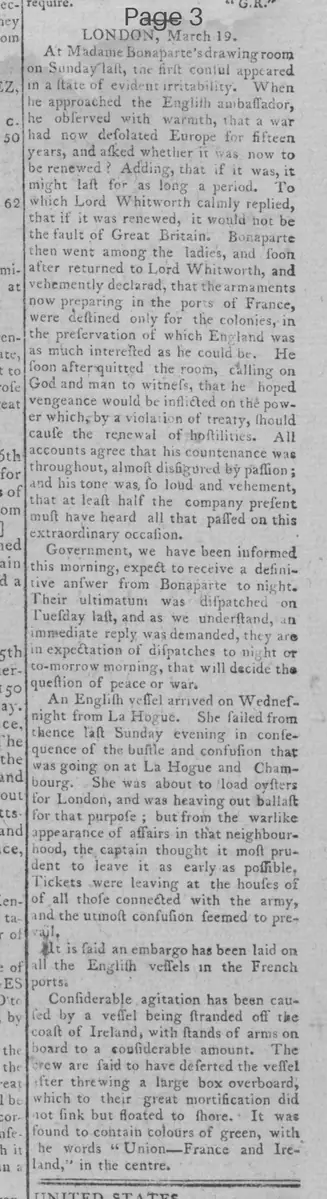
At Madame Bonaparte's drawing room on Sunday last, the first consul appeared in a state of evident irritability. When he approached the English ambassador, he observed with warmth, that a war had now desolated Europe for fifteen years, and asked whether it was now to be renewed? Adding, that if it was, it might last for as long a period. To which Lord Whitworth calmly replied, that if it was renewed, it would not be the fault of Great Britain. Bonaparte then went among the ladies, and soon after returned to Lord Whitworth, and vehemently declared, that the armaments now preparing in the ports of France, were destined only for the colonies, in the preservation of which England was as much interested as he could be. He soon after quitted the room, calling on God and man to witness, that he hoped vengeance would be inflicted on the power which, by a violation of treaty, should cause the renewal of hostilities. All accounts agree that his countenance was throughout, almost disfigured by passion; and his tone was, so loud and vehement, that at least half the company present must have heard all that passed on this extraordinary occasion.
Government, we have been informed this morning, expect to receive a definitive answer from Bonaparte to night. Their ultimatum was dispatched on Tuesday last, and as we understand, an immediate reply was demanded, they are in expectation of dispatches to night or to-morrow morning, that will decide the question of peace or war.
An English vessel arrived on Wednesday night from La Hogue. She sailed from thence last Sunday evening in consequence of the bustle and confusion that was going on at La Hogue and Cherbourg. She was about to load oysters for London, and was heaving out ballast for that purpose ; but from the warlike appearance of affairs in that neighbourhood, the captain thought it most prudent to leave it as early as possible.
Tickets were leaving at the houses of all those connected with the army, and the utmost confusion seemed to prevail,
It is said an embargo has been laid on all the English vessels in the French ports.
Considerable agitation has been caused by a vessel being stranded off the coast of Ireland, with stands of arms on board to a considerable amount. The crew are said to have deserted the vessel after throwing a large box overboard. which to their great mortification did not sink but floated to shore. It was found to contain colours of green, with the words "Union France and Ireland," in the centre.
What sub-type of article is it?
What keywords are associated?
What entities or persons were involved?
Where did it happen?
Foreign News Details
Primary Location
France
Event Date
Sunday Last, As Reported March 19
Key Persons
Outcome
heightened diplomatic tensions; british government awaits definitive response to ultimatum on peace or war; rumors of french military preparations and embargo; discovery of arms and french-irish union colors off ireland
Event Details
At Madame Bonaparte's drawing room on Sunday last, the first consul confronted the English ambassador Lord Whitworth about renewing war after 15 years, claiming French armaments were for colonies. He expressed vehement hopes for vengeance on treaty violators. Government expects Bonaparte's reply to ultimatum tonight or tomorrow. English vessel fled La Hogue amid bustle at French ports, army ticket distributions, and confusion. Rumored embargo on English vessels in France. Stranded vessel off Ireland carried arms; crew deserted after failing to sink box with green colors inscribed 'Union France and Ireland'.