Thank you for visiting SNEWPapers!
Sign up free
Story
September 1, 1820
Daily National Intelligencer
Washington, District Of Columbia
What is this article about?
Editorial from Rhode-Island American praises Washington City's public buildings, especially the Capitol, as symbols fostering national pride and unity in the republic. Argues against cost concerns, emphasizes need for tangible national monuments, and suggests enhancing the city to prevent relocation westward.
Clipping
OCR Quality
98%
Excellent
Full Text
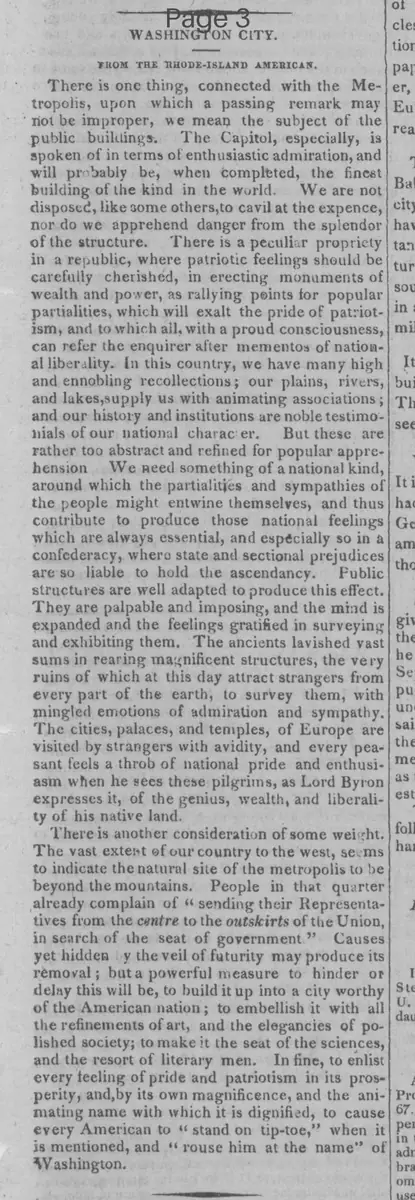
WASHINGTON CITY
FROM THE RHODE-ISLAND AMERICAN.
There is one thing, connected with the Metropolis, upon which a passing remark may not be improper, we mean the subject of the public buildings. The Capitol, especially, is spoken of in terms of enthusiastic admiration, and will probably be, when completed, the finest building of the kind in the world. We are not disposed, like some others, to cavil at the expence, nor do we apprehend danger from the splendor of the structure. There is a peculiar propriety in a republic, where patriotic feelings should be carefully cherished, in erecting monuments of wealth and power, as rallying points for popular partialities, which will exalt the pride of patriotism, and to which all, with a proud consciousness, can refer the enquirer after mementos of national liberality. In this country, we have many high and ennobling recollections; our plains, rivers, and lakes, supply us with animating associations; and our history and institutions are noble testimonials of our national character. But these are rather too abstract and refined for popular apprehension. We need something of a national kind, around which the partialities and sympathies of the people might entwine themselves, and thus contribute to produce those national feelings which are always essential, and especially so in a confederacy, where state and sectional prejudices are so liable to hold the ascendancy. Public structures are well adapted to produce this effect. They are palpable and imposing, and the mind is expanded and the feelings gratified in surveying and exhibiting them. The ancients lavished vast sums in rearing magnificent structures, the very ruins of which at this day attract strangers from every part of the earth, to survey them, with mingled emotions of admiration and sympathy. The cities, palaces, and temples, of Europe are visited by strangers with avidity, and every peasant feels a throb of national pride and enthusiasm when he sees these pilgrims, as Lord Byron expresses it, of the genius, wealth, and liberality of his native land.
There is another consideration of some weight. The vast extent of our country to the west, seems to indicate the natural site of the metropolis to be beyond the mountains. People in that quarter already complain of "sending their Representatives from the centre to the outskirts of the Union, in search of the seat of government." Causes yet hidden by the veil of futurity may produce its removal; but a powerful measure to hinder or delay this will be, to build it up into a city worthy of the American nation; to embellish it with all the refinements of art, and the elegancies of polished society; to make it the seat of the sciences, and the resort of literary men. In fine, to enlist every feeling of pride and patriotism in its prosperity, and, by its own magnificence, and the animating name with which it is dignified, to cause every American to "stand on tip-toe," when it is mentioned, and "rouse him at the name" of Washington.
FROM THE RHODE-ISLAND AMERICAN.
There is one thing, connected with the Metropolis, upon which a passing remark may not be improper, we mean the subject of the public buildings. The Capitol, especially, is spoken of in terms of enthusiastic admiration, and will probably be, when completed, the finest building of the kind in the world. We are not disposed, like some others, to cavil at the expence, nor do we apprehend danger from the splendor of the structure. There is a peculiar propriety in a republic, where patriotic feelings should be carefully cherished, in erecting monuments of wealth and power, as rallying points for popular partialities, which will exalt the pride of patriotism, and to which all, with a proud consciousness, can refer the enquirer after mementos of national liberality. In this country, we have many high and ennobling recollections; our plains, rivers, and lakes, supply us with animating associations; and our history and institutions are noble testimonials of our national character. But these are rather too abstract and refined for popular apprehension. We need something of a national kind, around which the partialities and sympathies of the people might entwine themselves, and thus contribute to produce those national feelings which are always essential, and especially so in a confederacy, where state and sectional prejudices are so liable to hold the ascendancy. Public structures are well adapted to produce this effect. They are palpable and imposing, and the mind is expanded and the feelings gratified in surveying and exhibiting them. The ancients lavished vast sums in rearing magnificent structures, the very ruins of which at this day attract strangers from every part of the earth, to survey them, with mingled emotions of admiration and sympathy. The cities, palaces, and temples, of Europe are visited by strangers with avidity, and every peasant feels a throb of national pride and enthusiasm when he sees these pilgrims, as Lord Byron expresses it, of the genius, wealth, and liberality of his native land.
There is another consideration of some weight. The vast extent of our country to the west, seems to indicate the natural site of the metropolis to be beyond the mountains. People in that quarter already complain of "sending their Representatives from the centre to the outskirts of the Union, in search of the seat of government." Causes yet hidden by the veil of futurity may produce its removal; but a powerful measure to hinder or delay this will be, to build it up into a city worthy of the American nation; to embellish it with all the refinements of art, and the elegancies of polished society; to make it the seat of the sciences, and the resort of literary men. In fine, to enlist every feeling of pride and patriotism in its prosperity, and, by its own magnificence, and the animating name with which it is dignified, to cause every American to "stand on tip-toe," when it is mentioned, and "rouse him at the name" of Washington.
What sub-type of article is it?
Editorial
Political Commentary
What themes does it cover?
Moral Virtue
What keywords are associated?
Capitol Building
National Pride
Washington City
Public Buildings
Patriotism
Republican Monuments
Where did it happen?
Washington City
Story Details
Location
Washington City
Story Details
The article defends the construction of grand public buildings like the Capitol in Washington as essential for cultivating national pride and unity in the republic, countering criticisms of expense and suggesting enhancements to secure its position as the capital against potential westward relocation.