Thank you for visiting SNEWPapers!
Sign up free
The Evansville Daily Journal
Evansville, Vanderburgh County, Indiana
What is this article about?
Captain Zachary Taylor's letters describe the Indian attack on Fort Harrison on September 4, 1812, where his small, sickly garrison successfully defended the fort by extinguishing fires and repelling assaults, suffering minimal losses. Relief forces approached soon after.
Clipping
OCR Quality
Full Text
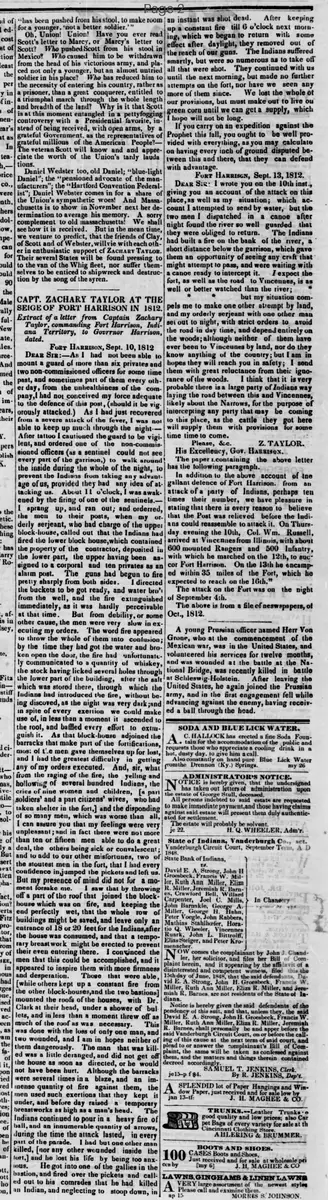
SIEGE OF FORT HARRISON IN 1812.
Extract of a letter from Captain Zachary Taylor, commanding Fort Harrison, Indiana Territory, to Governor Harrison, dated.
FORT HARRISON, Sept. 10, 1812
Dear SIR:--As I had not been able to mount a guard of more than six privates and two non-commissioned officers for some time past, and sometimes part of them every other day, from the unhealthiness of the company, I had not conceived my force adequate to the defence of this post, (should it be vigorously attacked.) As I had just recovered from a severe attack of the fever, I was not able to keep up much through the night--- After tattoo I cautioned the guard to be vigilant, and ordered one of the non-commissioned officers (as a sentinel could not see every part of the garrison,) to walk around the inside during the whole of the night, to prevent the Indians from taking any advantage of us, provided they had any idea of attacking us. About 11 o'clock, I was awakened by the firing of one of the sentinels.-- I sprang up, and ran out; and ordered the men to their posts, when my orderly sergeant, who had charge of the upper block-house, called out that the Indians had fired the lower block house, which contained the property of the contractor, deposited in the lower part, the upper having been assigned to a corporal and ten privates as an alarm post. The guns had begun to fire pretty sharply from both sides. I directed the buckets to be got ready, and water brought from the well, and the fire extinguished immediately, as it was hardly perceivable at that time. But from debility, or some other cause, the men were very slow in executing my orders. The word fire appeared to throw the whole of them into confusion; by the time they had got the water and broken open the door, the fire had unfortunately communicated to a quantity of whiskey, the stock having licked several holes through the lower part of the building, after the salt which was stored there, through which the Indians had introduced the fire, without being discovered, as the night was very dark; and in spite of every exertion we could make use of, in less than a moment it ascended to the roof, and baffled every effort to extinguish it. As that block-house adjoined the barracks that make part of the fortifications, most of the men gave themselves up for lost, and I had the greatest difficulty in getting any of my orders executed. And, sir, what from the raging of the fire, the yelling and howling of several hundred Indians, the cries of nine women and children, [in part soldiers' and a part citizens' wives, who had taken shelter in the fort,] and the desponding of so many men, which was worse than all, I can assure you that my feelings were very unpleasant; and in fact there were not more than ten or fifteen men able to do a great deal, the others being sick or convalescent; and to add to our other misfortunes, two of the stoutest men in the fort, that I had every confidence in, jumped the pickets and left us. But my presence of mind did not for a moment forsake me.
I saw that by throwing off a part of the roof that joined the block-house which was on fire, and keeping the end perfectly wet, that the whole row of buildings might be saved, and leave only an entrance of 18 or 20 feet for the Indians, after the house was consumed, and that a temporary breast work might be erected to prevent their even entering there. I convinced the men that this could be accomplished, and it appeared to inspire them with more firmness and desperation. Those that were able, [while others kept up a constant fire from the other block-houses, and the two bastions] mounted the roofs of the houses, with Dr. Clark at their head, under a shower of bullets, and in less than a moment threw off as much of the roof as was necessary.
This was done with the loss of only one man, and two wounded, and I am in hopes neither of them dangerously. The man that was killed was a little deranged, and did not get off the house as soon as directed, or he would not have been hurt. Although the barracks were several times in a blaze, and an immense quantity of fire against them, the men used such exertions that they kept it under, and before day raised a temporary breastworks as high as a man's head. The Indians continued to pour in a heavy fire of ball, and an innumerable quantity of arrows, during the time the attack lasted, in every part of the parade. I had but one other man killed, [nor any other wounded inside the fort,] and he lost his life by being too anxious. He got into one of the galleys in the bastion, and fired over the pickets and called out to his comrades that he had killed
an Indian, and in an instant was shot dead. After keeping up a constant fire till 6 o'clock next morning, which we began to return with some effect after daylight, they removed out of the reach of our guns. The Indians suffered smartly, but were so numerous as to take off all that were shot. They continued with us until the next morning, but made no further attempts on the fort, nor have we seen any more of them since.
We lost the whole of our provisions, but must make out to live on green corn until we can get a supply, which I hope will not be long.
If you carry on an expedition against the Prophet this fall, you ought to be well provided with everything, as you may calculate on having every inch of ground disputed between this and there, that they can defend with advantage.
YOURS, &c.
Z. TAYLOR.
His Excellency, Gov. Harrison.
FORT HARRISON, Sept. 13, 1812.
Dear SIR: I wrote you on the 10th inst., giving you an account of the attack on this place, as well as my situation; which account I attempted to send by water, but the two men I dispatched in a canoe after night found the river so well guarded that they were obliged to return. The Indians had built a fire on the bank of the river, a short distance below the garrison, which gave them an opportunity of seeing any craft that might attempt to pass, and were waiting with a canoe ready to intercept it. I expect the fort, as well as the road to Vincennes, is as well or better watched than the river; but my situation compels me to make one other attempt by land. and my orderly sergeant with one other man set out to night, with strict orders to avoid the road in day time, and depend entirely on the woods; although neither of them have ever been to Vincennes by land, nor do they know anything of the country; but I am in hopes they will reach you in safety; I send them with great reluctance from their ignorance of the woods. I think that it is very probable there is a large party of Indians way laying the road between this and Vincennes, likely about the Narrows, for the purpose of intercepting any party that may be coming to this place, as the cattle they got here will supply them with provisions for some time to come.
Please,
& c.
Z. TAYLOR.
The paper containing the above letter has the following paragraph.
In addition to the above account of the gallant defence of Fort Harrison, from an attack of a party of Indians, perhaps ten times their number, we have pleasure in stating that there is every reason to believe that the Post was relieved before the Indians could reassemble to attack it. On Thursday evening the 10th, Col. Wm. Russell, arrived at Vincennes from Illinois, with about 600 mounted Rangers and 500 Infantry, with which he marched on the 12th, to succor Fort Harrison. On the 13th he encamped within 35 miles of the Fort, which he expected to reach on the 16th."
The attack on the Fort was on the night of September 4th.
The above is from a file of newspapers, of Oct., 1812.
What sub-type of article is it?
What themes does it cover?
What keywords are associated?
What entities or persons were involved?
Where did it happen?
Story Details
Key Persons
Location
Fort Harrison, Indiana Territory
Event Date
September 4, 1812
Story Details
Captain Taylor's garrison at Fort Harrison repels a nighttime Indian attack on September 4, 1812, by extinguishing fires set to blockhouses, removing parts of roofs to prevent spread, and maintaining fire under duress, losing two men killed and two wounded while inflicting casualties on the attackers. Follow-up efforts to seek relief succeed as Col. Russell's forces approach.