Thank you for visiting SNEWPapers!
Sign up free
Letter to Editor
September 27, 1830
Phenix Gazette
Alexandria, Virginia
What is this article about?
The letter reflects on how the recent French Revolution may override self-interest with patriotism and aid in settling longstanding U.S. claims against France for pre-Napoleonic spoliations, potentially through Lafayette's influence and repurposing Algerine plunder. It critiques past diplomatic efforts by James Brown and hopes for success under Mr. Rives.
Clipping
OCR Quality
95%
Excellent
Full Text
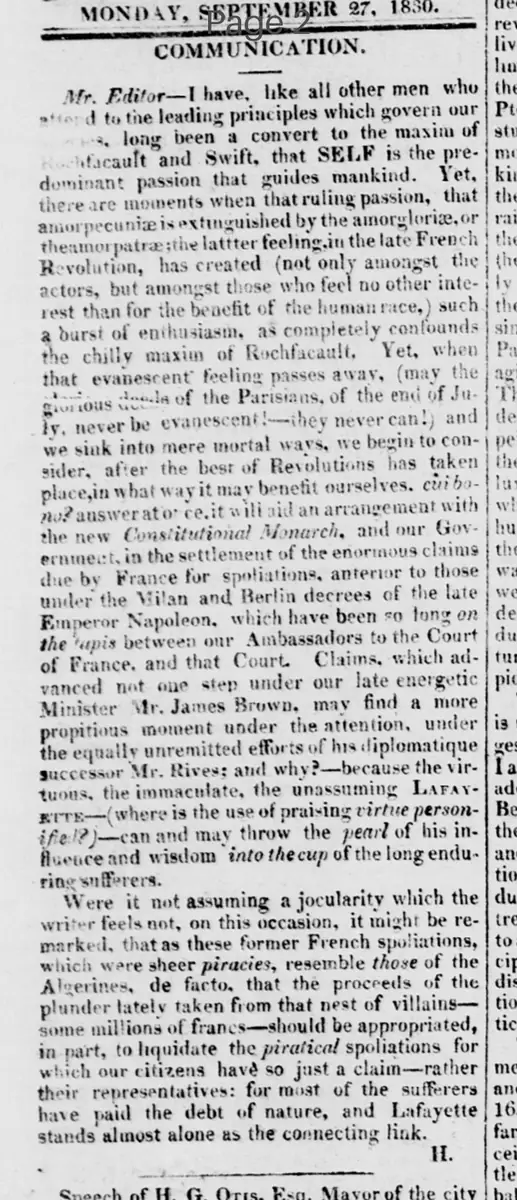
COMMUNICATION.
Mr. Editor—I have, like all other men who have long been a convert to the maxim of La Rochefoucauld and Swift, that SELF is the predominant passion that guides mankind. Yet, there are moments when that ruling passion, that amor pecuniae is extinguished by the amor gloriae, or the amor patriae; the latter feeling, in the late French Revolution, has created (not only amongst the actors, but amongst those who feel no other interest than for the benefit of the human race) such a burst of enthusiasm, as completely confounds the chilly maxim of La Rochefoucauld. Yet, when that evanescent feeling passes away (may the glorious idea of the Parisians, of the end of July, never be evanescent!—they never can!) and we sink into mere mortal ways, we begin to consider, after the best of Revolutions has taken place, in what way it may benefit ourselves. Can it? Answer to this: It aided an arrangement with the new Constitutional Monarch, and our Government, in the settlement of the enormous claims due by France for spoliations, anterior to those under the Milan and Berlin decrees of the late Emperor Napoleon, which have been so long on the tapis between our Ambassadors to the Court of France, and that Court. Claims, which advanced not one step under our late energetic Minister Mr. James Brown, may find a more propitious moment under the attention, under the equally unremitted efforts of his diplomatique successor Mr. Rives; and why?—because the virtuous, the immaculate, the unassuming Lafayette—(where is the use of praising virtue personified?)—can and may throw the pearl of his influence and wisdom into the cup of the long enduring sufferers.
Were it not assuming a jocularity which the writer feels not, on this occasion, it might be remarked, that as these former French spoliations, which were sheer piracies, resemble those of the Algerines, de facto, that the proceeds of the plunder lately taken from that nest of villains—some millions of francs—should be appropriated, in part, to liquidate the piratical spoliations for which our citizens have so just a claim—rather their representatives: for most of the sufferers have paid the debt of nature, and Lafayette stands almost alone as the connecting link.
H.
Mr. Editor—I have, like all other men who have long been a convert to the maxim of La Rochefoucauld and Swift, that SELF is the predominant passion that guides mankind. Yet, there are moments when that ruling passion, that amor pecuniae is extinguished by the amor gloriae, or the amor patriae; the latter feeling, in the late French Revolution, has created (not only amongst the actors, but amongst those who feel no other interest than for the benefit of the human race) such a burst of enthusiasm, as completely confounds the chilly maxim of La Rochefoucauld. Yet, when that evanescent feeling passes away (may the glorious idea of the Parisians, of the end of July, never be evanescent!—they never can!) and we sink into mere mortal ways, we begin to consider, after the best of Revolutions has taken place, in what way it may benefit ourselves. Can it? Answer to this: It aided an arrangement with the new Constitutional Monarch, and our Government, in the settlement of the enormous claims due by France for spoliations, anterior to those under the Milan and Berlin decrees of the late Emperor Napoleon, which have been so long on the tapis between our Ambassadors to the Court of France, and that Court. Claims, which advanced not one step under our late energetic Minister Mr. James Brown, may find a more propitious moment under the attention, under the equally unremitted efforts of his diplomatique successor Mr. Rives; and why?—because the virtuous, the immaculate, the unassuming Lafayette—(where is the use of praising virtue personified?)—can and may throw the pearl of his influence and wisdom into the cup of the long enduring sufferers.
Were it not assuming a jocularity which the writer feels not, on this occasion, it might be remarked, that as these former French spoliations, which were sheer piracies, resemble those of the Algerines, de facto, that the proceeds of the plunder lately taken from that nest of villains—some millions of francs—should be appropriated, in part, to liquidate the piratical spoliations for which our citizens have so just a claim—rather their representatives: for most of the sufferers have paid the debt of nature, and Lafayette stands almost alone as the connecting link.
H.
What sub-type of article is it?
Philosophical
Political
Reflective
What themes does it cover?
Politics
Economic Policy
What keywords are associated?
French Revolution
Us Claims
Spoliations
Lafayette
Diplomacy
Algerines
Napoleon Decrees
What entities or persons were involved?
H.
Mr. Editor
Letter to Editor Details
Author
H.
Recipient
Mr. Editor
Main Argument
the french revolution may facilitate the settlement of u.s. claims against france for pre-napoleonic spoliations through lafayette's influence and the new constitutional monarchy, building on diplomatic efforts by successors to james brown like mr. rives.
Notable Details
References La Rochefoucauld And Swift On Self Interest
Mentions July Revolution In Paris
Discusses Diplomats James Brown And Mr. Rives
Praises Lafayette's Potential Role
Suggests Using Algerine Plunder For Claims