Thank you for visiting SNEWPapers!
Sign up free
Literary
September 18, 1817
Alexandria Gazette & Daily Advertiser
Alexandria, Virginia
What is this article about?
Satirical essay from 1817 mocking pseudoscientific explanations of the Cape Ann sea serpent as a descendant of Pegasus, a magnetic method for finding longitude, and a 'patent chronometer' using a coin on a string to tell time, presented as a learned memoir.
Merged-components note: Satirical article on the sea serpent and related topics continued across pages
Clippings
1 of 2
OCR Quality
88%
Good
Full Text
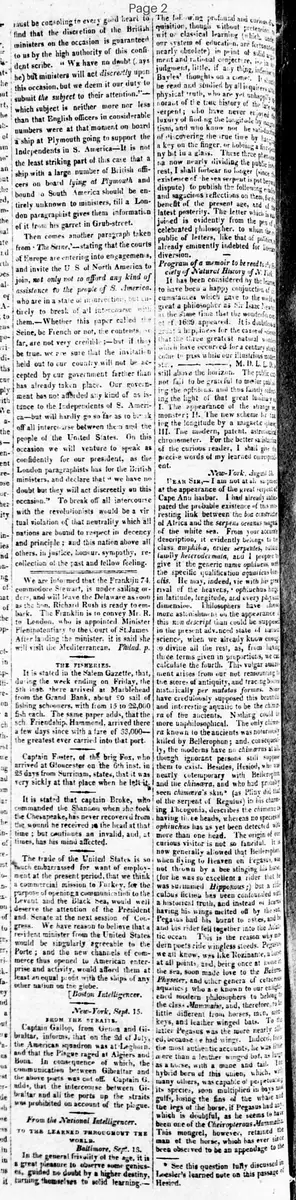
From the National Intelligencer.
TO THE LEARNED THROUGHOUT THE WORLD.
Baltimore, Sept. 18.
In the general frivolity of the age, it is a great pleasure to observe some geniuses, guided no doubt by a higher destiny, turning themselves to solid learning.— The following profound and curious disquisition though without pretension to wit or classical learning which under our system of education are fortunate nearly obsolete in print of solid argument and rational conjecture, is in judgment, little, if anything, inferior to Bayle's thoughts on a comet. I should be read and studied by all inquirers after physical truth, who are yet unhappily ignorant of the true history of the sea serpent; who have never enjoyed the luxury of finding the longitude by magnetism, and who know not the satisfaction of discovering the true time by hanging a key on the finger, or holding a fire-jibbet by the bit in a glass. These three phenomena now nearly dividing the public interest, I shall forbear no longer (since existence of the sea serpent is put beyond dispute) to publish the following erudite and sagacious reflections on them, for the benefit of the present age, and of latest posterity. The letter which is joined is evidently from the pen of a celebrated philosopher, to whom the public of letters, like that of politics, are already eminently indebted for literary diversion.
Program of a memoir to be read to the Society of Natural History of N. York
It has been considered by the learned to have been a happy conjunction of circumstances which gave to the world so great a philosopher as Sir Isaac Newton at the same time that the wonderful comet of 1689 appeared. It is doubtless a great happiness for the cause of science that the three greatest natural wonders which have occurred for a century past came to pass while our illustrious modern Sir Isaac was still above the horizon. The public cannot fail to be grateful to me for publishing the opinions, and thus faintly reflecting the light of that great luminary.
I. The appearance of the strange sea monster; II. The new scheme for finding the longitude by a magnetic sphere; III. The modern, patent, astronomical chronometer. For the better satisfaction of the curious reader, I shall give the precise words of my learned correspondent.
New-York, August 31.
Dear Sir,—I am not at all surprised at the appearance of the great serpent of Cape Ann harbor. I had already anticipated the probable existence of this interesting link between the boa constrictor of Africa and the serpens oceanus magna of the White Sea. From your accurate description, it evidently belongs to the class amphibia, order serpentes, natural family herpetodermata, and I propose to give it the generic name ophiucus, or the specific qualification aquatice aston alis. He may, indeed, vie with his great rival of the heavens, 'ophiuchus major' in latitude, longitude, and every physical dimension. Philosophers have been more astonished on the appearance of this non descript than could be supposed in the present advanced state of natural science, when we already know enough to divine all the rest, as, from having three terms given in proportion, we can calculate the fourth. This vulgar amazement arises from our not remounting to the stores of antiquity, and tracing about historically per mutatas formas. Some have credulously supposed this beautiful and interesting aquatic to be the chimæra of the ancients. Nothing could be more unphilosophical. The only chimæra known to the ancients was not of its sort killed by Bellerophon: and, consequently, the moderns have no chimæras at all though ignorant persons still suppose them to exist. Besides, Hesiod, who was nearly cotemporary with Bellerophon and the chimæra, and who had probably seen chimæra's skin (as Pliny did that of the serpent of Regulus) in his charming Theogonia, describes the chimæra as having three heads, whereas no species of ophiuchus has as yet been detected with more than one head. The origin of our curious visitor is not so fanciful. It is now generally allowed that Bellerophon when flying to Heaven on Pegasus, was not thrown by a bee stinging his horse, (for he was so excellent a rider that he was surnamed Hippodamus;) but a ridiculous fiction has been confounded with a historical truth, and instead of its having his wings melted off by the sun, Pegasus had his burnt to ashes, and he and his rider fell together into the Attic ocean.
This is the reason why modern poets ride wingless steeds. Pegasus we all know, was like Rosinante, a horse at all points, and, being once at home in the sea, soon made love to the Physeter, and other genera of cetaceous aquatics; who are known to our enlightened modern philosophers to belong to the class Mammalia, and, therefore to be little different from horses, men, monkeys, and leather winged bats. To the latter Pegasus was the more nearly allied, because he had wings. Indeed, from the most authentic accounts, he was nothing more than a leather winged bat, as large as a horse, with a mane and tail. The hybrid born of this union, which, with many others, was capable of perpetuating its species, soon multiplied in bays and gulfs, losing the fins of the whale and the legs of the horse, if Pegasus had any! which is doubtful, as he seems to have been one of the Cheiropterous Mammalia.
This mongrel, however, retained the mane of the horse, which has ever since been observed to be an appendage to the Loesler's learned note on this passage See this question fully discussed in Hesiod.
Uphincbus, a huge waiting in Orotalus,
Say of the serpent of Paradise, which
Coluber, and other genera. Thus Milton
Who doubtless an Ophiucus:
"Or Jove's own thunderbolts
With turret crest, and sleek enamelled neck.
Fawning, and licking the ground, &c."
Licking the ground for all is an equine
propensity, and supports the hypothesis
of Ophiuchus being of Pegasean origin.
But this point is settled by the fact that
the Ophiucus of Cape Ann has precisely
the head and mane of a horse.
The more natural phenomena any
theory can explain, the more certainly is
it a true theory. Now this hypothesis
beautifully solves the great question of
the origin of the singular marine animals
miscall'd mermaids; who are, in truth,
no maids at all, but descendants of Belle-
rophon, who betook himself to the dol-
phins, as Pegasus did to the whales. and
a horse seems very little to deserve Horace's
scorn—he—Castus Bellerophon.
Let then this classical guest of Cane
And cease to inspire terror. He is the
high descendant of Pegasus who has vi-
sited our coast, and we only regret that
he has lost his wings. The fire from his
nostrils is a mere deceptio visus, and no-
thing more than the phosphorescent co-
ruscations of the amusing infinitude of
Medusa, which sprung up with Pegasus
from the blood of Medusa, and illuminate
the paths through which he and his de-
scendants.
The cutaneous protuberances which you
describe about the vertebræ, costæ, &c.
are signs or symptoms of an irregular form,
and uneven consistency. The vast fangs
of this Leviathan are probably purely
cutaneous, though perhaps a little calcined
by his fiery breath, it, as you sup-
pose he breathe flame of a white heat.
So
much for the serpent.
The longitude is a subject which has
long occupied philosophical enquiry, and
baffled astronomical skill. The applica-
tion of magnetism to so difficult a prob-
lem, does equal honor to our country and
to my learned friend, Mr. ——. I sup-
pose the artificial, magnetised, terreugin-
ous sphere, to turn, as it is moved east
or west, just as one spur wheel turns a-
nother; magnetism being a species of
spur, or, as the Latins said, stimulus,
which meant any exciting force—spurs
too, "like magnets, are made of iron."
Should the experiment succeed, I know
of no modern discovery, in scientific one-
chanics, of equal value. The project of
the ingenious and erudite Dr. Wilson,
was not on principles philosophical.—
Nor do I think even Mr. Rittenhouse's ex-
cellent machine near so simple or elegant.
I have, however, thought of applying the
newly invented chronometer to any learned
friend and correspondent, Dr. ——,
to this purpose. Its structure is extreme-
ly simple, and the modus operandi clear-
ly deducible from the best established
physical principles. It consists of a five-
penny-bit fixed to a string 6 inches long,
held between the thumb and fore finger,
suspended in a half pint glass, the elbow
resting the while on the table. In this
posture of affairs the five-penny bit begins
its oscillations, and strikes the hour, mi-
nute, and second, to the smallest frac-
tion, against the side of the glass.
It has been objected to this theory, that
the faculty of ascertaining the hour is pe-
culiar to particular individuals, like the
second sight among the Scotch. This is
an objection which nothing but ignorance
could conceive and laziness propagate;
for it is manifest that this, like every
higher endowment, though the gift of na-
ture to its favorite prodigies, yet that,
like poetic genius, it may be acquired,
by long application, by all. For this
purpose professorships should be estab-
lished in all our learned universities, for
the instruction of persons of all ages and
sexes, in finding the true time by the pa-
tent chronometer.
This would be a much easier method of
finding the longitude, and much more
conformable to the liberal spirit of mo-
dern enquiry, than the tedious and un-
certain process of spherical trigonometry,
or the immersion of Jupiter's satellites.—
Then too the great object of Lord Ba-
con's inductive philosophy, viz. to level wit, & leave no great
superiority to the more exquisite minds
on the subject, will be accomplished, for a
child could hold a string as well as New-
tton or La Place.
This noble invention may also be ap-
plied to many purposes of practical utility.
Experience had taught, long before
Hippocrates, perhaps as early as Esculapius
or Apollo himself, that nothing is
more essential in all the science of Hy-
geine, than the observation of regular
hours for eating and drinking. A good
grog watch, therefore, has long been a
desideratum in the philosophy of domes-
tic economy. This seems extremely apt
to answer all the ends of so useful a ma-
chine. A tumbler or glass would per-
form the double duty of chiming the
hour and holding the liquor. Even the
five-penny-bit might, after striking the
time, assume a vicarious function, & pay
for the whiskey. The draught would
quicken the circulation of the subtle fluid,
which detects unconsciously the hidden
hour, and thus time might be taken
by the forelock, and led on a quarter faster
in every hour, than our present lazy
watches, with all their patent levers, will
drive it. This would be so much clear
gain to a craving stomach.
The other objections which have been
made to this curious and valuable inven-
tion, are like that which has already
been stated, the mere suggestions of
ignorant scepticism. It has been impertinently
asked, "What connection can
there be between the artificial and arbitrary
divisions of time, itself a mere
creature of mind, and having no influ-
ence on the principles of the material
world, and the five-penny-bit tumbler
and string?" This is another error, a-
rising from our not ascending in such
profound enquiries to the fountain head.
The ancients, in fact, originally divided
time just as nature had done, by means
of the patent five-penny-bit, or grog
watch. Nature separated the hours, man
only numbered them. The sand glass
was not, as has been ignorantly and va-
pouringly pretended by pedants, filled
with sand, which ran through a hole, but
it was called sand glass, merely because
it was customary to stick it in the sand
for greater steadiness, while the experi-
mental philosopher was feeling in his
breeches pocket for a five-penny-bit, or
a six-pence, with which to begin his ope-
rations. That the first time piece or
chronometer used by the learned, was
nothing more than our patent watch, may
be made appear by invincible arguments.
1. In the Greek language, Chronos
is said to be derived from Kronos
(Saturn), because he destroyed his children,
and time destroys its own produc-
tions. This absurd fable shows how vi-
lified and calumniated philosophers have
been in all ages. Kronos, or Saturn, in-
stead of being a cannibal, the devourer of
his own children, was a very amiable gen-
tleman, who kept house first in Greece,
and afterwards in Italy. He was a very
exact observer of the heavens and taught
astronomy to his son Chiron the centaur,
who made the celestial globe for the Ar-
gonautic expedition. Saturn had of course
occasion for accurate time pieces. The
figure which has been incautiously suppos-
ed to be a scythe on the ancient medals
of Saturn, was in fact his watch, consist-
ing of a cut sixpence a little bent, tied to
a string. With this and a glass he made
his astronomical observations, and when
done he gave his apparatus to the Cory-
bantes as a rattle, to amuse Jupiter, and
hence the monstrous fable of their beating
kettles to drown his cries. Sometimes
when he had no small change about him
to find the hour, or buy a gill of whiskey,
he used a bit of lead, which was from this
time called Saturnum. The uppermost
planet was also called, in honor of such a
distinguished astronomer, Saturn, as we
have since had with equal propriety the
Georgium Sidus. Kronos being then the
first measurer of time, time itself was
called after him, Chronos.
2. If a doubt could still remain that the
ancient sand glass was our modern grog
watch, Horace, the most accurate of poets,
and one who was never without a
glass to learn the hour, and take a drink
of wine, would put this matter finally to
rest. In Lib. 1. Sat. 3, he pathetically
laments that before he and his friends
could after a hot journey tie their mules,
and pull out their five penny bits to find
the hour, it had fled. For the words,
Dum æs exigitur, dum mula ligatur
Tota abit hora,
can mean nothing else but being as Pliny
tells us a small Roman coin, and ara
Corybantia are admitted to have been the
cymbals of the Corybantes, which have
already been shewn to have been our grog
watch. Q. E. D.
To this demonstration I shall only add
one other passage from Horace. Lib 2,
Sat. 7. Priscus is represented as the
most impatient person in the world, be-
cause he spent his whole time, nay even
lived, in trying to force the hour with a
nail or key, instead of a five-penny bit.
Vixit inæqualis, clavo ut mutaret horas.
These arguments may suffice to con-
vince the most incredulous, that this last
improvement in measuring time is only a
recurrence to the original method of the
ingenious ancients. They also refute an
old dogma, nihil simul inventum est et
perfectum, for the first invention was per-
fect.
Yours with great admiration and es-
teem
****** "*******, M.D. LL.D. &c.
P. S. I had intended to write a com-
mentary vindicating the text of our au-
thor, but, upon consideration, I find his
argument too clear, and his reasoning too
irresistible, to require elucidation.
Perhaps, I may, at leisure allow, give a
dissertation upon the best means of attack
and defence of the Sea Serpent; with an
inquiry whether Torpedos or Steam Fur-
naces be preferable in Serpentine wars.
RICHARDUS ARISTARCHUS.
TO THE LEARNED THROUGHOUT THE WORLD.
Baltimore, Sept. 18.
In the general frivolity of the age, it is a great pleasure to observe some geniuses, guided no doubt by a higher destiny, turning themselves to solid learning.— The following profound and curious disquisition though without pretension to wit or classical learning which under our system of education are fortunate nearly obsolete in print of solid argument and rational conjecture, is in judgment, little, if anything, inferior to Bayle's thoughts on a comet. I should be read and studied by all inquirers after physical truth, who are yet unhappily ignorant of the true history of the sea serpent; who have never enjoyed the luxury of finding the longitude by magnetism, and who know not the satisfaction of discovering the true time by hanging a key on the finger, or holding a fire-jibbet by the bit in a glass. These three phenomena now nearly dividing the public interest, I shall forbear no longer (since existence of the sea serpent is put beyond dispute) to publish the following erudite and sagacious reflections on them, for the benefit of the present age, and of latest posterity. The letter which is joined is evidently from the pen of a celebrated philosopher, to whom the public of letters, like that of politics, are already eminently indebted for literary diversion.
Program of a memoir to be read to the Society of Natural History of N. York
It has been considered by the learned to have been a happy conjunction of circumstances which gave to the world so great a philosopher as Sir Isaac Newton at the same time that the wonderful comet of 1689 appeared. It is doubtless a great happiness for the cause of science that the three greatest natural wonders which have occurred for a century past came to pass while our illustrious modern Sir Isaac was still above the horizon. The public cannot fail to be grateful to me for publishing the opinions, and thus faintly reflecting the light of that great luminary.
I. The appearance of the strange sea monster; II. The new scheme for finding the longitude by a magnetic sphere; III. The modern, patent, astronomical chronometer. For the better satisfaction of the curious reader, I shall give the precise words of my learned correspondent.
New-York, August 31.
Dear Sir,—I am not at all surprised at the appearance of the great serpent of Cape Ann harbor. I had already anticipated the probable existence of this interesting link between the boa constrictor of Africa and the serpens oceanus magna of the White Sea. From your accurate description, it evidently belongs to the class amphibia, order serpentes, natural family herpetodermata, and I propose to give it the generic name ophiucus, or the specific qualification aquatice aston alis. He may, indeed, vie with his great rival of the heavens, 'ophiuchus major' in latitude, longitude, and every physical dimension. Philosophers have been more astonished on the appearance of this non descript than could be supposed in the present advanced state of natural science, when we already know enough to divine all the rest, as, from having three terms given in proportion, we can calculate the fourth. This vulgar amazement arises from our not remounting to the stores of antiquity, and tracing about historically per mutatas formas. Some have credulously supposed this beautiful and interesting aquatic to be the chimæra of the ancients. Nothing could be more unphilosophical. The only chimæra known to the ancients was not of its sort killed by Bellerophon: and, consequently, the moderns have no chimæras at all though ignorant persons still suppose them to exist. Besides, Hesiod, who was nearly cotemporary with Bellerophon and the chimæra, and who had probably seen chimæra's skin (as Pliny did that of the serpent of Regulus) in his charming Theogonia, describes the chimæra as having three heads, whereas no species of ophiuchus has as yet been detected with more than one head. The origin of our curious visitor is not so fanciful. It is now generally allowed that Bellerophon when flying to Heaven on Pegasus, was not thrown by a bee stinging his horse, (for he was so excellent a rider that he was surnamed Hippodamus;) but a ridiculous fiction has been confounded with a historical truth, and instead of its having his wings melted off by the sun, Pegasus had his burnt to ashes, and he and his rider fell together into the Attic ocean.
This is the reason why modern poets ride wingless steeds. Pegasus we all know, was like Rosinante, a horse at all points, and, being once at home in the sea, soon made love to the Physeter, and other genera of cetaceous aquatics; who are known to our enlightened modern philosophers to belong to the class Mammalia, and, therefore to be little different from horses, men, monkeys, and leather winged bats. To the latter Pegasus was the more nearly allied, because he had wings. Indeed, from the most authentic accounts, he was nothing more than a leather winged bat, as large as a horse, with a mane and tail. The hybrid born of this union, which, with many others, was capable of perpetuating its species, soon multiplied in bays and gulfs, losing the fins of the whale and the legs of the horse, if Pegasus had any! which is doubtful, as he seems to have been one of the Cheiropterous Mammalia.
This mongrel, however, retained the mane of the horse, which has ever since been observed to be an appendage to the Loesler's learned note on this passage See this question fully discussed in Hesiod.
Uphincbus, a huge waiting in Orotalus,
Say of the serpent of Paradise, which
Coluber, and other genera. Thus Milton
Who doubtless an Ophiucus:
"Or Jove's own thunderbolts
With turret crest, and sleek enamelled neck.
Fawning, and licking the ground, &c."
Licking the ground for all is an equine
propensity, and supports the hypothesis
of Ophiuchus being of Pegasean origin.
But this point is settled by the fact that
the Ophiucus of Cape Ann has precisely
the head and mane of a horse.
The more natural phenomena any
theory can explain, the more certainly is
it a true theory. Now this hypothesis
beautifully solves the great question of
the origin of the singular marine animals
miscall'd mermaids; who are, in truth,
no maids at all, but descendants of Belle-
rophon, who betook himself to the dol-
phins, as Pegasus did to the whales. and
a horse seems very little to deserve Horace's
scorn—he—Castus Bellerophon.
Let then this classical guest of Cane
And cease to inspire terror. He is the
high descendant of Pegasus who has vi-
sited our coast, and we only regret that
he has lost his wings. The fire from his
nostrils is a mere deceptio visus, and no-
thing more than the phosphorescent co-
ruscations of the amusing infinitude of
Medusa, which sprung up with Pegasus
from the blood of Medusa, and illuminate
the paths through which he and his de-
scendants.
The cutaneous protuberances which you
describe about the vertebræ, costæ, &c.
are signs or symptoms of an irregular form,
and uneven consistency. The vast fangs
of this Leviathan are probably purely
cutaneous, though perhaps a little calcined
by his fiery breath, it, as you sup-
pose he breathe flame of a white heat.
So
much for the serpent.
The longitude is a subject which has
long occupied philosophical enquiry, and
baffled astronomical skill. The applica-
tion of magnetism to so difficult a prob-
lem, does equal honor to our country and
to my learned friend, Mr. ——. I sup-
pose the artificial, magnetised, terreugin-
ous sphere, to turn, as it is moved east
or west, just as one spur wheel turns a-
nother; magnetism being a species of
spur, or, as the Latins said, stimulus,
which meant any exciting force—spurs
too, "like magnets, are made of iron."
Should the experiment succeed, I know
of no modern discovery, in scientific one-
chanics, of equal value. The project of
the ingenious and erudite Dr. Wilson,
was not on principles philosophical.—
Nor do I think even Mr. Rittenhouse's ex-
cellent machine near so simple or elegant.
I have, however, thought of applying the
newly invented chronometer to any learned
friend and correspondent, Dr. ——,
to this purpose. Its structure is extreme-
ly simple, and the modus operandi clear-
ly deducible from the best established
physical principles. It consists of a five-
penny-bit fixed to a string 6 inches long,
held between the thumb and fore finger,
suspended in a half pint glass, the elbow
resting the while on the table. In this
posture of affairs the five-penny bit begins
its oscillations, and strikes the hour, mi-
nute, and second, to the smallest frac-
tion, against the side of the glass.
It has been objected to this theory, that
the faculty of ascertaining the hour is pe-
culiar to particular individuals, like the
second sight among the Scotch. This is
an objection which nothing but ignorance
could conceive and laziness propagate;
for it is manifest that this, like every
higher endowment, though the gift of na-
ture to its favorite prodigies, yet that,
like poetic genius, it may be acquired,
by long application, by all. For this
purpose professorships should be estab-
lished in all our learned universities, for
the instruction of persons of all ages and
sexes, in finding the true time by the pa-
tent chronometer.
This would be a much easier method of
finding the longitude, and much more
conformable to the liberal spirit of mo-
dern enquiry, than the tedious and un-
certain process of spherical trigonometry,
or the immersion of Jupiter's satellites.—
Then too the great object of Lord Ba-
con's inductive philosophy, viz. to level wit, & leave no great
superiority to the more exquisite minds
on the subject, will be accomplished, for a
child could hold a string as well as New-
tton or La Place.
This noble invention may also be ap-
plied to many purposes of practical utility.
Experience had taught, long before
Hippocrates, perhaps as early as Esculapius
or Apollo himself, that nothing is
more essential in all the science of Hy-
geine, than the observation of regular
hours for eating and drinking. A good
grog watch, therefore, has long been a
desideratum in the philosophy of domes-
tic economy. This seems extremely apt
to answer all the ends of so useful a ma-
chine. A tumbler or glass would per-
form the double duty of chiming the
hour and holding the liquor. Even the
five-penny-bit might, after striking the
time, assume a vicarious function, & pay
for the whiskey. The draught would
quicken the circulation of the subtle fluid,
which detects unconsciously the hidden
hour, and thus time might be taken
by the forelock, and led on a quarter faster
in every hour, than our present lazy
watches, with all their patent levers, will
drive it. This would be so much clear
gain to a craving stomach.
The other objections which have been
made to this curious and valuable inven-
tion, are like that which has already
been stated, the mere suggestions of
ignorant scepticism. It has been impertinently
asked, "What connection can
there be between the artificial and arbitrary
divisions of time, itself a mere
creature of mind, and having no influ-
ence on the principles of the material
world, and the five-penny-bit tumbler
and string?" This is another error, a-
rising from our not ascending in such
profound enquiries to the fountain head.
The ancients, in fact, originally divided
time just as nature had done, by means
of the patent five-penny-bit, or grog
watch. Nature separated the hours, man
only numbered them. The sand glass
was not, as has been ignorantly and va-
pouringly pretended by pedants, filled
with sand, which ran through a hole, but
it was called sand glass, merely because
it was customary to stick it in the sand
for greater steadiness, while the experi-
mental philosopher was feeling in his
breeches pocket for a five-penny-bit, or
a six-pence, with which to begin his ope-
rations. That the first time piece or
chronometer used by the learned, was
nothing more than our patent watch, may
be made appear by invincible arguments.
1. In the Greek language, Chronos
is said to be derived from Kronos
(Saturn), because he destroyed his children,
and time destroys its own produc-
tions. This absurd fable shows how vi-
lified and calumniated philosophers have
been in all ages. Kronos, or Saturn, in-
stead of being a cannibal, the devourer of
his own children, was a very amiable gen-
tleman, who kept house first in Greece,
and afterwards in Italy. He was a very
exact observer of the heavens and taught
astronomy to his son Chiron the centaur,
who made the celestial globe for the Ar-
gonautic expedition. Saturn had of course
occasion for accurate time pieces. The
figure which has been incautiously suppos-
ed to be a scythe on the ancient medals
of Saturn, was in fact his watch, consist-
ing of a cut sixpence a little bent, tied to
a string. With this and a glass he made
his astronomical observations, and when
done he gave his apparatus to the Cory-
bantes as a rattle, to amuse Jupiter, and
hence the monstrous fable of their beating
kettles to drown his cries. Sometimes
when he had no small change about him
to find the hour, or buy a gill of whiskey,
he used a bit of lead, which was from this
time called Saturnum. The uppermost
planet was also called, in honor of such a
distinguished astronomer, Saturn, as we
have since had with equal propriety the
Georgium Sidus. Kronos being then the
first measurer of time, time itself was
called after him, Chronos.
2. If a doubt could still remain that the
ancient sand glass was our modern grog
watch, Horace, the most accurate of poets,
and one who was never without a
glass to learn the hour, and take a drink
of wine, would put this matter finally to
rest. In Lib. 1. Sat. 3, he pathetically
laments that before he and his friends
could after a hot journey tie their mules,
and pull out their five penny bits to find
the hour, it had fled. For the words,
Dum æs exigitur, dum mula ligatur
Tota abit hora,
can mean nothing else but being as Pliny
tells us a small Roman coin, and ara
Corybantia are admitted to have been the
cymbals of the Corybantes, which have
already been shewn to have been our grog
watch. Q. E. D.
To this demonstration I shall only add
one other passage from Horace. Lib 2,
Sat. 7. Priscus is represented as the
most impatient person in the world, be-
cause he spent his whole time, nay even
lived, in trying to force the hour with a
nail or key, instead of a five-penny bit.
Vixit inæqualis, clavo ut mutaret horas.
These arguments may suffice to con-
vince the most incredulous, that this last
improvement in measuring time is only a
recurrence to the original method of the
ingenious ancients. They also refute an
old dogma, nihil simul inventum est et
perfectum, for the first invention was per-
fect.
Yours with great admiration and es-
teem
****** "*******, M.D. LL.D. &c.
P. S. I had intended to write a com-
mentary vindicating the text of our au-
thor, but, upon consideration, I find his
argument too clear, and his reasoning too
irresistible, to require elucidation.
Perhaps, I may, at leisure allow, give a
dissertation upon the best means of attack
and defence of the Sea Serpent; with an
inquiry whether Torpedos or Steam Fur-
naces be preferable in Serpentine wars.
RICHARDUS ARISTARCHUS.
What sub-type of article is it?
Satire
Essay
What themes does it cover?
Nature
Moral Virtue
What keywords are associated?
Sea Serpent
Cape Ann
Pegasus
Bellerophon
Longitude
Chronometer
Satire
Pseudoscience
What entities or persons were involved?
Richardus Aristarchus.
Literary Details
Title
To The Learned Throughout The World.
Author
Richardus Aristarchus.
Subject
On The Sea Serpent, Longitude By Magnetism, And Patent Chronometer.
Form / Style
Satirical Pseudo Scholarly Disquisition.
Key Lines
I Am Not At All Surprised At The Appearance Of The Great Serpent Of Cape Ann Harbor.
It Consists Of A Five Penny Bit Fixed To A String 6 Inches Long, Held Between The Thumb And Fore Finger, Suspended In A Half Pint Glass.
The Ancients, In Fact, Originally Divided Time Just As Nature Had Done, By Means Of The Patent Five Penny Bit, Or Grog Watch.