Thank you for visiting SNEWPapers!
Sign up free
Rocky Ford Enterprise
Rocky Ford, Otero County, Colorado
What is this article about?
John R. Walsh, former president of the Chicago National Bank, convicted on 54 counts of misapplying funds to his own enterprises totaling $16 million, leading to the bank's 1905 closure. Faces up to 540 years imprisonment; defense argues actions benefited banks with no losses.
Clipping
OCR Quality
Full Text
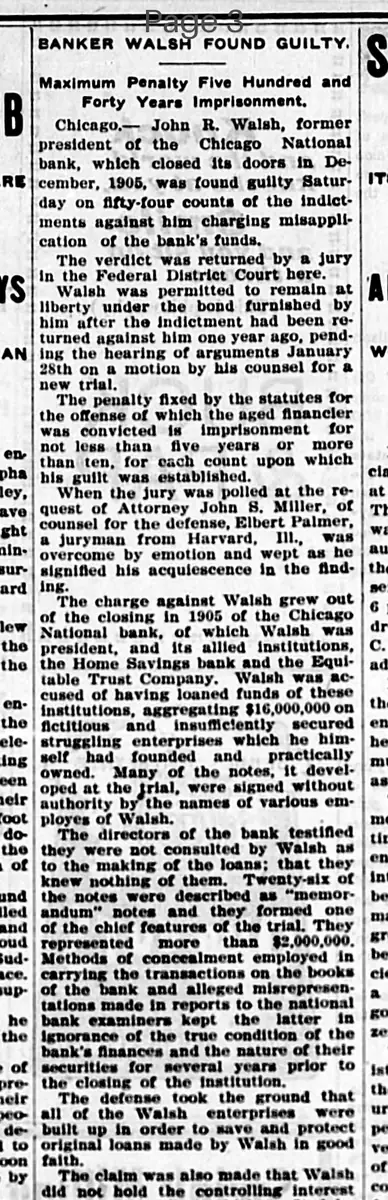
Maximum Penalty Five Hundred and Forty Years Imprisonment.
Chicago.—John R. Walsh, former president of the Chicago National bank, which closed its doors in December, 1905, was found guilty Saturday on fifty-four counts of the indictments against him charging misapplication of the bank's funds.
The verdict was returned by a jury in the Federal District Court here. Walsh was permitted to remain at liberty under the bond furnished by him after the indictment had been returned against him one year ago, pending the hearing of arguments January 28th on a motion by his counsel for a new trial.
The penalty fixed by the statutes for the offense of which the aged financier was convicted is imprisonment for not less than five years or more than ten, for each count upon which his guilt was established.
When the jury was polled at the request of Attorney John S. Miller, of counsel for the defense, Elbert Palmer, a juryman from Harvard, Ill., was overcome by emotion and wept as he signified his acquiescence in the finding.
The charge against Walsh grew out of the closing in 1905 of the Chicago National bank, of which Walsh was president, and its allied institutions, the Home Savings bank and the Equitable Trust Company. Walsh was accused of having loaned funds of these institutions, aggregating $16,000,000 on fictitious and insufficiently secured struggling enterprises which he himself had founded and practically owned. Many of the notes, it developed at the trial, were signed without authority by the names of various employees of Walsh.
The directors of the bank testified they were not consulted by Walsh as to the making of the loans; that they knew nothing of them. Twenty-six of the notes were described as “memorandum” notes and they formed one of the chief features of the trial. They represented more than $2,000,000.
Methods of concealment employed in carrying the transactions on the books of the bank and alleged misrepresentations made in reports to the national bank examiners kept the latter in ignorance of the true condition of the bank's finances and the nature of their securities for several years prior to the closing of the institution.
The defense took the ground that all of the Walsh enterprises were built up in order to save and protect original loans made by Walsh in good faith.
The claim was also made that Walsh did not hold the controlling interest in the corporations which profited by the loans, but that the Chicago National bank held it, Walsh being only a trustee and a conservator of the bank's interests. Walsh was on the witness stand for two days. He admitted nearly all of the transactions charged against him, but clung to the defense that all he did was for the good of the banks he headed and that all of the loans proved good and that no one lost anything in consequence of them.
In substantiation of the latter claim the defense offered evidence to show that since the closing of the banks Walsh had bought back the collateral taken from him by the clearing house banks, amounting to $7,000,000, giving in payment a note for the same amount, payable in five years. The collateral released, Walsh was able to go ahead with the building of his railroads.
What sub-type of article is it?
What themes does it cover?
What keywords are associated?
What entities or persons were involved?
Where did it happen?
Story Details
Key Persons
Location
Chicago
Event Date
December, 1905 (Bank Closing); Saturday (Verdict); January 28th (Arguments)
Story Details
John R. Walsh found guilty on fifty-four counts of misapplying Chicago National Bank funds to fictitious and insufficiently secured loans for his enterprises. Bank closed in 1905; defense claims loans were to protect original investments and proved good with no losses.