Thank you for visiting SNEWPapers!
Sign up free
Alexandria Daily Advertiser
Alexandria, Virginia
What is this article about?
Reports from London indicate Bonaparte is pushing peace overtures to discredit Britain's war continuation, amid efforts to gain allies. Prussia's king reportedly urges Britain to negotiate, amid discussions on European balance of power and past peace gains by France.
Merged-components note: Continuation of the same article from London papers on peace overtures, with sequential reading order and spatial proximity.
Clipping
OCR Quality
Full Text
Received at the Office of the Register.
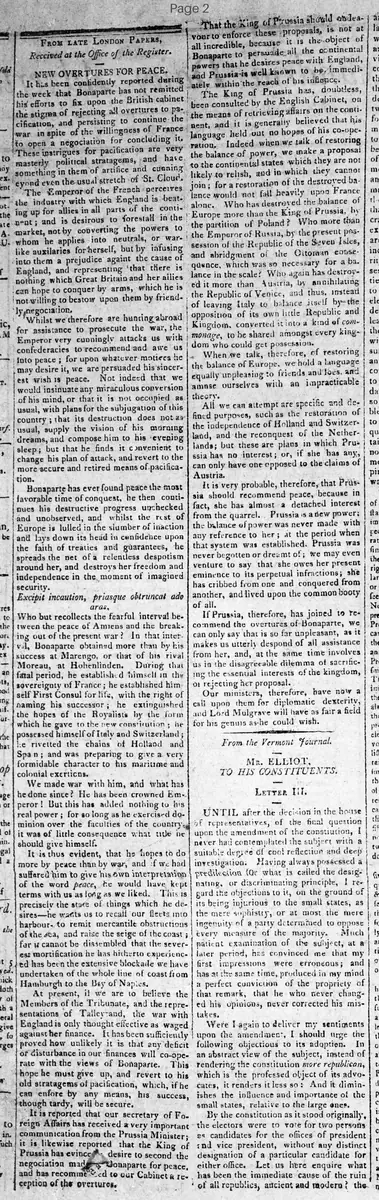
NEW OVERTURES FOR PEACE.
It has been confidently reported during the week that Bonaparte has not remitted his efforts to fix upon the British cabinet the stigma of rejecting all overtures to pacification, and persisting to continue the war in spite of the willingness of France to open a negociation for concluding it. These intrigues for pacification are very masterly political stratagems, and have something in them of artifice and cunning beyond even the usual stretch of St. Cloud.
The Emperor of the French perceives the industry with which England is beating up for allies in all parts of the continent; and is desirous to forestall in the market, not by converting the powers to whom he applies into neutrals, or warlike auxiliaries for herself, but by infusing into them a prejudice against the cause of England, and representing 'that there is nothing which Great Britain and her allies can hope to conquer by arms, which he is not willing to bestow upon them by friendly negociation.
Whilst we therefore are hunting abroad for assistance to prosecute the war, the Emperor very cunningly attacks us with confederacies to recommend and awe us into peace; for upon whatever motives he may desire it, we are persuaded his sincerest wish is peace. Not indeed that we would insinuate any miraculous conversion of his mind, or that it is not occupied as usual, with plans for the subjugation of this country; that its destruction does not as usual, supply the vision of his morning dreams, and compose him to his evening sleep; but that he finds it convenient to change his plan of attack, and revert to the more secure and retired means of pacification.
Bonaparte has ever found peace the most favorable time of conquest, he then continues his destructive progress unchecked and unobserved, and whilst the rest of Europe is lulled in the slumber of inaction and lays down its head in confidence upon the faith of treaties and guarantees, he spreads the net of a relentless despotism around her, and destroys her freedom and independence in the moment of imagined security.
Excipit incaution, priasque obtruncat adoras,
Who but recollects the fearful interval between the peace of Amiens and the breaking out of the present war? In that interval, Bonaparte obtained more than by his success at Marengo, or that of his rival Moreau, at Hohenlinden. During that fatal period, he established himself in the sovereignty of France: he established himself First Consul for life. with the right of naming his successor: he extinguished the hopes of the Royalists by the form which he gave to the new constitution ; he possessed himself of Italy and Switzerland he rivetted the chains of Holland and Spain; and was preparing to give a very formidable character to his maritime and colonial exertions.
We made war with him, and what has he done since? He has been crowned Emperor! But this has added nothing to his real power ; for so long as he exercised dominion over the faculties of the country. it was of little consequence what title he should give himself.
It is thus evident, that he hopes to do more by peace than by war, and if we had suffered him to give his own interpretation of the word peace, he would have kept terms with us as long as we liked. This is precisely the state of things which he desires--he wants us to recall our fleets into harbour- to remit mercantile obstructions of the sea, and raise the siege of the coast ; for it cannot be dissembled that the severest mortification he has hitherto experienced has been the extensive blockade we have undertaken of the whole line of coast from Hamburgh to the Bay of Naples.
At present, if we are to believe the Members of the Tribunate, and the representations of Talleyrand, the war with England is only thought effective as waged against her finance. It has been sufficiently proved how unlikely it is that any deficit or disturbance in our finances will co-operate with the views of Bonaparte. This hope he must give up, and revert to his old stratagems of pacification, which, if he can enforce by any means, his success, though tardy, will be secure.
It is reported that our secretary of Foreign Affairs has received a very important communication from the Prussia Minister; it is likewise reported that the King of Prussia has evinced a desire to second the negociation made to Bonaparte for peace. and has recommended to our Cabinet a reception of these overtures.
That the King of Prussia should endeavor to enforce these proposals, is not at all incredible. because it is the object of Bonaparte to persuade all the continental powers that he desires peace with England, and Prussia is well known to be, immediately within the reach of his influence.
The King of Prussia has, doubtless, been consulted by the English Cabinet, on the means of retrieving affairs on the continent, and it is generally believed that his language held out no hopes of his co-operation. Indeed when we talk of restoring the balance of power, we make a proposal to the continental states which they are not likely to relish, and in which they cannot join; for a restoration of this destroyed balance would not fall heavily upon France alone. Who has destroyed the balance of Europe more than the King of Prussia, by the partition of Poland? Who more than the Emperor of Russia, by the present possession of the Republic of the Seven Isles, and abridgment of the Ottoman consequence, which was so necessary for a balance in the scale? Who again has destroyed it more than Austria, by annihilating the Republic of Venice, and thus. instead of leaving Italy to balance itself by the opposition of its own little Republic and Kingdom, converted it into a kind of commonage, to be shared amongst every kingdom who could get possession.
When we talk, therefore, of restoring the balance of Europe, we hold a language equally unpleasing to friends and foes. and amuse ourselves with an impracticable theory.
All we can attempt are specific and defined purposes, such as the restoration of the independence of Holland and Switzerland, and the reconquest of the Netherlands; but these are plans in which Prussia has no interest; or, if she has any, can only have one opposed to the claims of Austria.
It is very probable, therefore, that Prussia should recommend peace, because in fact, she has almost a detached interest from the quarrel. Prussia is a new power: the balance of power was never made with any reference to her; at the period when that system was established. Prussia was never begotten or dreamt of; we may even venture to say that she owes her present eminence to its perpetual infractions; she has cribbed from one and conquered from another, and lived upon the common booty of all.
If Prussia, therefore, has joined to recommend the overtures of Bonaparte, we can only say that is so far unpleasant, as it makes us utterly despond of all assistance from her, and, at the same time involves us in the disagreeable dilemma of sacrificing the essential interests of the kingdom, or rejecting her proposal.
Our ministers, therefore, have now a call upon them for diplomatic dexterity, and Lord Mulgrave will have as fair a field for his genius as he could wish.
What sub-type of article is it?
What keywords are associated?
What entities or persons were involved?
Where did it happen?
Foreign News Details
Primary Location
France
Event Date
During The Week
Key Persons
Outcome
reported peace overtures from france; king of prussia recommends negotiation to britain; analysis of european balance of power and prussia's disinterest in alliance.
Event Details
Bonaparte is reportedly making overtures for peace to portray Britain as unwilling to negotiate, while seeking to prejudice continental powers against England. The text analyzes Bonaparte's strategic use of peace for conquest, referencing the Peace of Amiens. Prussia's involvement in recommending peace is discussed, highlighting its self-interested position and the challenges in restoring Europe's balance of power.